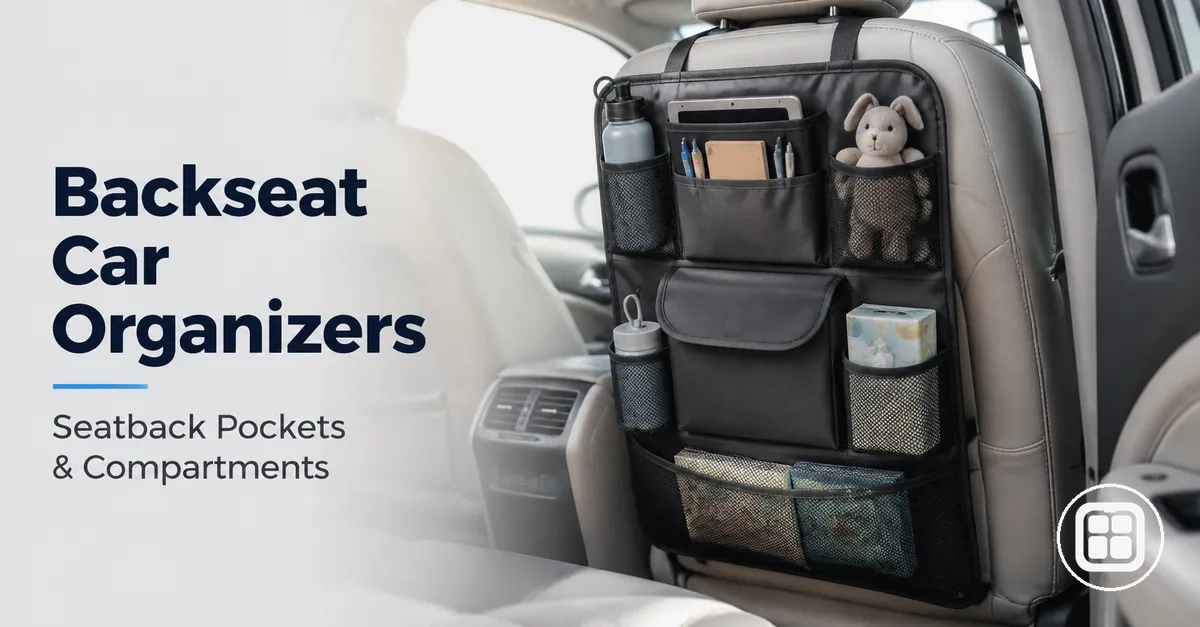
Backseat car organizers for seatback storage, fit, and passenger access
Backseat car organizers are storage accessories designed to attach to the rear side of vehicle seats and support organized seatback storage for rear passengers. They are used to hold small items within reach of rear passengers instead of placing everything on the seat or floor. This setup makes seatback storage the central context for evaluating how the organizer behaves inside a vehicle.
Access to items in a backseat car organizer depends on its attachment system and the vehicle seat design. Headrest straps and seatback contact points influence how securely the organizer stays positioned, while seat shape and headrest structure affect overall fit variation. Rear passengers may experience different access levels depending on how the organizer sits once installed, so usability is closely tied to fit and attachment conditions rather than a fixed outcome.
Pockets, compartments, and tablet holder sections shape how useful the organizer is for specific use cases such as commuting, family travel, or shared cars. These features determine whether items stay visible and reachable for rear passengers during use. In many cases, this type of seatback storage is evaluated by how well it supports passenger-facing access while keeping items separated, with a clear boundary that it serves rear-seat organization rather than trunk cargo storage.
What backseat car organizers are and when they make sense
A backseat car organizer is a storage accessory mounted behind or around a vehicle seat that enables rear-seat access to stored items. It supports seatback storage for passengers who need reach from the back row. It makes sense when rear-seat access is more important than keeping items in other areas of the vehicle.
This example of backseat car organizers shows how seatback position, headrest attachment, and rear-seat access come together inside the cabin. The image highlights how storage accessory placement changes passenger reach and visibility.
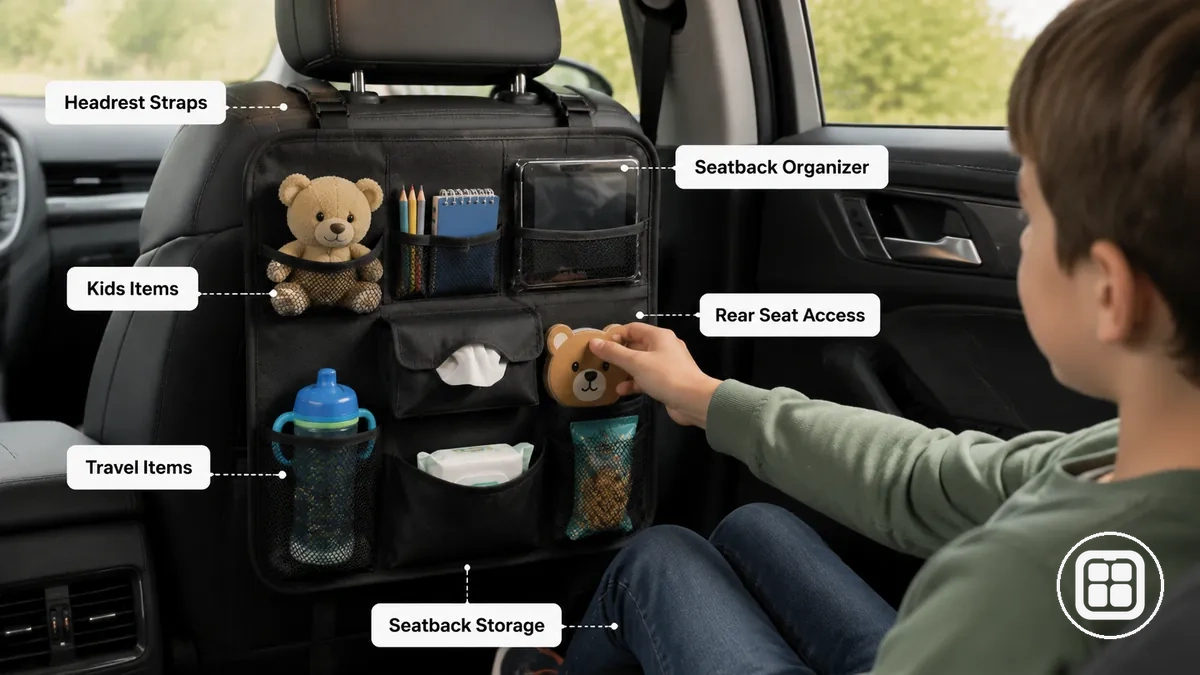
Backseat car organizers are often used for kids items, travel items, and daily storage needs where passengers benefit from direct access during a ride. Headrest attachment and seatback contact influence how the organizer stays positioned, while pockets and compartments shape how items are distributed and reached. In many cases, suitability depends on seat design and rear-seat layout rather than a fixed setup, so practical use varies by vehicle and passenger needs.
This type of seatback storage focuses on passenger-facing organization inside the cabin rather than trunk cargo storage. The distinction matters when evaluating whether items should remain within rear-seat reach or be separated into rear cargo space. Fit and usefulness depend on how the seatback structure supports access without obstructing passenger comfort.
Backseat organizer types and mounting styles
Backseat organizer types and mounting styles describe how a backseat car organizer attaches to a vehicle seat and how that attachment influences rear-seat storage behavior. These mounting styles define the connection between the storage accessory and the seat structure. Mounting style affects attachment logic, stability, and rear-seat access in everyday use.
Seatback hanging organizers and headrest-mounted bags are two primary mounting approaches within backseat organizers. A seatback hanging organizer typically uses upper and lower straps across the seatback to maintain position, while a headrest-mounted bag connects through headrest posts using adjustable straps. These differences change how pockets are accessed and how the structure responds to movement, and suitability often depends on seatback shape and headrest design.
Strap system design, pocket orientation, and attachment point placement define how each backseat car organizer behaves in practical use. Strap systems control how tightly the unit stays against the seatback, while pocket orientation influences how rear passengers reach stored items. Attachment points determine how load is distributed across the seat structure.
Before comparing mounting styles in a structured view, it helps to understand how attachment points and access patterns interact in real vehicle layouts.
The following table organizes the main mounting styles by attachment logic, access behavior, and fit considerations to clarify their functional differences.
| Mounting style | Attachment point | Access benefit | Fit caution |
|---|---|---|---|
| Seatback hanging organizer | Upper and lower seatback straps | Direct rear passenger pocket access | Varies with seatback height and contour |
| Headrest-mounted bag | Headrest posts and strap loops | Elevated and visible storage access | Depends on headrest spacing and design |
| Strap system layout | Multiple adjustable strap points | Flexible pocket positioning | Stability depends on strap tension and seat contact |
Mounting style evaluation is typically based on how clearly the attachment method can be matched to seat geometry. Seatback hanging organizers and headrest-mounted bags are easier to distinguish visually, while strap system variations require closer attention to attachment points and pocket orientation to understand stability and access behavior.
Seatback hanging organizers
A seatback hanging organizer is a subtype of backseat storage accessory that attaches to the seatback using upper strap and lower strap connections. It keeps the organizer body aligned against seatback contact and supports rear passenger access to stored items through structured pockets. This subtype primarily functions as a hanging attachment system that distributes storage across the seatback surface.
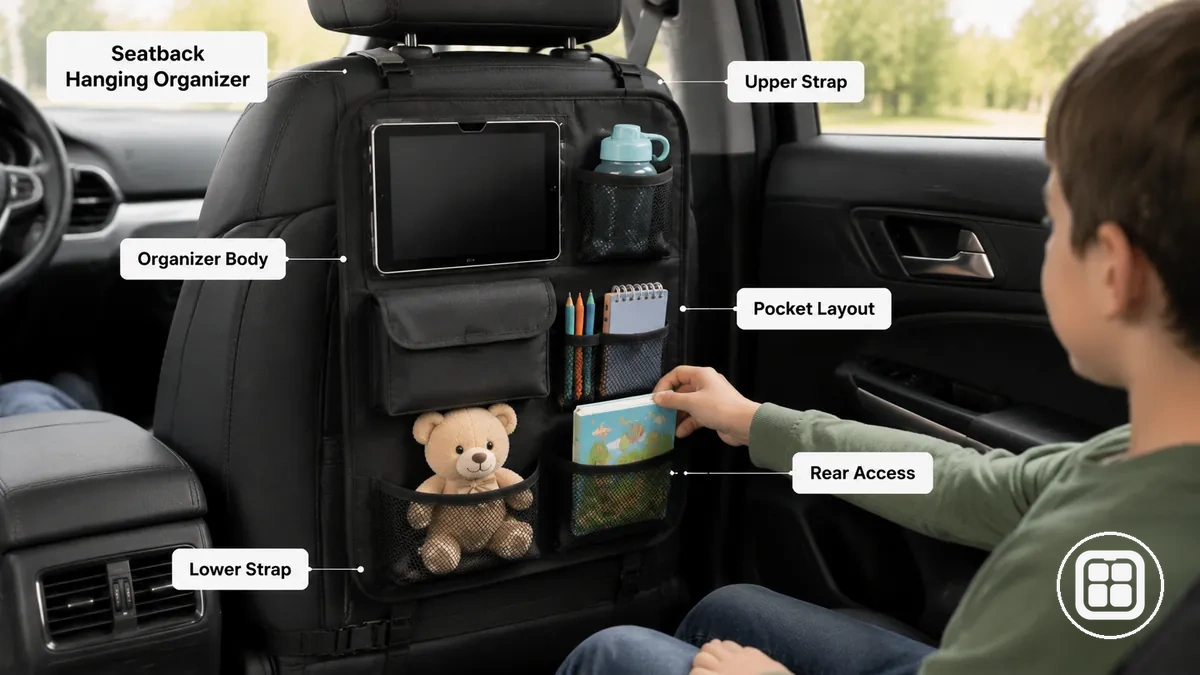
The seatback hanging organizer structure can be understood through its core components and how they influence behavior during use:
- Organizer body and seatback contact affect overall stability, which may vary depending on strap tension and seatback shape.
- Upper strap and lower strap define the vertical anchoring system that holds the organizer against the seatback.
- Pocket layout determines how easily rear passenger access is achieved for small items during travel.
- Seatback coverage depends on how the hanging surface aligns with the vehicle seat design and contour.
:contentReference[oaicite:0]{index=0}
Headrest-mounted organizer bags
A headrest-mounted organizer bag is a subtype of backseat storage that attaches mainly through headrest posts or upper-seat attachment points. It relies on strap adjustability to suspend the bag behind the seat, with stability depending on how securely it connects to the headrest structure. In most cases, headrest attachment becomes the key condition that determines how the bag behaves during use.
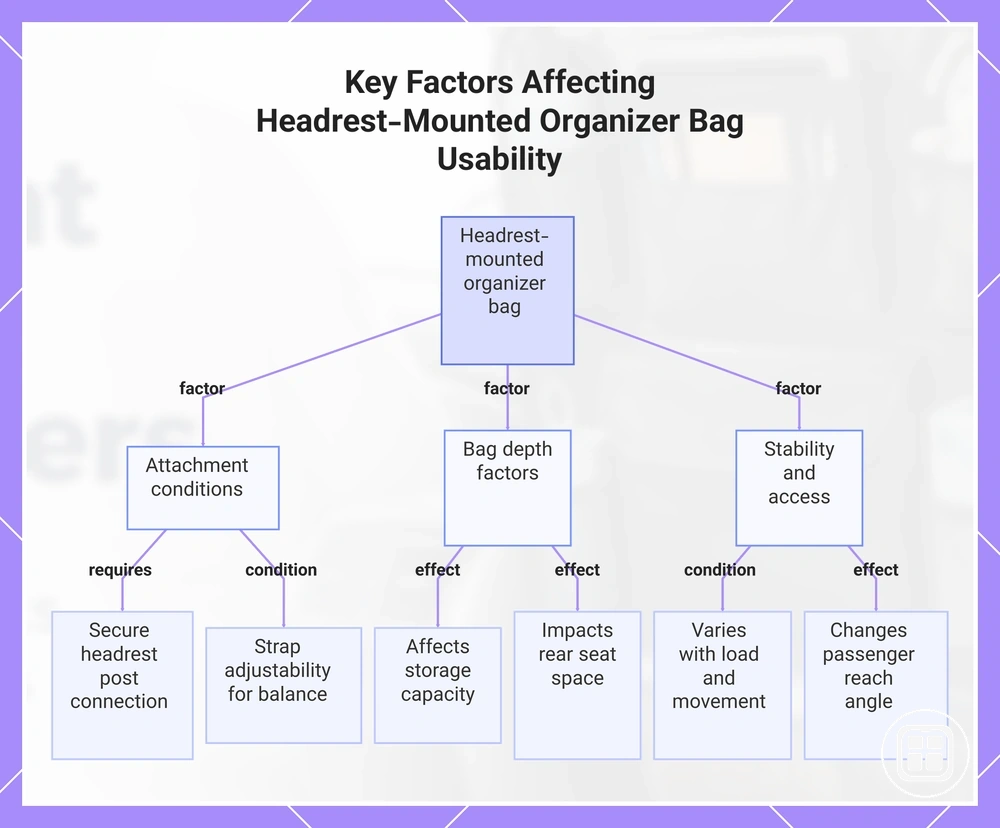
Fit and usability depend on a few local factors rather than a fixed configuration. Headrest shape and spacing influence how the straps sit, while bag depth can affect balance and available rear-seat space. Hanging stability may vary with load distribution, and access angle can change how easily rear passengers reach stored items, especially when the seat design limits straight-line access.
- Headrest posts: determine whether strap connection is secure and properly aligned
- Strap adjustability: influences hanging position and balance control
- Bag depth: affects storage capacity and rear-seat space usage
- Hanging stability: may vary depending on load weight and seat movement
- Access angle: changes how easily rear passengers reach compartments
This chart illustrates the key factors that determine the fit, stability, and usability of a headrest-mounted organizer bag.
Storage layout and access features
Storage layout and access features define how a backseat organizer distributes items across pockets, compartments, and access points, and how easily passengers can reach them during use. These elements directly affect whether the organizer supports real passenger needs in daily scenarios. Overall usefulness depends on item type, access behavior, and layout structure rather than feature count alone.
Pockets, compartments, bottle holders, and tablet sleeves form the core storage layout through clear entity-attribute-value relationships. Pockets and compartments support item separation for small objects, while bottle holders provide fixed placement for drink containers. Tablet sleeves create a defined space for devices, and each element contributes differently to passenger access depending on size and reach conditions.
Mesh sections, closures, and reachability refine how storage layout performs in practice. Mesh sections improve item visibility, closures help control item security during movement, and reachability determines how easily passengers can access stored items without adjusting seating position. These factors often vary depending on seat distance and organizer placement.
Storage layout decisions often connect to specific use cases such as kids’ items, commuting needs, shared vehicles, and travel situations. In these contexts, effectiveness depends on how well access features match item frequency, size, and passenger interaction patterns rather than simply increasing storage capacity.
| Feature | Attribute | Useful condition | Decision effect |
|---|---|---|---|
| Pockets | Item separation | When carrying multiple small items | Improves organization and reduces clutter |
| Compartments | Structured storage zones | When grouping different item types | Supports clearer item organization |
| Bottle holders | Fixed cylindrical support | When drinks are used during travel | Improves stability for bottles |
| Tablet sleeves | Dedicated device storage | When rear-seat device access is needed | Supports structured device placement |
| Mesh sections | Visible storage areas | When quick item identification is needed | Improves visibility and access speed |
| Closures | Security control | When movement may displace items | Helps keep items secured during travel |
Pockets, compartments, and bottle storage
Pockets, compartments, and bottle storage define how a backseat organizer separates items and controls access during travel. This section focuses on item separation through pocket and compartment design, where usefulness depends on item size, construction, and how the storage elements are shaped for access.
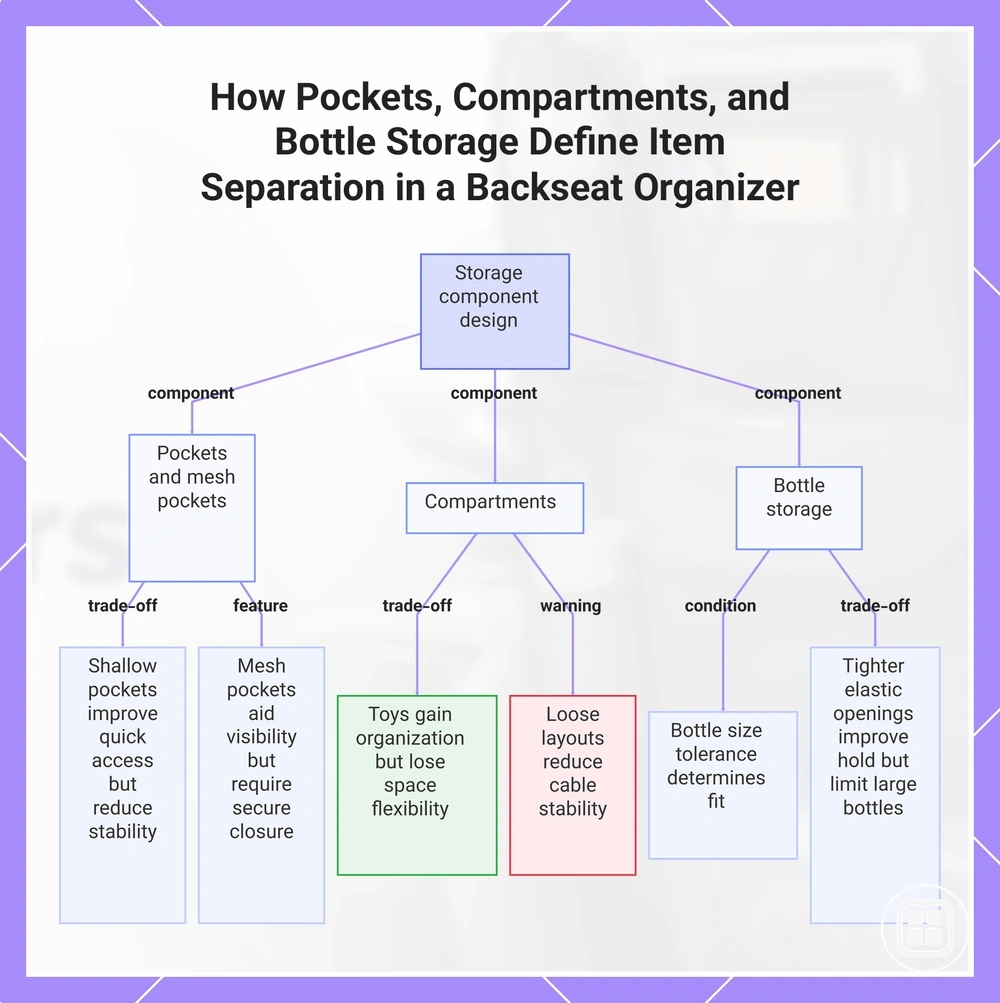
Storage behavior varies with how each component is built and used. Pocket depth affects whether items stay contained or shift during movement. Compartments create structured zones for different item types, while bottle storage depends on bottle size tolerance and pocket construction, especially where elastic openings influence grip and fit limits.
- Wipes and small items: depend on pocket depth and elastic openings, where shallow designs improve quick access but reduce containment stability
- Toys and travel accessories: rely on compartments, where separation improves organization but reduces flexible space usage
- Bottle storage: depends on bottle size tolerance, where tighter elastic openings improve hold but may limit larger bottles
- Mesh pockets: support visibility for frequently used items, but closure type can affect how secure items remain during movement
- Cables and small electronics: benefit from compartment separation, but loose layouts may reduce item stability during travel
This chart shows how the three main storage components—pockets, compartments, and bottle storage—control item separation, access, and stability through their design features.
Tablet holders and passenger-facing access
A tablet holder is a rear-seat component that enables passenger-facing access to a device through a dedicated tablet sleeve. It supports screen viewing or interaction based on how the sleeve is structured and positioned behind the seat. Its effectiveness depends on tablet sleeve size, visibility, and passenger reach rather than universal compatibility.
Passenger-facing access is influenced by viewing height, touch access alignment, and how securely the tablet holder reduces movement during travel. Cable opening design can support charging access, while glare and viewing angle may reduce screen clarity depending on light conditions. Movement risk can also increase when the holder is loosely secured or the seat position shifts during travel.
- Tablet sleeve size: determines device fit and limits excessive looseness or pressure
- Touch access: depends on whether passengers can interact without repositioning
- Viewing height: affects comfort and visibility based on rear-seat positioning
- Cable opening: allows charging access when supported by sleeve design
- Passenger reach: influences ease of adjustment or removal during travel
- Glare: may reduce screen clarity depending on angle and light exposure
Fit, attachment, and passenger clearance
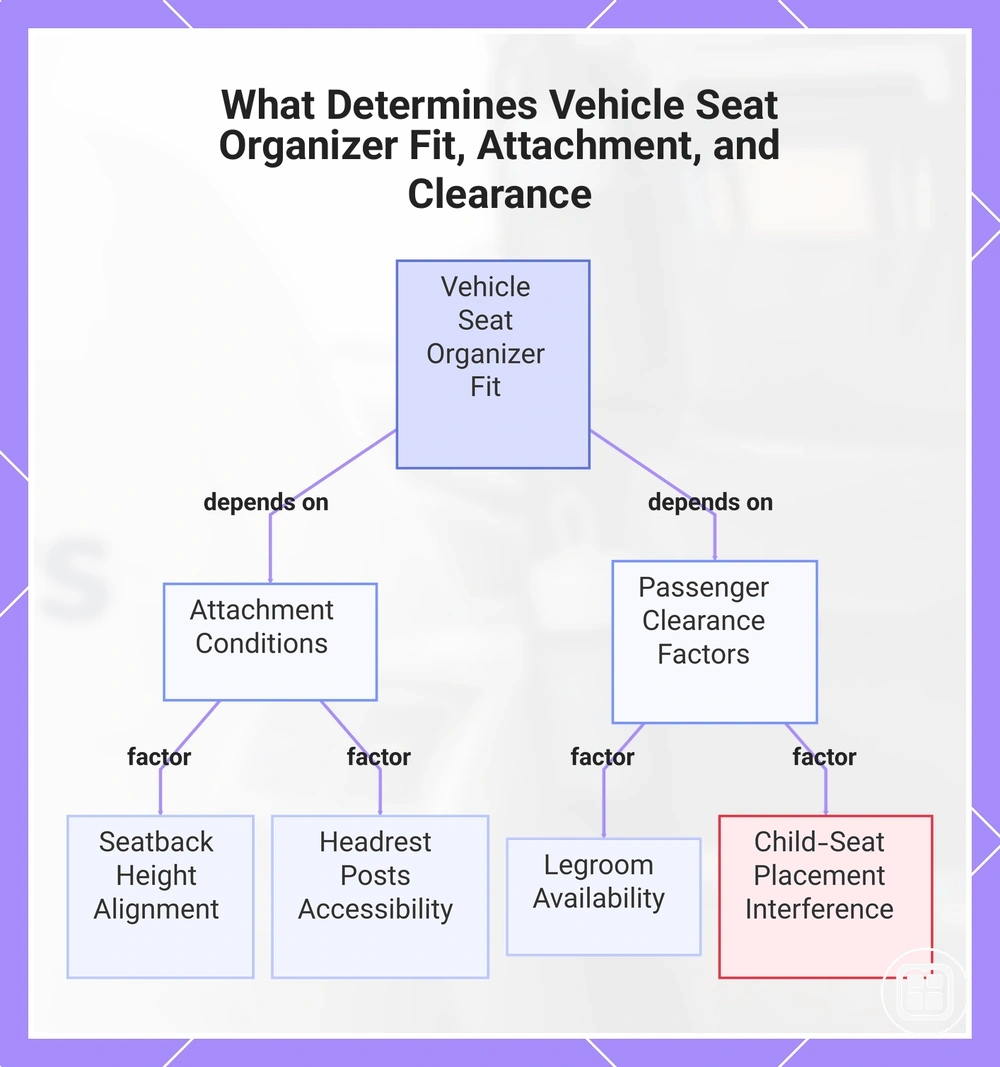
Fit, attachment, and passenger clearance depend on how the vehicle seat geometry aligns with the organizer design. Seatback height, headrest posts, strap adjustability, and rear-seat space together determine whether the setup can be mounted and used without restricting passenger movement. In most cases, fit depends on both the vehicle seat and organizer design rather than a single universal condition.
Seatback height influences how evenly the organizer rests, while headrest posts determine whether upper attachment is physically possible. Strap adjustability affects positioning flexibility, and lower anchoring supports stability against shifting or sagging during use. These elements define the core attachment condition and directly affect overall seat fit behavior.
Legroom, child-seat placement, and passenger movement shape usable passenger clearance. Limited legroom may reduce comfort when the organizer occupies rear-seat space, while child-seat placement can restrict mounting or adjustment options. Passenger movement also determines how freely rear occupants can access items without interference from the installed structure.
In compact rear-seat layouts with a child seat installed, attachment may still be possible, but passenger clearance can become limited depending on strap routing and seat geometry. In such cases, adjustment improves positioning, but overall usability remains dependent on space constraints.
- Seatback height alignment: affects how the organizer sits against the seat surface
- Headrest posts accessibility: determines whether secure upper attachment is possible
- Strap adjustability range: influences positioning and tension control
- Lower anchoring stability: reduces shifting or sagging during movement
- Legroom availability: impacts passenger comfort and usable rear space
- Child-seat placement interference: may restrict mounting options or adjustment space
- Passenger movement clearance: affects in-cabin access and usability
This chart shows the key attachment conditions and passenger clearance factors that determine whether a vehicle seat organizer fits properly.
Headrest straps and seatback size
Headrest straps and seatback size determine whether a backseat organizer can attach securely and maintain stable positioning during use. Attachment quality depends on how headrest straps align with the available seatback size, making the strap-to-seat match the main condition for usability. Fit varies by seat geometry and organizer design rather than a fixed outcome.
Strap length affects how headrest straps reach and secure around headrest posts, while seatback contact area influences how evenly the load is distributed across the surface. Buckle position can change how tension is maintained, especially when seatback size is taller, wider, or uneven. In some cases, fixed headrests or short strap ranges may increase sagging risk due to limited adjustment space and reduced contact balance.
- Headrest post access: confirms whether headrest straps can be properly secured
- Strap length fit: checks if adjustment range matches seatback height
- Seatback contact area: evaluates stability and surface balance
- Buckle position alignment: helps maintain consistent strap tension
- Sagging risk check: identifies instability in larger or uneven seatbacks
Legroom, child seats, and rear passenger movement
Legroom, child seats, and rear passenger movement depend on how much usable space remains after a backseat organizer is attached. Rear-seat clearance changes with organizer thickness, loaded pocket depth, and seat geometry, which can reduce or shift available passenger space. In most cases, loaded pocket depth can change usable passenger space and affect comfort during rear seating.
Child seats, passenger height, knee contact, and item protrusion further influence rear-seat usability. Increased organizer thickness or deeper loaded pockets may extend into seating space and increase knee contact risk for taller passengers. Child seats can reduce positioning flexibility, while rear passenger movement may become more limited when stored items extend forward into the cabin area.
- Organizer thickness: may reduce legroom when overall depth increases
- Loaded pocket depth: can extend into seating space and affect passenger comfort
- Child seats: reduce available clearance and limit installation flexibility
- Knee contact: may increase when passenger height and protrusion overlap
- Item protrusion: can restrict rear passenger movement and seating adjustment
How backseat organizers compare with other car organizer placements
Backseat storage is a placement focused on passenger-side access, while other organizer placement options shift usability toward cargo handling or driver interaction. The way placement is chosen affects access point behavior, capacity usage, and how storage is shared inside the vehicle. In most cases, placement determines who can directly reach stored items and how they are used during travel.
Compared with trunk storage, backseat storage prioritizes quicker access from the cabin while trunk storage prioritizes higher capacity for bulky items. Trunk storage typically provides stronger cargo capacity due to its larger enclosed space, but the access point is separated from passengers. Backseat placement, in contrast, supports easier passenger reach but generally offers more limited capacity compared to trunk-based organization.
When compared with front seat storage and console storage, the difference shifts toward driver reach versus passenger reach. Front seat storage and console storage are designed for driver reach and quick access to small essentials, but they can increase distraction risk if overused during driving. Backseat storage instead supports rear passenger reach and reduces dependency on driver interaction, creating a more distributed access pattern inside the cabin.
The comparison below clarifies how placement differences affect usability across backseat storage, trunk storage, front seat storage, and console storage. Explore other types
| Placement | Best access point | Capacity tendency | Better use case |
|---|---|---|---|
| Backseat storage | Rear passenger reach | Medium | Shared items, passenger convenience |
| Trunk storage | Cargo access point | High | Bulky items, luggage, long trips |
| Front seat storage | Driver reach | Low to medium | Small essentials, quick access while driving |
| Console storage | Central access point | Low | Frequently used small items, controlled access |
When backseat storage is better than trunk storage
Backseat storage is better than trunk storage when rear-seat accessibility and immediate reach for frequently used items are the main priority. It supports small-item organization within the cabin, making it easier for passengers to access items without moving to the cargo area. In most cases, this advantage is strongest when the focus is on frequently used items rather than stored cargo.
The difference becomes clearer when separating small-item organization from bulky cargo needs. Backseat storage is more suitable for kids items, entertainment access, and passenger reach, while trunk storage is more aligned with bulky cargo that does not require frequent access during travel.
- Kids items: better supported by backseat storage due to rear-seat accessibility
- Frequently used items: benefit from quick passenger reach in backseat storage
- Small-item organization: fits naturally in cabin-based storage placement
- Entertainment access: more convenient from rear-seat position during travel
- Bulky cargo: better suited to trunk storage due to larger capacity and separation from passengers
When front seat or console storage is a better fit
Front seat storage or console storage is a better fit when driver reach and front-passenger access to small essentials are the primary need. This placement focuses on keeping frequently used items within immediate reach of the front cabin while front-passenger access supports shared control of small essentials. In most cases, the decision depends on whether quick access outweighs rear passenger independence needs.
Item type and access behavior further define when these placements are more suitable. Small essentials that need repeated use during driving are often better positioned in front seat storage or console storage, but this setup may introduce distraction risk depending on how often items are handled while driving. Access balance between driver reach and rear passenger independence can shift based on how items are distributed in the cabin.
- Small essentials: better suited for front seat storage due to direct driver reach
- Shared center access: console storage supports front-passenger access with controlled placement
- Rear passenger independence: reduced when front-focused storage dominates cabin organization
- Frequent handling items: increase distraction risk when placed in driver reach zones
How to choose a backseat organizer by use case
Choosing a backseat organizer depends on the use case and how the storage will be used inside the vehicle. The use case determines which features matter most, especially in terms of storage layout, attachment style, and access features. In most cases, the decision is driven by how passengers interact with items during travel.
Key selection checks:
- Use case definition such as family travel, commuting, or shared cars
- Storage layout needs for tablet use and bottle storage requirements
- Access feature priority based on how often items are reached
- Attachment style compatibility with seat design and stability conditions
- Cleaning needs for spills, dust, and frequent handling environments
- Fit checks based on seatback dimensions and vehicle compatibility
- Must-have features required for safe and practical usage
- Optional convenience features that improve usability but are not essential
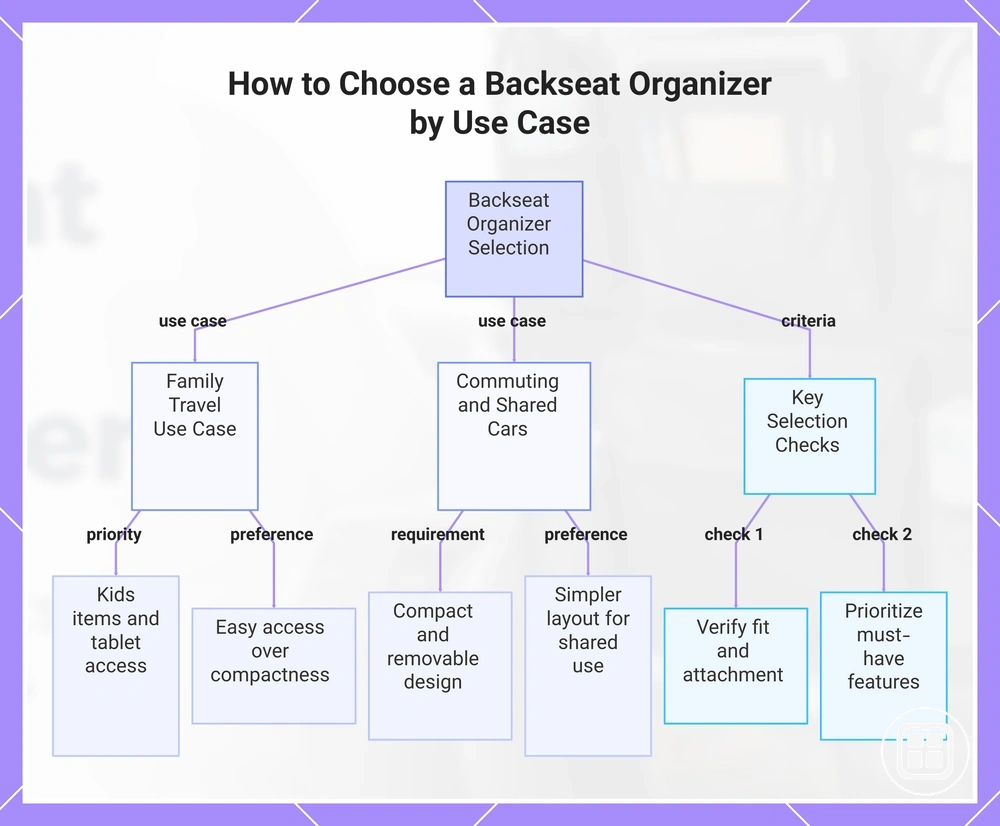
For family travel, backseat organizer selection typically prioritizes kids items, tablet use, and easy access during longer journeys. Storage layout becomes important for keeping items organized within reach, while bottle storage and entertainment access improve passenger comfort. In these cases, accessibility often matters more than compactness alone.
For commuting and shared cars, selection usually focuses on compact storage, easy removal, and flexible usage across different users. Tablet use, bottle storage, and cleaning needs become more important because items and users may change frequently. A simpler layout often works better for shared environments.
The products below are useful examples for comparing available options. Before buying, check that the compatibility criteria, key features, and product details match your needs.
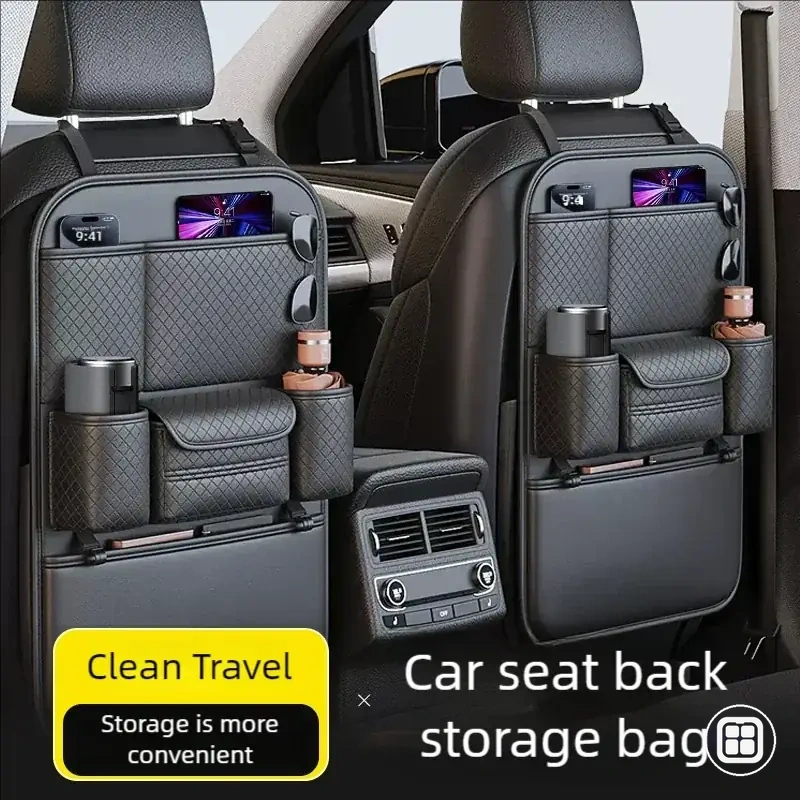
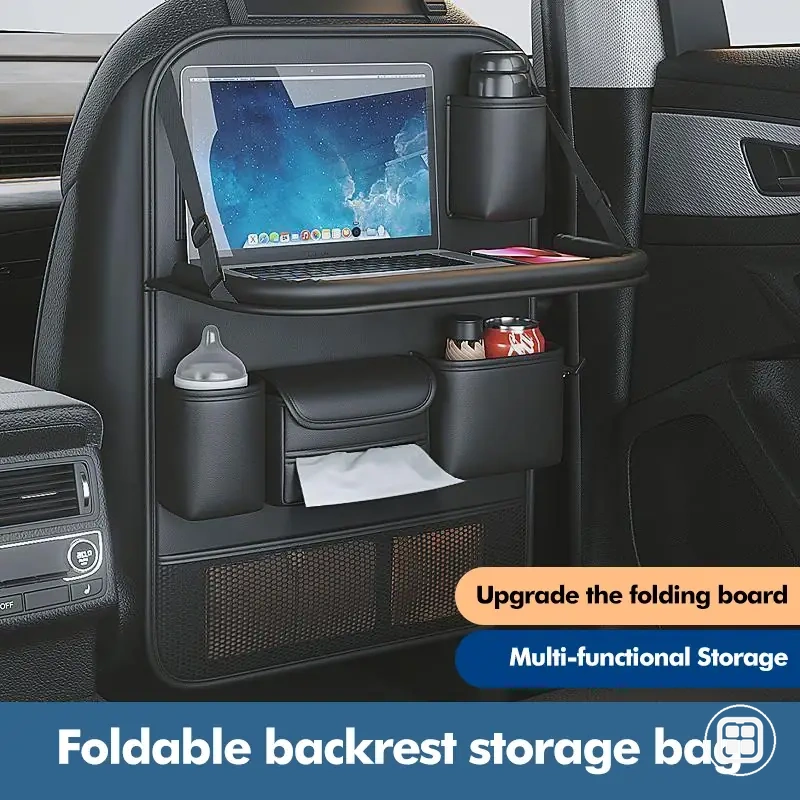
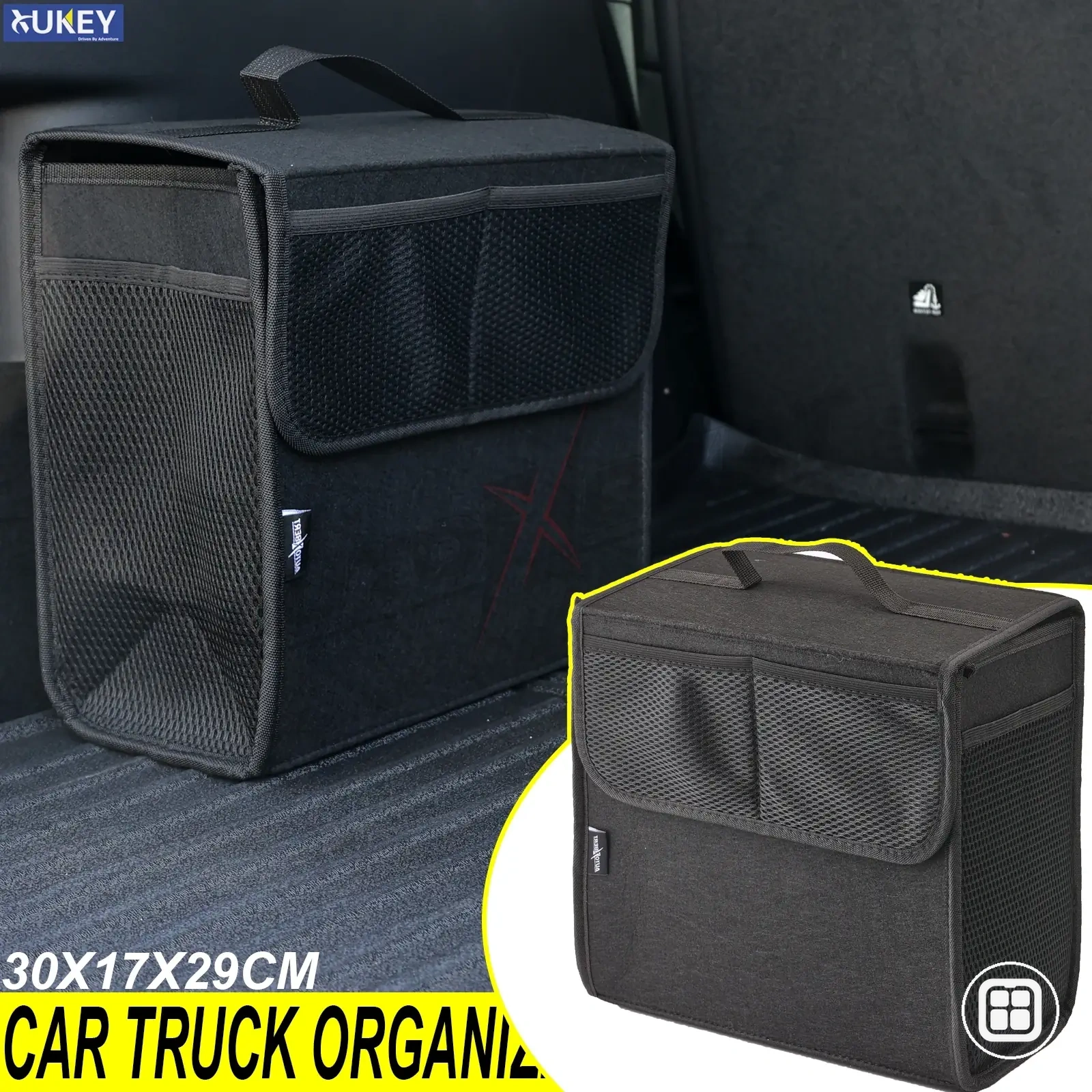
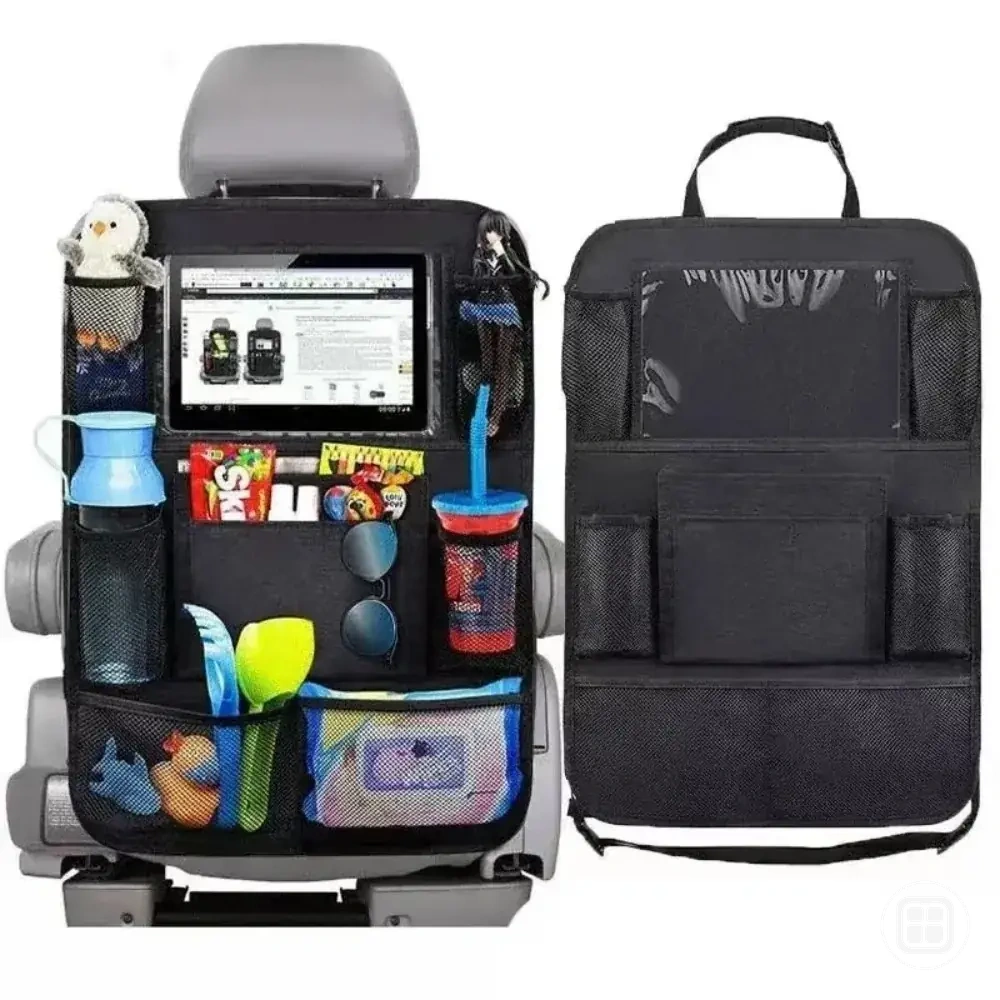
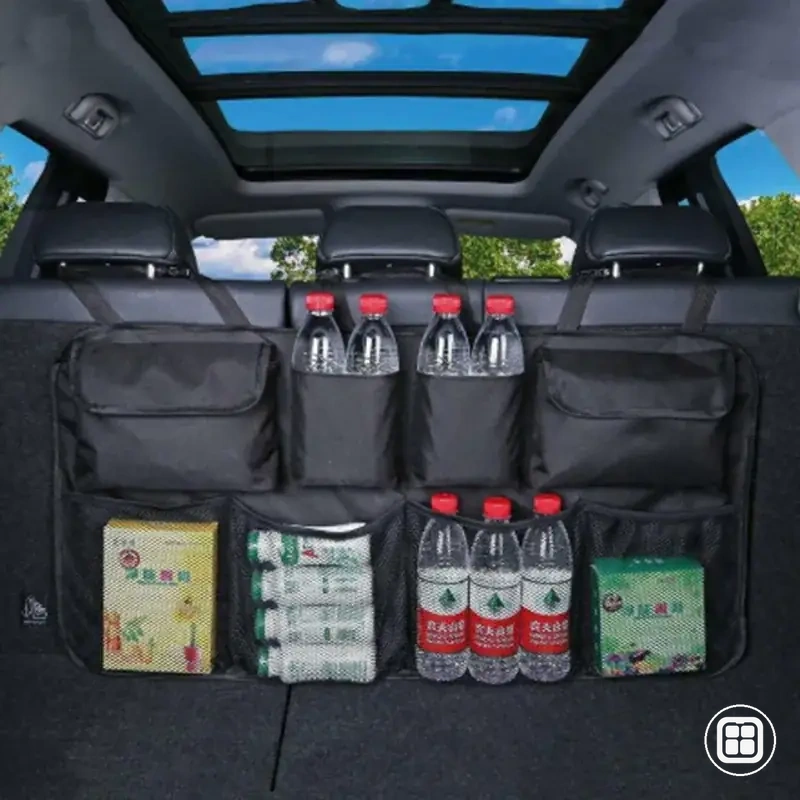
Fit checks determine whether the organizer matches seat dimensions, attachment style, and intended load conditions. Must-have features ensure safe attachment and usable access, while optional features add convenience without being essential. Prioritizing fit checks first helps eliminate incompatible options before considering additional features.
This chart helps you select a backseat organizer by use case, covering family travel needs, commuting requirements, and key selection checks for fit and features.
Backseat organizers for kids and family travel
Backseat organizers for kids and family travel depend on how kids use storage during trips, especially for toys, snacks, wipes, and bottles. In family travel scenarios, selection depends on child access and item grouping rather than overall size, since travel duration and item quantity can vary. Use cases such as short daily trips or longer journeys influence which features matter most.
Key traits for kids and family travel selection:
- Kids, toys, snacks, and wipes grouping for structured child access during travel
- Bottles placement that supports spill tolerance and reduces movement during driving
- Tablet position designed for stable viewing during family travel use
- Child access that allows safe reach without disturbing driver focus
- Strap stability to maintain position during short trips and longer travel
- Pocket visibility to help locate items quickly during active use
- Cleaning effort considerations for spills, crumbs, and frequent handling
Short daily trips may only require lightweight organization for snacks and wipes, while longer family travel can benefit from more structured separation of toys, bottles, and tablet use. However, larger size is not always required because item volume and child access patterns differ between families.
Spill tolerance and cleaning effort are key decision factors in family use. Quick-clean surfaces and accessible pockets help reduce maintenance time, while stable strap design supports bottle safety during movement. Tablet position should remain stable enough for viewing without frequent adjustment.
Guest handling, visibility, and menu access
Guest handling, visibility, and menu access depend on how frequently guests interact with a menu holder and how directly they need to read information during service. In contexts with repeated guest handling, selection is shaped by visibility and menu access because frequent touchpoints can influence how the holder format performs in daily use. This creates a direct link between interaction level and readability conditions.
- Guest handling frequency that increases touch pressure and repeated repositioning during service
- Visibility conditions affected by glare, lighting, and readable angle of the menu display
- Menu access speed based on how quickly guests can identify and use information
- Double-sided viewing when multiple guests require readable access from different positions
- Insert replacement needs that affect handling effort and operational flow
- Cleaning pressure that increases with frequent contact and shared usage environments
- Resistance to tipping influenced by stability and material weight balance
Higher guest handling usually increases cleaning pressure and makes stable positioning more important, while lower-touch environments may allow simpler formats with reduced structural demands. Visibility and menu access must remain balanced so guests can read content without frequent adjustment, especially when interaction frequency is high.
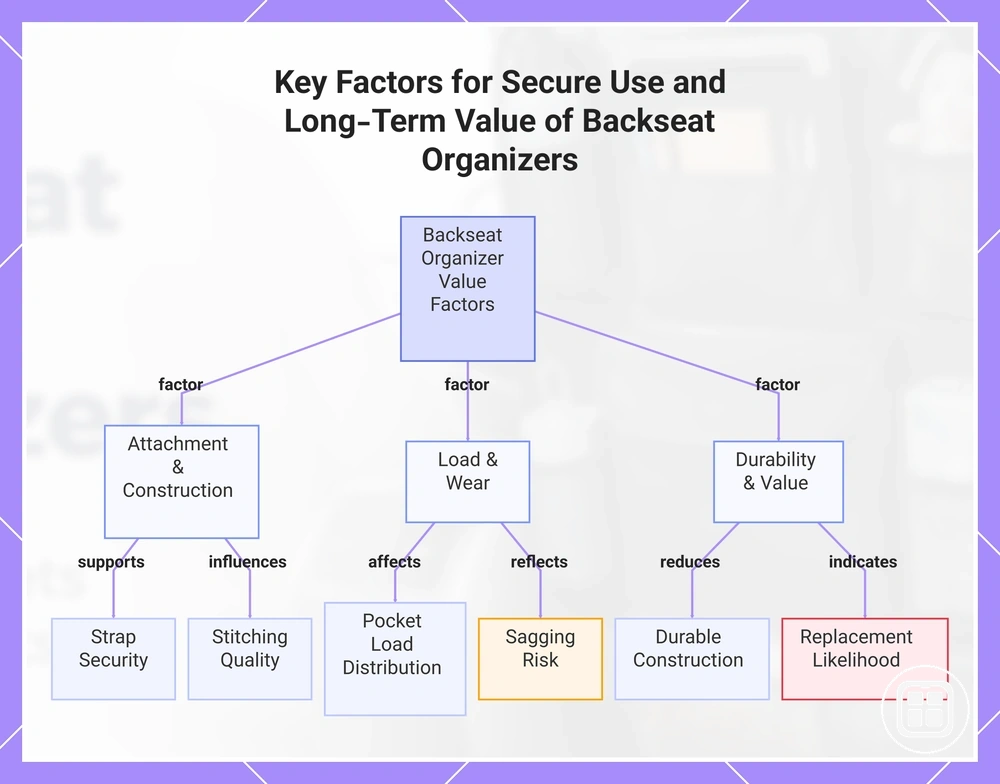
Secure use and long-term value of backseat organizers
Secure use and long-term value of backseat organizers depend on how stable the attachment remains under real commuting and shared use conditions. In most cases, secure use is shaped by strap security, durable construction, stitching, pocket load, surface cleaning effort, sagging risk, and replacement likelihood. These factors determine how consistently the organizer performs under repeated use and shared-car variability, directly influencing ownership value over time.
Strap security, stitching quality, pocket load distribution, and surface cleaning effort affect how the organizer behaves in daily use. Weak stitching or uneven pocket load can increase sagging risk, while higher cleaning effort can reduce practicality in commuting environments where usage is frequent. The following value checklist highlights key condition-to-effect relationships:
- Strap security: supports stable attachment during movement and repeated handling
- Durable construction: reduces structural weakening under continuous use
- Stitching: influences pocket integrity under varying load conditions
- Pocket load: affects balance and sagging risk when unevenly distributed
- Surface cleaning: impacts maintenance effort in shared use environments
- Sagging risk: reflects long-term stability under stored weight
- Replacement likelihood: indicates how quickly wear may require replacement
Simple organizers may be sufficient for commuting use with light everyday carry items, while stronger construction may be more relevant in shared cars with higher passenger variability and heavier pocket load. Back to hub overview
The products below are useful examples for comparing available options. Before buying, check that the compatibility criteria, key features, and product details match your needs.
This chart outlines the main condition-to-effect relationships that influence the secure use and long-term value of backseat organizers under real commuting and shared use conditions.