
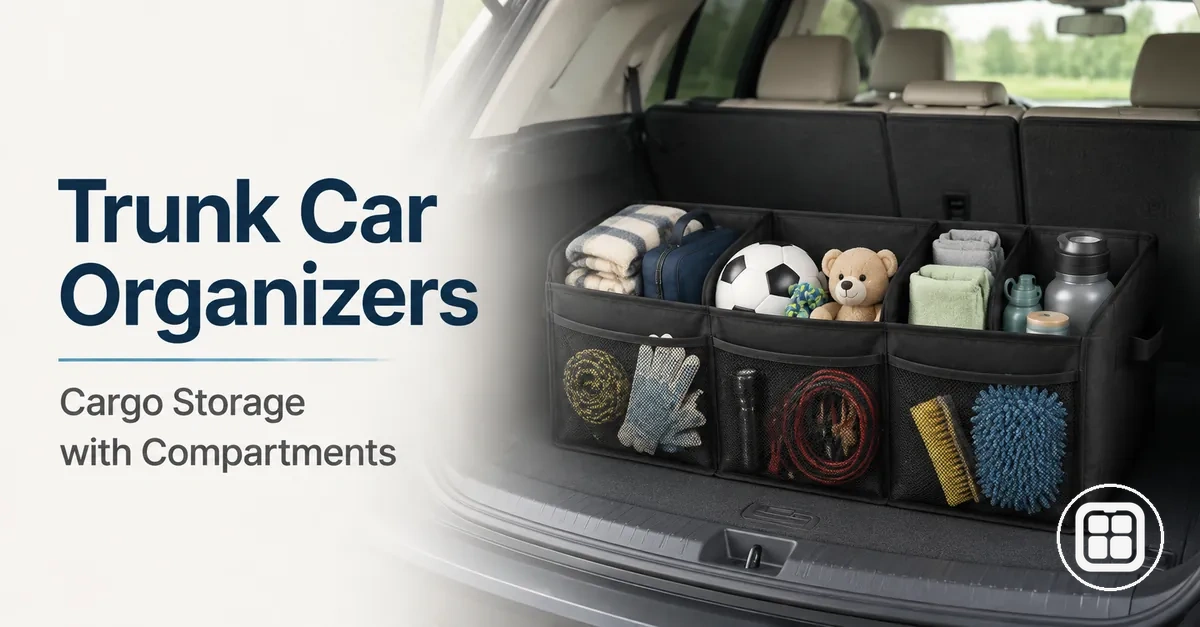
Trunk car organizers: cargo storage types and fit criteria
A trunk car organizer is a storage unit designed for the cargo area of a vehicle to separate and hold items in a more structured way. It helps reduce loose movement and improves access to trunk storage during everyday use. This page focuses on trunk cargo storage as a practical context for understanding how these organizers function in real vehicle conditions.
Choosing a trunk car organizer depends on how the cargo area is used and what kind of items are typically stored. Different trunk storage needs require different storage formats, especially when balancing access, space usage, and item separation. Fit expectations also vary based on trunk shape and how much usable space is available, which makes selection criteria important before deciding on a specific car storage organizer type.
Evaluation of a trunk car organizer usually involves multiple factors such as cargo fit, compartments, material, and stability. Compartments influence how well items are separated, while material quality can affect cleaning behavior and durability over time. Stability is also relevant because trunk floor conditions and cargo weight can change how securely the organizer stays in place, so performance often depends on combined conditions rather than a single feature.
The relationship between organizer type and trunk conditions is central to understanding how different setups behave in real use. As part of a broader car organizer system, trunk solutions should be seen in relation to other storage needs across the vehicle. Back to hub overview provides the wider context for comparing placement-based organizer options within the same system.
Overall, trunk car organizers are best understood as adaptable cargo solutions that support structured storage in rear vehicle space. Their effectiveness typically depends on matching selection criteria with real trunk dimensions, cargo behavior, and intended use rather than assuming uniform performance across all vehicles.
What a trunk car organizer does in the cargo area
A trunk car organizer is a storage unit placed in the cargo area to separate, stabilize, and make items easier to access during everyday driving use. It functions as a structured layer on the trunk floor that reduces loose movement of stored objects. This makes trunk storage more organized under typical driving and loading conditions for rear cargo storage use.
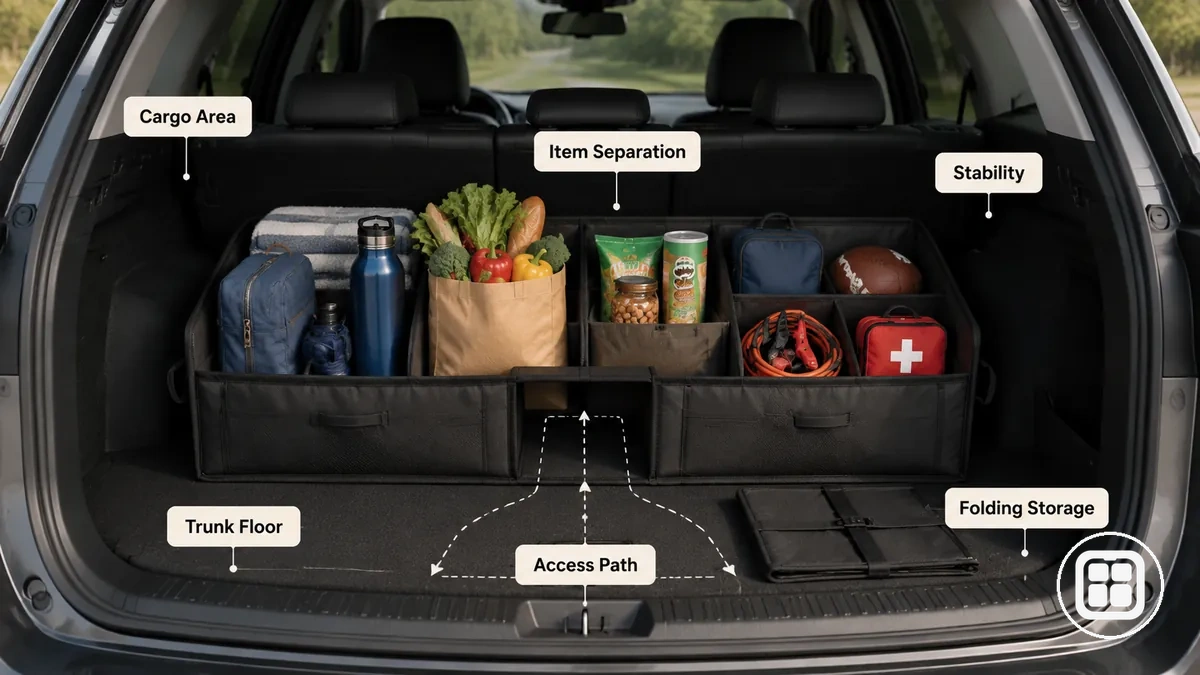
In practical use, a trunk car organizer supports cargo containment, item separation, and controlled access to stored objects in the rear cargo storage space. It can be designed with compartments that help divide items such as tools, groceries, or travel essentials while keeping them reachable without fully unpacking the cargo area. Basic stability depends on how the organizer interacts with the trunk floor and how load distribution affects movement during driving.
- Separates items to reduce mixed or scattered cargo in the trunk storage space
- Keeps frequently used items more accessible without full unloading
- Adapts when empty or lightly loaded by folding or compressing in some designs
- Supports basic stability depending on straps, weight, and trunk floor surface
- Helps reduce loose clutter movement under normal driving conditions
A trunk car organizer differs from seatback, console, and gap organizers because its primary function is centered on rear cargo storage rather than passenger-area organization. This distinction matters when evaluating how storage needs are distributed between the cargo area and the front or interior cabin zones. Fit and performance can vary based on vehicle size, trunk shape, and intended cargo use, so selection is typically condition-dependent rather than universal.
Trunk organizer types and construction formats
Trunk organizer types and construction formats refer to how a trunk car organizer is built to manage capacity, flexibility, and stability inside the cargo area. The structure determines how the storage unit behaves on the trunk floor during use. These construction differences directly affect item separation, access, and how the organizer adapts to changing cargo needs.
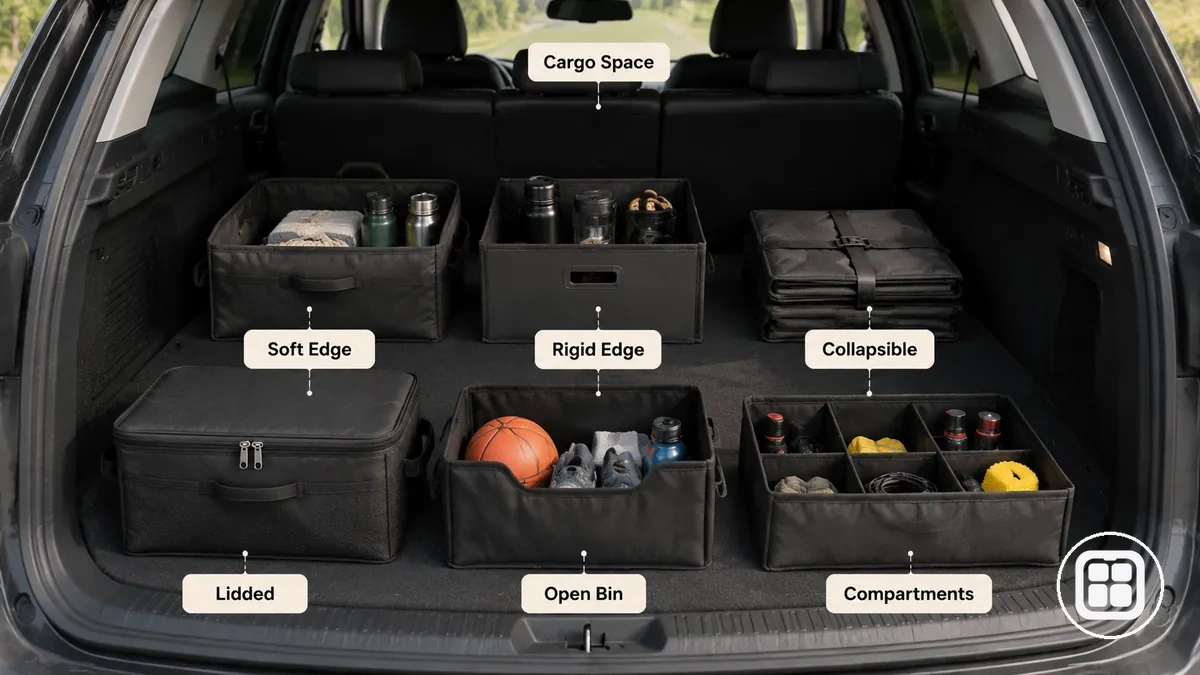
Different trunk organizer types are grouped by how their walls, edges, and compartments are designed. Soft-edge formats tend to allow more flexibility and folding behavior, while rigid-edge formats focus on shape retention under heavier loads. Collapsible, lidded, open-bin, and compartment-based designs each influence how quickly items can be accessed and how the rear cargo storage space is organized under different conditions, with trade-offs depending on use requirements.
Trunk organizer types depend on construction format and how the design responds to cargo behavior, trunk space limits, and access needs.
| Format | Main structure | Practical advantage | Trade-off | Best-fit use case |
|---|---|---|---|---|
| Soft-edge | Flexible walls | Easy folding and light handling | Less shape retention | Light cargo and flexible storage |
| Rigid-edge | Reinforced panels | Stable structure under load | Less flexibility when empty | Heavier or structured cargo |
| Collapsible | Foldable build | Saves trunk space when not used | Setup required before use | Occasional storage needs |
| Lidded | Covered design | Improved privacy and containment | Slower access | Secure enclosed storage |
| Open-bin | Open compartments | Fast access to items | Less containment control | Frequent access storage |
| Compartment-based | Segmented layout | Strong item separation | Fixed internal structure | Organized multi-item storage |
These construction-based differences help explain how trunk organizer types interact with different vehicle layouts and cargo area constraints. Explore other types to understand how placement-based categories compare with construction-based formats across a full car organizer system.
Soft-edge trunk organizers
Soft-edge trunk organizer is a flexible cargo storage unit designed with fabric walls and flexible sides that adjust to available space inside the cargo area. It uses a collapsible structure instead of rigid framing, which supports storage convenience and easier folding when not in use. This design creates flexible cargo behavior focused on light cargo handling.
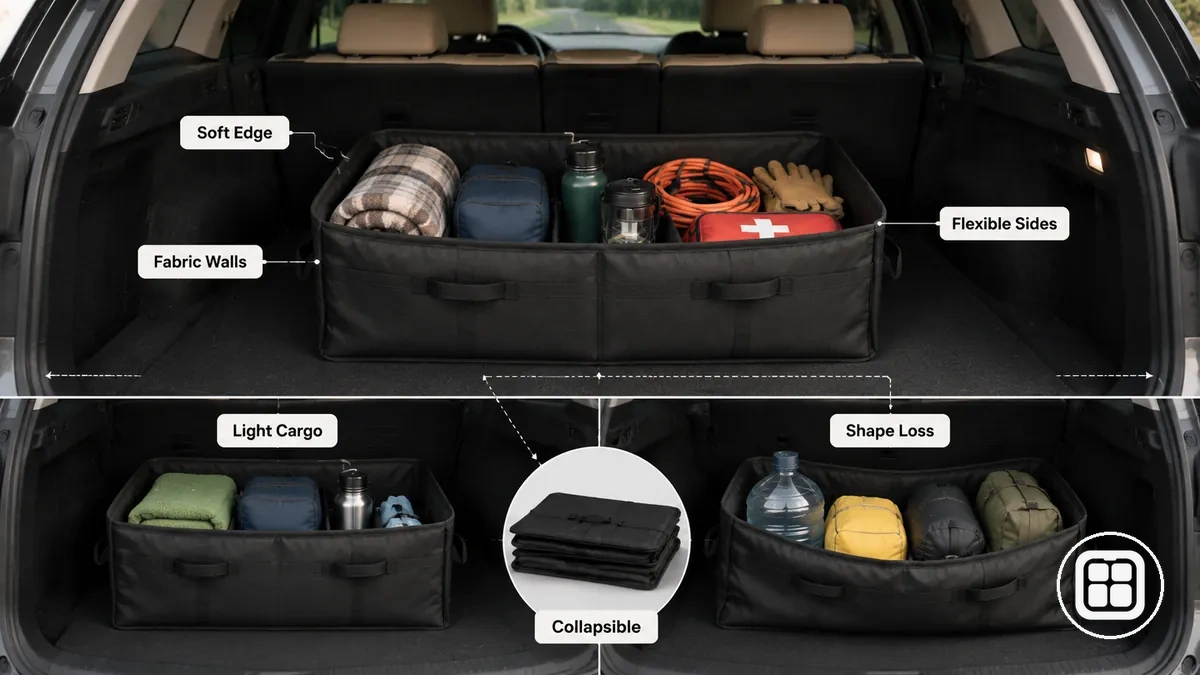
In practical use, a soft-edge trunk organizer can support groceries, cloth items, and light travel accessories where flexible sides and basic sidewall support are sufficient. It may show shape loss when exposed to heavier loads due to its fabric-based structure, so performance typically depends on lighter cargo conditions rather than rigid containment needs.
Rigid-edge trunk organizers
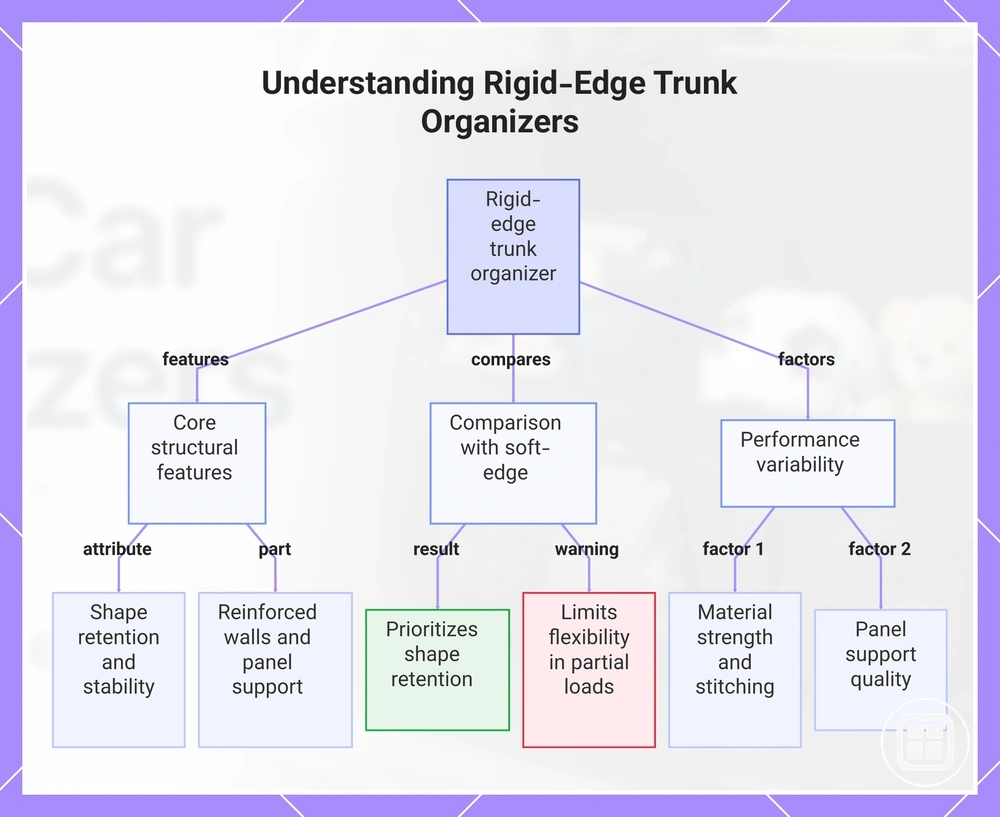
Rigid-edge trunk organizer is a structured cargo container designed with reinforced walls and a firm base structure that supports shape retention inside the cargo area. It focuses on compartment stability and controlled cargo separation, so items remain more consistently positioned during movement, contributing to stable cargo organization.
This rigid-edge trunk organizer typically uses panel support and reinforced walls to maintain structure under varying cargo conditions, including heavier cargo behavior where stability depends on base structure and build quality. Compared to soft-edge formats, which rely on flexible sides and may reduce shape retention under pressure, rigid-edge designs prioritize shape retention and compartment stability but introduce a storage trade-off when flexibility is needed, especially in partially loaded conditions. Performance varies by material strength, stitching, and panel support rather than being uniform across all designs. :contentReference[oaicite:0]{index=0}
This chart explains the core structural features of a rigid-edge trunk organizer, how it compares to soft-edge alternatives, and the key factors that influence its performance.
Collapsible and lidded trunk organizers
Collapsible trunk organizer and lidded trunk organizer refer to two design approaches where folding behavior and lid coverage shape how cargo access and space control work inside the trunk. A collapsible trunk organizer prioritizes foldability for storage when empty, while a lidded trunk organizer focuses on covered cargo that can support privacy and dust protection. The core difference lies in folding behavior versus lid coverage, which directly affects access speed and storage handling.
Collapsible designs improve storage when empty by reducing trunk space usage, making them practical when the organizer is not in active use. Lidded designs add a covered layer that can support privacy and dust protection for stored items, but may reduce access speed due to lid handling. Neither format is universally superior, as performance depends on how often the trunk is kept empty or regularly organized. A common scenario is users who alternate between open trunk space and structured cargo use, where foldability or lid coverage becomes the deciding factor.
Comparison of collapsible vs lidded trunk organizer behavior:
| Format feature | Helps with | Trade-off |
|---|---|---|
| Collapsible trunk organizer | Storage when empty, foldability, trunk space flexibility | Less covered cargo protection during use |
| Lidded trunk organizer | Covered cargo, privacy, dust protection | Reduced access speed due to lid handling |
Cargo-area fit and trunk placement conditions
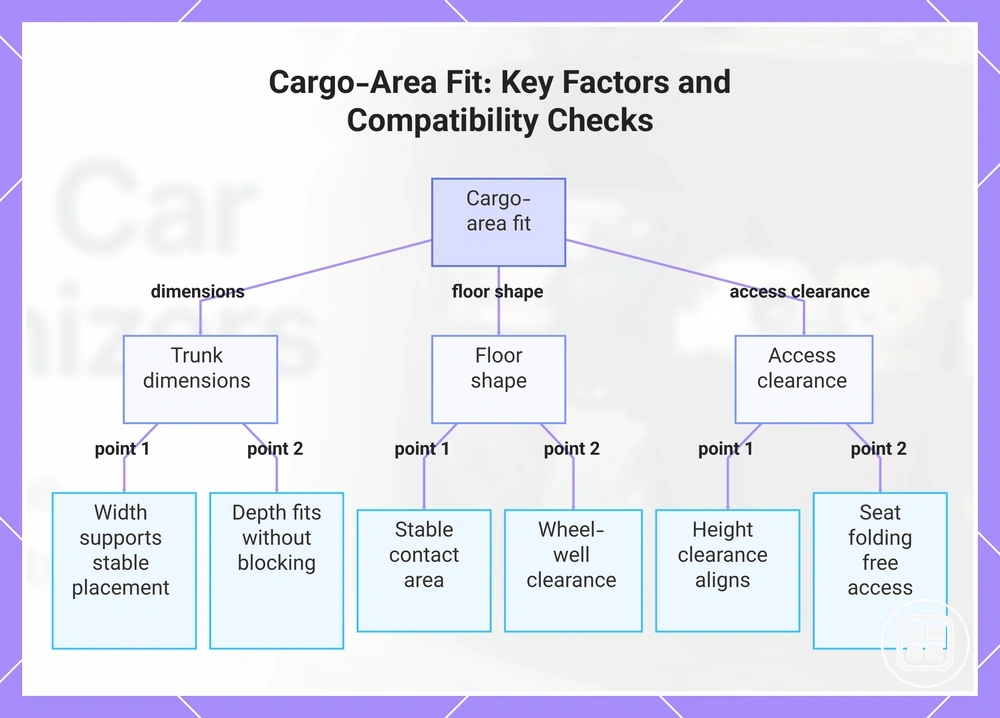
Cargo-area fit depends on trunk placement conditions that determine whether a trunk organizer can sit securely and remain usable inside a specific vehicle layout. Fit is influenced by trunk dimensions, floor shape, and access clearance, so usability may vary across different cargo configurations.
Trunk dimensions such as trunk depth and trunk width affect the usable footprint available for placement. Floor shape influences stability, especially when wheel-well intrusion or uneven surfaces change how the organizer sits on the cargo floor. Access clearance, including hatch opening or boot opening height, affects how easily cargo can be reached, while seat folding behavior in the vehicle layout may expand or restrict usable cargo access depending on configuration. These factors collectively define trunk placement conditions for practical use.
To verify cargo-area fit, the following points help evaluate whether the trunk organizer aligns with your vehicle layout:
- Trunk width supports stable placement without side pressure
- Trunk depth accommodates organizer footprint without blocking access zones
- Height clearance aligns with hatch opening or boot opening space
- Floor shape provides sufficiently stable contact for placement
- Wheel-well intrusion does not obstruct usable placement area
- Seat folding behavior does not interfere with cargo access routes
- Organizer placement does not block other cargo zones
Cargo-area fit varies by vehicle layout and trunk design, so each configuration should be checked individually rather than assuming uniform compatibility.
This chart shows the main factors that determine cargo-area fit for a trunk organizer and the specific checks to verify compatibility with your vehicle layout.
Sedan trunks, SUV cargo holds, and floor shape
Vehicle cargo context depends on how a sedan trunk or SUV cargo hold is shaped, because cargo geometry directly affects trunk organizer placement, movement, and access conditions. Sedan trunk depth and enclosed boot space create different constraints compared to an SUV cargo hold, where cargo height and hatch access can change visibility and reach behavior.
Sedan trunks typically provide deeper but more enclosed storage, where boot opening size and trunk depth may limit access and reduce visibility depending on placement. SUV cargo holds usually offer higher cargo height and easier hatch access, but floor shape can vary due to wheel-well intrusion or uneven surfaces, which may influence organizer stability and movement during use. These differences in floor shape and cargo geometry determine how the same trunk organizer behaves across different vehicle layouts.
Comparison of sedan and SUV cargo conditions for trunk organizers:
| Vehicle cargo context | Fit effect | What to check |
|---|---|---|
| sedan trunk | enclosed space may limit access and visibility | trunk depth, boot opening, access clearance |
| SUV cargo hold | higher cargo area improves access but may vary in stability | cargo height, floor shape, wheel-well intrusion, hatch access |
| shared behavior | placement stability depends on surface and organizer footprint | floor flatness and vehicle layout |
The same trunk organizer may behave differently across sedan and SUV cargo environments because cargo geometry and floor conditions change placement stability and access behavior in each case.
Organizer footprint, height, and access clearance
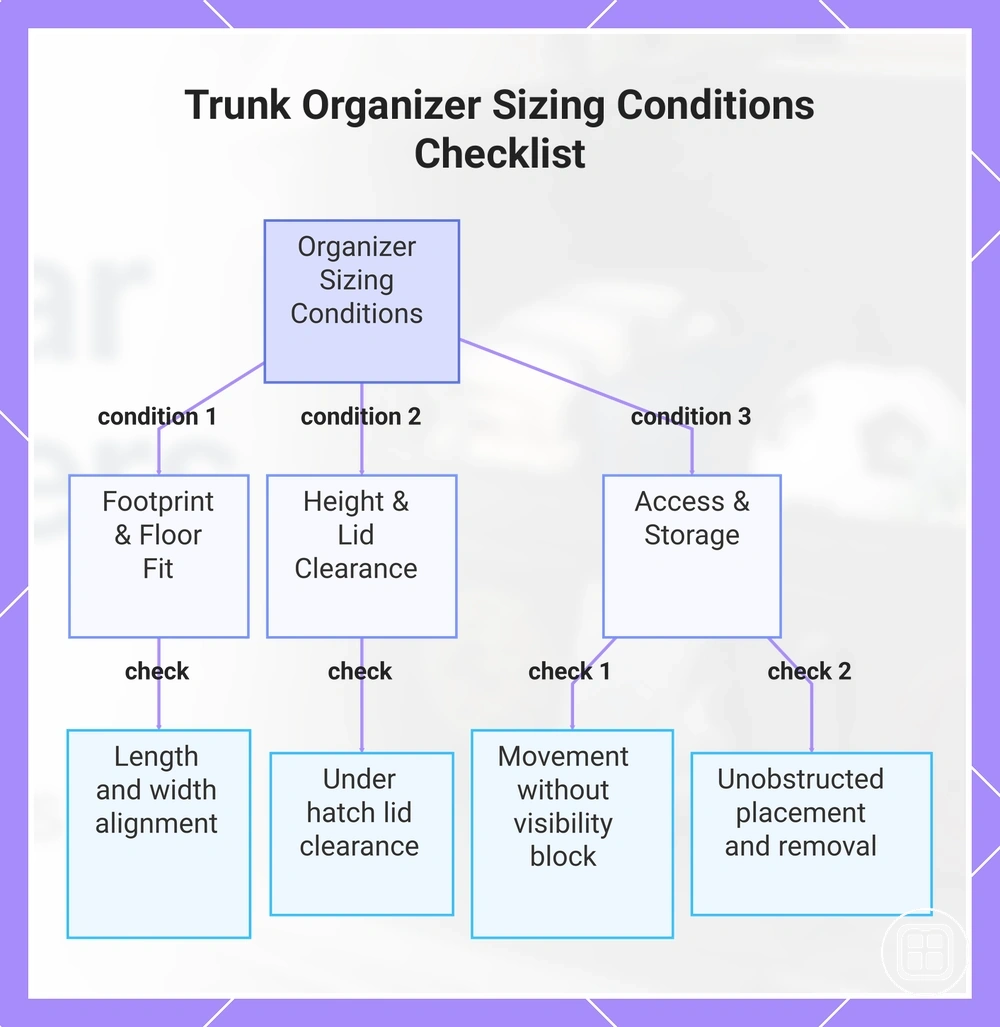
Organizer footprint, height, and access clearance depend on how the base footprint fits the trunk floor and how available space aligns with trunk opening constraints. Length and width of the organizer footprint determine usable cargo area coverage, while height and lid clearance affect whether the unit can sit under the hatch opening without restricting movement. These sizing conditions require verification against the vehicle’s own measurements rather than assuming fixed compatibility.
A practical scenario involves placing a low-profile organizer and a taller compartment-based organizer inside the same trunk. In this case, folded size and cargo visibility can change how easily the organizer can be stored or repositioned when not in use, depending on access clearance and interior space conditions.
Before selecting a trunk organizer, verify the following sizing conditions:
- Organizer footprint aligns with available trunk floor length and width
- Height fits within lid clearance under the hatch opening
- Access clearance allows movement without blocking cargo visibility
- Folded size supports storage when the organizer is not in use
- Trunk opening allows placement and removal without obstruction
This chart shows the three key sizing conditions to verify when selecting a trunk organizer for vehicle compatibility.
Storage layout, compartments, and cargo access
Storage layout refers to how compartments, dividers, pockets, and access zones are arranged inside a trunk car organizer to manage item separation and cargo access. It defines how internal space is structured and how different storage sections interact, which directly shapes organization quality and usability during use.
Compartment structure, divider placement, and pocket positioning influence how items are separated and how quickly they can be accessed. Open access zones typically support faster reach, while covered storage can improve cargo visibility control and containment depending on use conditions. Frequently used items are usually more effective when placed in accessible zones, while less-used items can remain in deeper compartments, depending on capacity and item categories.
Storage layout can be evaluated by breaking down how each organizer component affects access and separation behavior. The following table presents an EAV structure showing how compartments, dividers, pockets, lids, and open sections influence cargo access outcomes.
| Organizer part | Attribute or criterion | Value or condition | Effect on cargo access |
|---|---|---|---|
| Compartments | Internal segmentation | Multiple or limited sections | Defines item separation structure and grouping clarity |
| Dividers | Flexibility | Fixed or adjustable partitions | Affects adaptability for different item sizes |
| Pockets | Placement | External or internal small-item zones | Improves reach for frequently used small items |
| Lids | Coverage level | Open or covered storage | Balances access speed with visibility and protection |
| Open sections | Accessibility | Uncovered storage zones | Enables faster retrieval with lower containment control |
Materials, waterproofing, and cleaning resistance
Material in a trunk car organizer refers to the surface fabric and structural build that influences how the organizer handles moisture, stains, and everyday wear inside the cargo area. It affects water resistance, cleaning resistance, and durability depending on fabric density, coated surface quality, seams, base panels, and liner construction. These factors determine trunk-use suitability under different loading and spill conditions.
Fabric density, coated surfaces, seams, base panels, and liners work together to define how spills are managed and how easily the organizer can be cleaned. Higher fabric density and coated surface layers usually improve water resistance and support wipe-clean behavior, while reinforced seams and rigid base panels improve structural durability. However, cleaning effort and stain or odor risk may still vary depending on how liquids interact with stitching points and liner coverage, especially during wet-item storage or frequent spill exposure.
Waterproofing and cleaning resistance should be understood as conditional properties based on material construction rather than uniform performance. The table below summarizes how key material features affect durability, spill handling, and maintenance effort under typical trunk-use scenarios such as groceries, sports gear, tools, and wet items.
| Material feature | What it helps with | Limitation to qualify |
|---|---|---|
| Fabric density | Improves durability and basic water resistance | May still allow seepage through seams or weak points |
| Coated surface | Enhances water resistance and wipe-clean behavior | Coating can reduce over time with repeated cleaning |
| Seams | Affects spill handling and structural integrity | Stitching areas may reduce overall water resistance |
| Base panels | Improves rigidity and trunk-use durability | May reduce flexibility in compact storage conditions |
| Liner | Supports spill control and reduces stain absorption | Effectiveness depends on coverage and fit quality |
Stability, straps, and anti-slide control
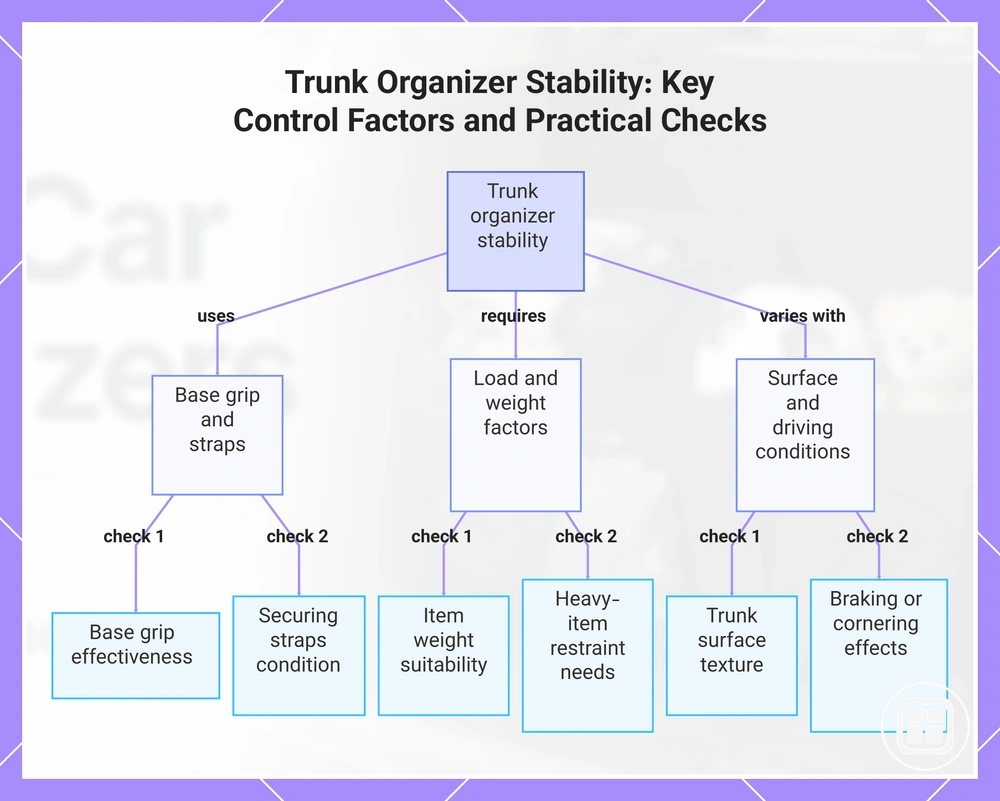
Trunk organizer stability refers to how a trunk car organizer reduces unwanted movement inside the cargo area using base grip, straps, and anti-slide control. It focuses on movement reduction rather than complete vehicle safety, and its effectiveness depends on weight distribution, trunk surface friction, and how the organizer is positioned. Under typical driving conditions, stability may improve when these factors are balanced together.
Base grip, securing straps, trunk surface texture, and load balance all influence how well anti-slide control works during use. Anti-slip contact at the base helps reduce shifting, while securing straps and handles can limit lateral movement when properly engaged. Loose-item control and uneven weight distribution may reduce stability, and driving conditions such as braking or cornering can further affect movement behavior depending on cargo setup. In cases involving heavier cargo, restraint needs may vary based on how the load is distributed.
Stability evaluation can be understood by checking how key control factors interact rather than relying on a single feature. The checklist below highlights practical points related to anti-slide control and movement reduction, while keeping in mind that heavy-item restraint may require separate vehicle-appropriate securing decisions beyond the organizer itself.
- Base grip effectiveness on trunk surface
- Condition and use of securing straps
- Balanced load distribution across compartments
- Item weight suitability within organizer limits
- Trunk surface texture and anti-slip compatibility
- Lid or cover usage for loose-item control
- Heavy-item restraint requirements based on vehicle setup
This chart outlines the main factors that influence trunk organizer stability, including base grip, straps, load balance, and driving conditions, along with key checks for each.
How to choose a trunk car organizer by use case
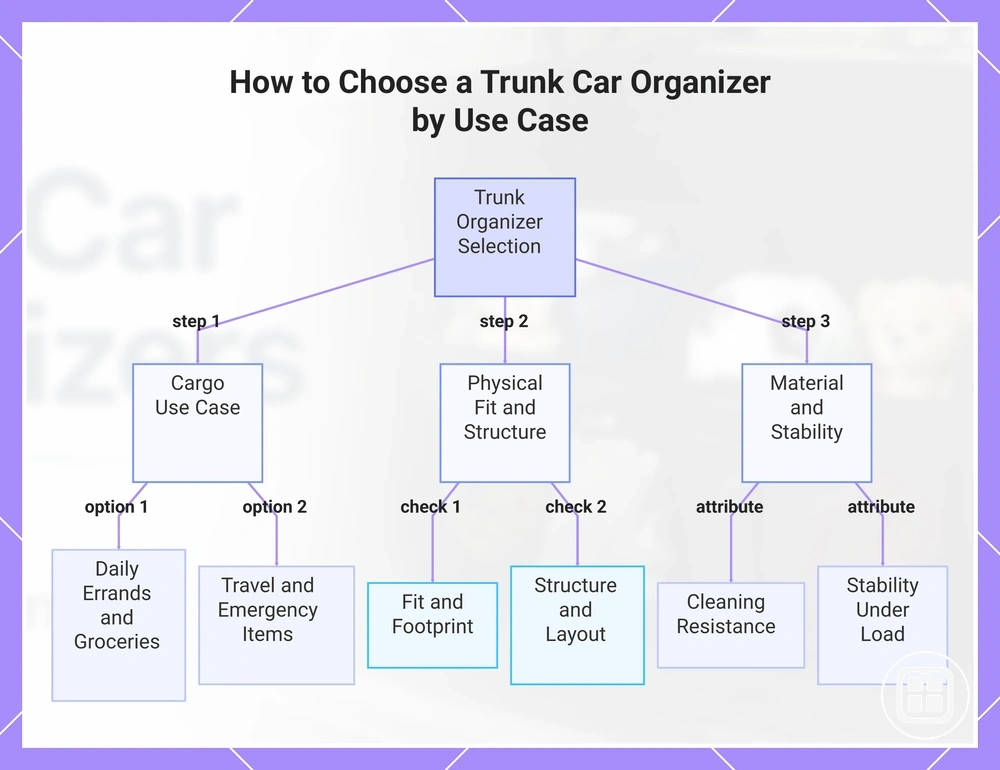
How to choose a trunk car organizer depends on use case because the decision must match cargo needs with fit, structure, layout, material, and stability requirements. The correct selection is guided by what you carry most often and how your trunk usage shifts between daily errands, travel cargo, emergency items, and groceries. This use case acts as the primary selection frame for comparing organizer types.
Use case and cargo frequency determine how the organizer behaves in real use. Daily errands and groceries usually require fast access layouts, while travel cargo and emergency items often need more structured compartments and separation. Family storage or mixed cargo use may require flexible layouts that can adapt over time, and these differences shape criteria such as access speed, compartment depth, and folding needs.
Fit and footprint must align with trunk shape and available cargo space to avoid blocking access or reducing usability. Structure and layout define how items are separated, whether through open zones or compartment-based organization. Verification of trunk dimensions and floor space ensures the selected organizer matches the actual vehicle conditions rather than assumed compatibility.
Material and stability influence durability, cleaning resistance, and movement control during driving. Higher fabric density and coated surfaces often improve cleaning resistance, while reinforced structure can support better stability under load. These factors involve trade-offs depending on cargo type, especially when balancing flexibility, weight handling, and cleaning effort across different usage conditions.
A decision checklist helps refine how to choose a trunk car organizer based on real usage patterns. Selection should consider cargo needs, fit, structure, layout, material, stability, folding requirements, and lid preference. Each factor should reflect how often the trunk changes between daily errands, travel cargo, emergency items, and groceries to ensure practical alignment.
Choosing a trunk car organizer becomes a process of matching use case with physical and functional criteria rather than selecting a universal option. Different use cases require different balances of access, structure, and stability, and the final decision depends on how the cargo area is actually used over time.
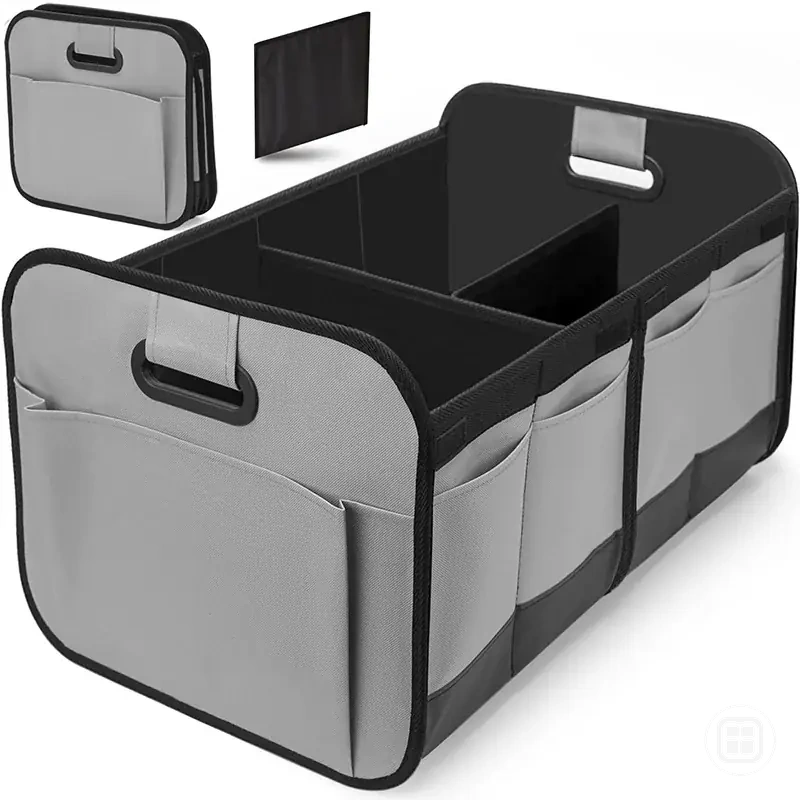
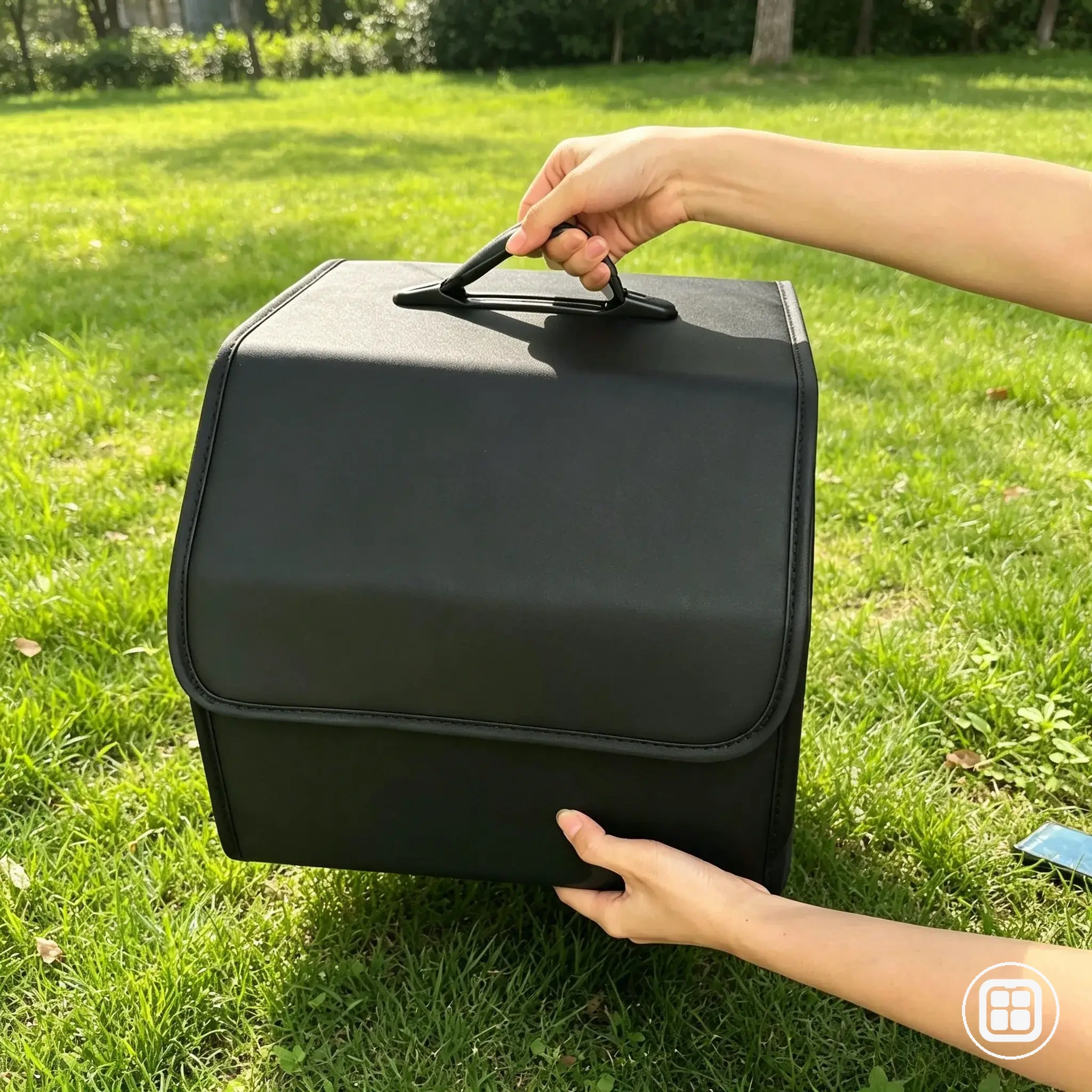
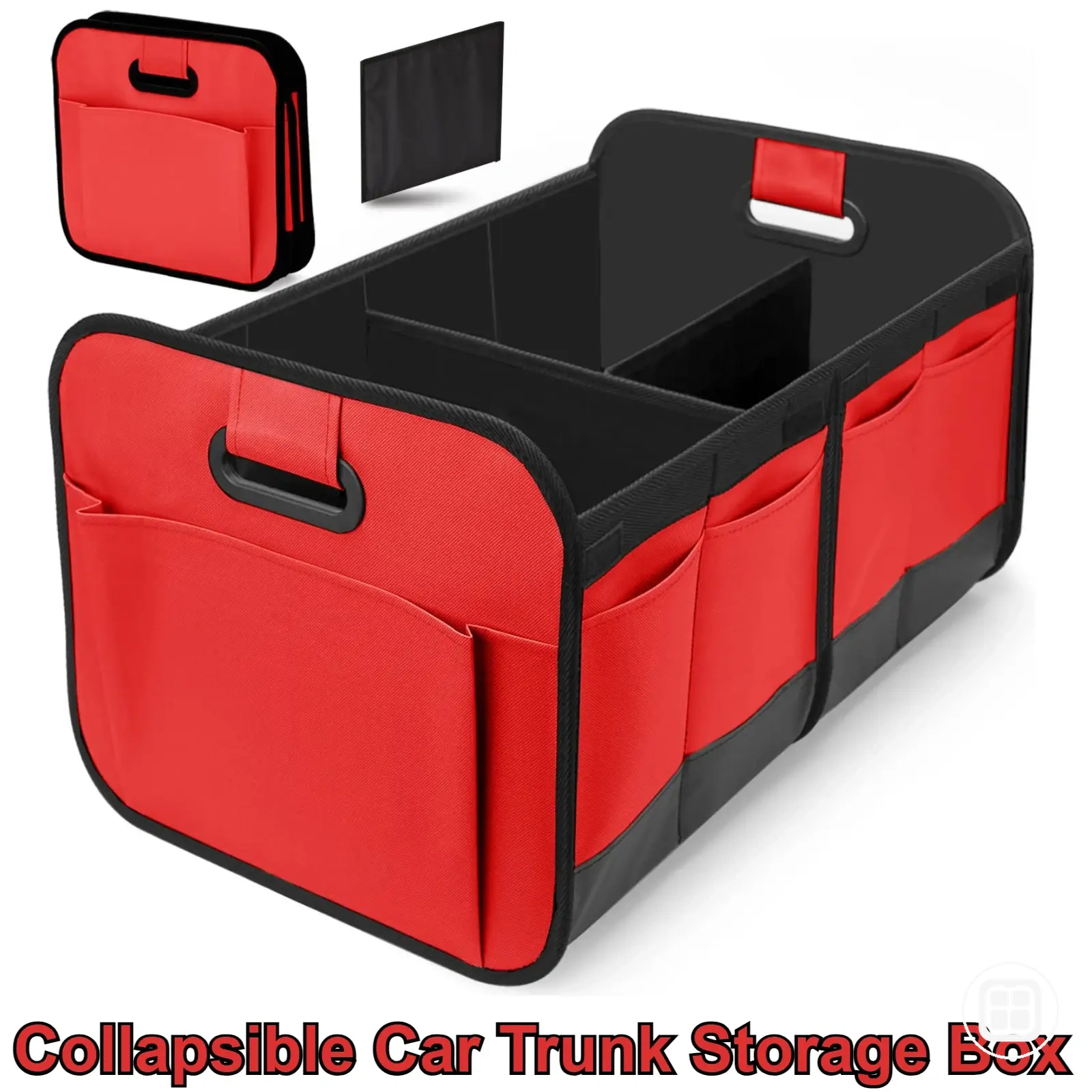
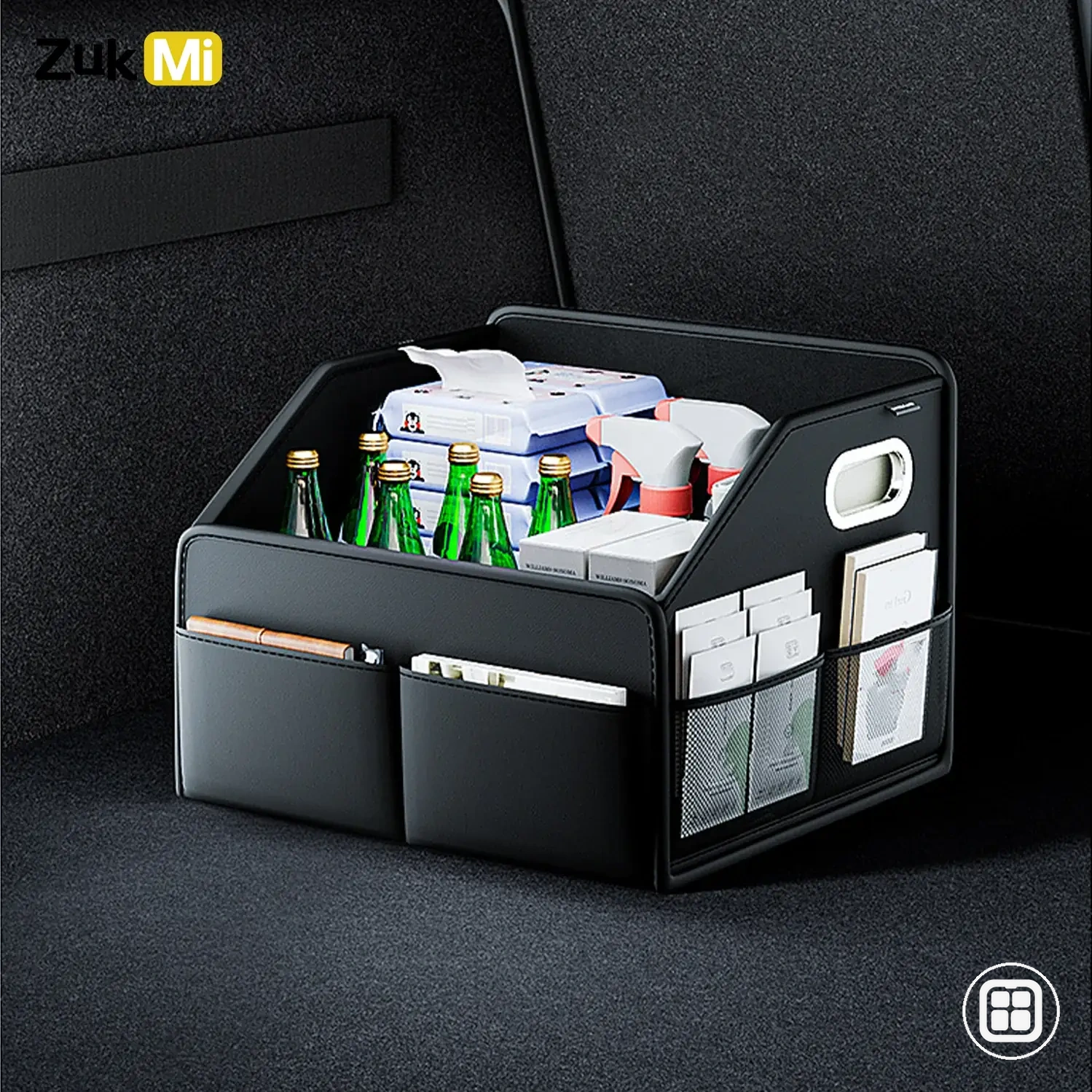
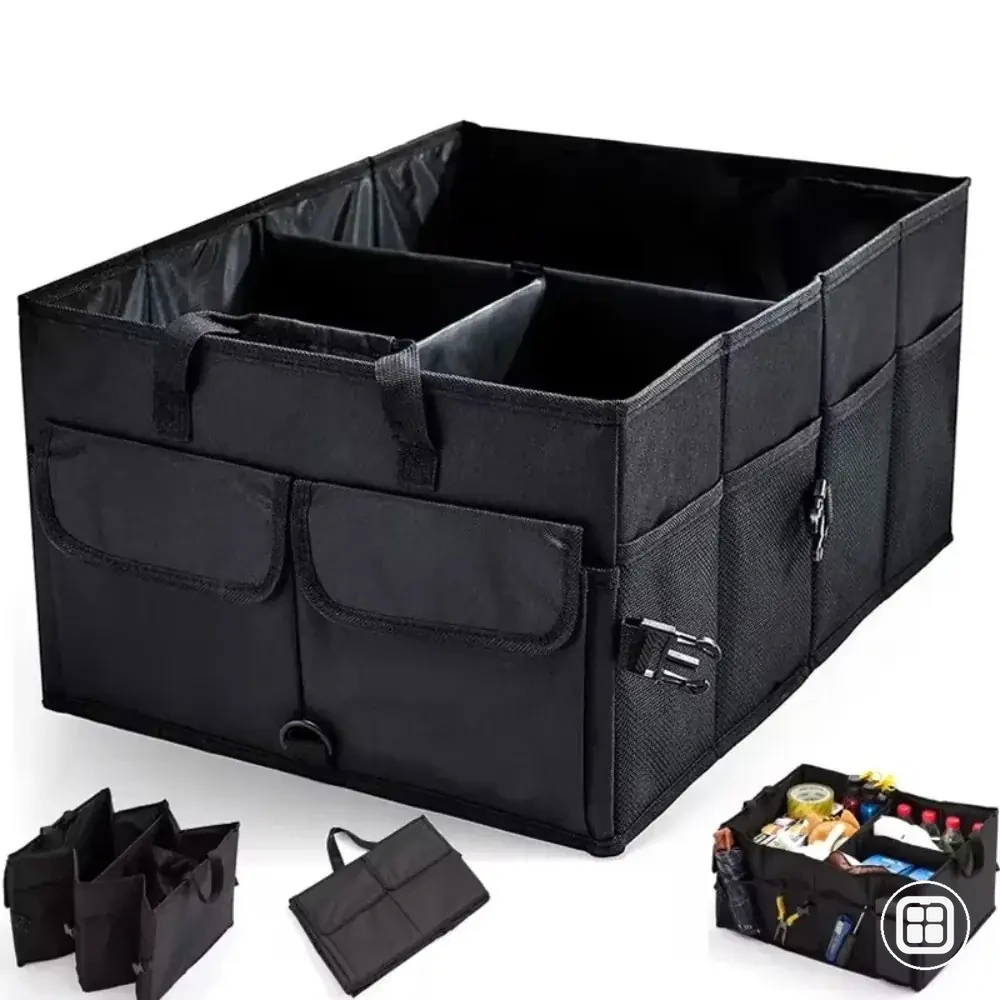
The products below are useful examples for comparing available options. Before buying, check that the compatibility criteria, key features, and product details match your needs.
This chart shows the decision process to select a trunk car organizer by evaluating cargo use case, physical fit and structure, and material and stability attributes.
Groceries, tools, emergency items, and travel cargo
Cargo categories such as groceries, tools, emergency items, and travel cargo require different compartments, material strength, and stability levels, so organizer suitability changes based on cargo type. Groceries often include bottles and loose small items that benefit from structured compartments to reduce movement. Tools usually depend on reinforced material and higher stability, while emergency items need fixed placement for quick access. Travel cargo typically requires flexible capacity and adaptable storage, linking each cargo category to a specific attribute priority.
Different cargo types shift which organizer attributes become most important, especially when balancing containment and access needs. Groceries may require spill handling behavior through compartment separation, while tools increase load demands that test base stability. Emergency items depend on consistent visibility and fixed positioning, whereas travel cargo often prioritizes flexible space usage and folding capability depending on luggage size and trip duration.
| Cargo type | Organizer attribute to prioritize | Why it matters |
|---|---|---|
| Groceries | Compartments and spill control | Helps separate bottles and loose small items to reduce shifting during transport |
| Tools | Material strength and stability | Supports heavier loads and reduces movement under weight pressure |
| Emergency items | Fixed placement and visibility | Keeps essential items consistently accessible in urgent situations |
| Travel cargo | Capacity and folding flexibility | Adapts to varying luggage sizes and changing storage needs |
| Loose small items / bottles | Divided compartments | Prevents rolling and improves internal organization stability |
Capacity, folding, lid coverage, and daily access trade-offs
Capacity, folding, lid coverage, and daily access trade-offs define how a trunk organizer balances storage volume with usability under real use conditions. Capacity can increase storage volume but may reduce available trunk space, folding can improve storage when empty but reduce rigidity, lid coverage can add protection but reduce access speed, and compartment count can improve separation but reduce flexibility.
These trade-offs depend on trunk space, cargo type, and how often the organizer is accessed or reconfigured. In smaller trunks, folding and compact storage may matter more, while frequent use with groceries or travel cargo may shift preference toward capacity or compartment structure. The decision is usually driven by the dominant use pattern rather than a single design feature.
Before comparing options, the main trade-offs can be summarized as follows:
| Attribute | Trade-off | Decision condition |
|---|---|---|
| Capacity | Reduces available trunk space when large | When higher storage volume is needed for frequent cargo loads |
| Folding | Reduces rigidity when collapsed | When storage flexibility and empty-trunk use are important |
| Lid coverage | Can reduce daily access speed | When covered storage or privacy is preferred over quick access |
| Compartment count | Can reduce flexibility for larger items | When item separation is prioritized over open space usage |
When a different car organizer type fits better
Placement need determines when a trunk organizer should be replaced by a different car organizer type, especially when access, visibility, and passenger use do not align with cargo-area storage behavior. A trunk organizer works best for larger items in the trunk space, while other placement-based options may be more suitable when items need to stay within reach inside the cabin rather than the rear cargo area.
Trunk organizers rely on rear access, which can reduce daily access speed when compared with in-cabin solutions. In contrast, passenger-area organizer types improve visibility and reach for items that need frequent use while driving or during passenger interaction. This difference in placement need directly affects how quickly items can be accessed and how clearly they remain visible during travel.
Explore other types when a different car organizer type fits better, since placement determines whether trunk storage or passenger-area storage better supports access, visibility, and passenger use requirements.
To clarify the boundary, the comparison below shows how trunk organizer and other car organizer types differ based on placement context and use behavior rather than performance ranking.
| Organizer type | Placement context | Better when | Not the main fit when |
|---|---|---|---|
| Trunk organizer | Cargo-area storage | Storing larger items with rear access | Frequent in-cabin access or driver-reach use is required |
| Backseat organizer | Passenger use (seatback) | Child-access storage or rear passenger organization | Items must remain in the trunk space |
| Front-seat organizer | Front cabin access | Quick driver or passenger access during travel | Bulk cargo storage is needed |
| Console organizer | Center cabin storage | Small-item driver access and controlled visibility | Larger cargo-area storage is required |
| Seat-gap organizer | Between-seat storage | Dropping-prevention and narrow item access | Structured cargo organization is required |
In boundary cases, cargo-area storage aligns better with trunk organizers, while child-focused access often aligns with backseat organizers, and small-item driver access is typically better served by console or seat-gap organizers depending on reach and visibility needs.
When placement need shifts toward frequent cabin access or tighter driver reach requirements, another car organizer type may be more suitable than trunk storage, depending on how access and visibility priorities are balanced.
The products below are useful examples for comparing available options. Before buying, check that the compatibility criteria, key features, and product details match your needs.