Car organizer storage layout: compartments, capacity, and access
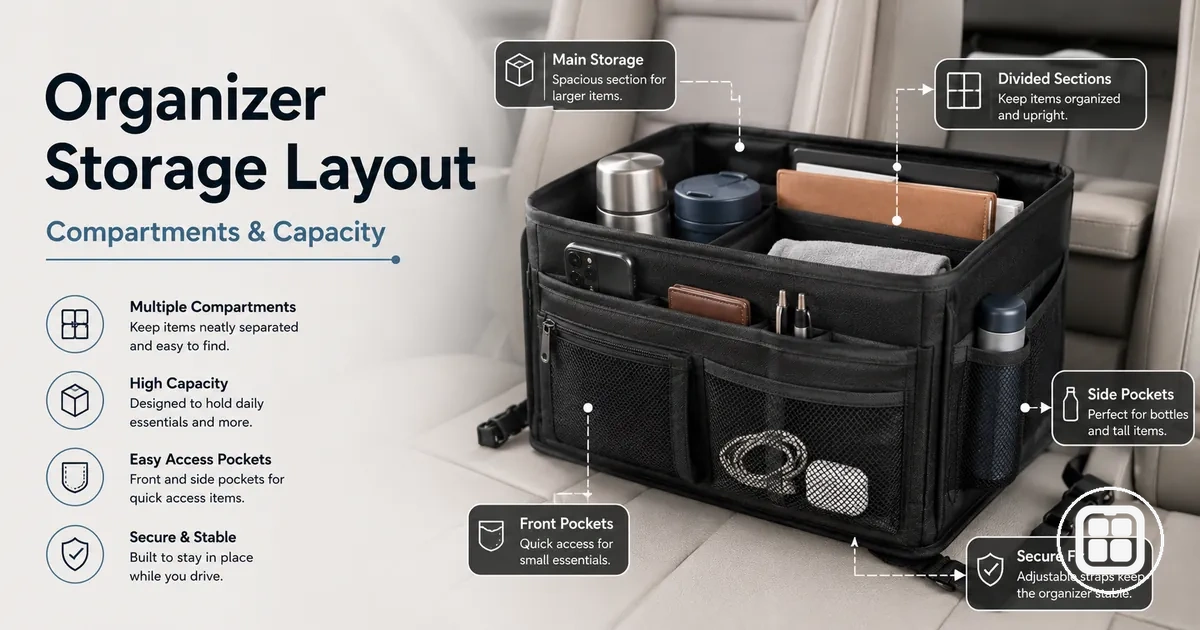
Car organizer storage layout refers to the internal arrangement of compartments, pockets, and dividers that shape how usable space is structured inside a car organizer. It determines how items are separated, how much capacity is practically available, and how access points support retrieval during use. This layout is not about vehicle fit, material quality, or installation behavior but about internal organization and access logic within the storage system.
In everyday use, a car organizer storage layout becomes important when different item mixes need structured separation, such as groceries, tools, emergency gear, or small accessories. Compartments and dividers influence how items are grouped, while capacity defines how much usable space remains after internal structure is applied. Access and visibility affect how quickly items can be seen and retrieved, especially when multiple objects are stored in different storage zones within the same organizer body.
A car organizer storage layout is essentially the system that controls how compartments, capacity, and access points work together to organize items inside a confined storage structure. It focuses on internal separation, usable space distribution, and retrieval efficiency rather than external compatibility factors. Back to hub overview for a broader context of car organizer categories and structure.
How storage layout changes what a car organizer can hold
Car organizer storage layout is the internal arrangement of compartments, pockets, dividers, and access zones that determines how storage space is structured. It defines how items are positioned, separated, and reached inside the car organizer. This structure shapes what the organizer can practically hold based on its internal organization.
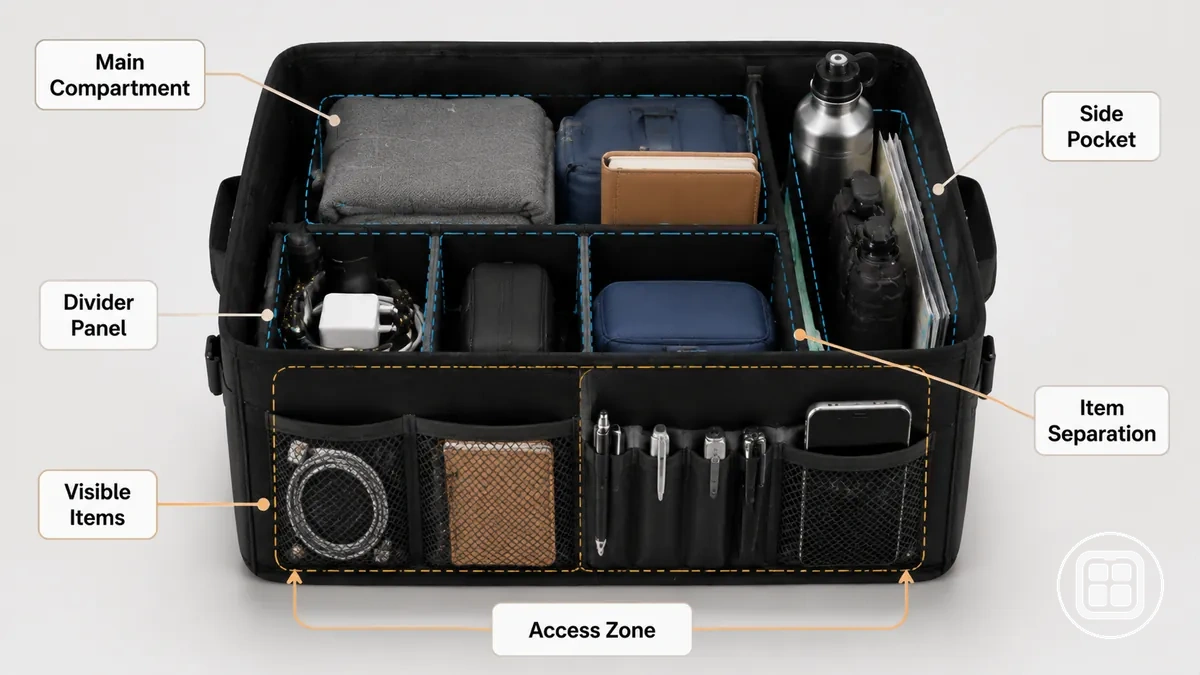
The storage layout directly influences what a car organizer can hold by shaping item separation, stacking behavior, and visibility. Compartment depth and divider placement control how different items are grouped without overlap. Access zones and pocket positioning affect how quickly items can be seen and retrieved during use.
Usable capacity depends on how the storage layout distributes internal space across compartments and pockets rather than empty volume alone. A layout that increases separation may reduce free space but improve retrieval and clarity. Capacity becomes meaningful only when the layout matches the actual item mix and how those items need to be organized.
Main compartment formats in car organizers
Car organizer storage behavior is controlled by the compartment format, which defines how compartments, pockets, dividers, and access zones shape internal storage structure. It determines how items are grouped, supported, and accessed inside the organizer. This makes compartment format a key factor in overall storage behavior.
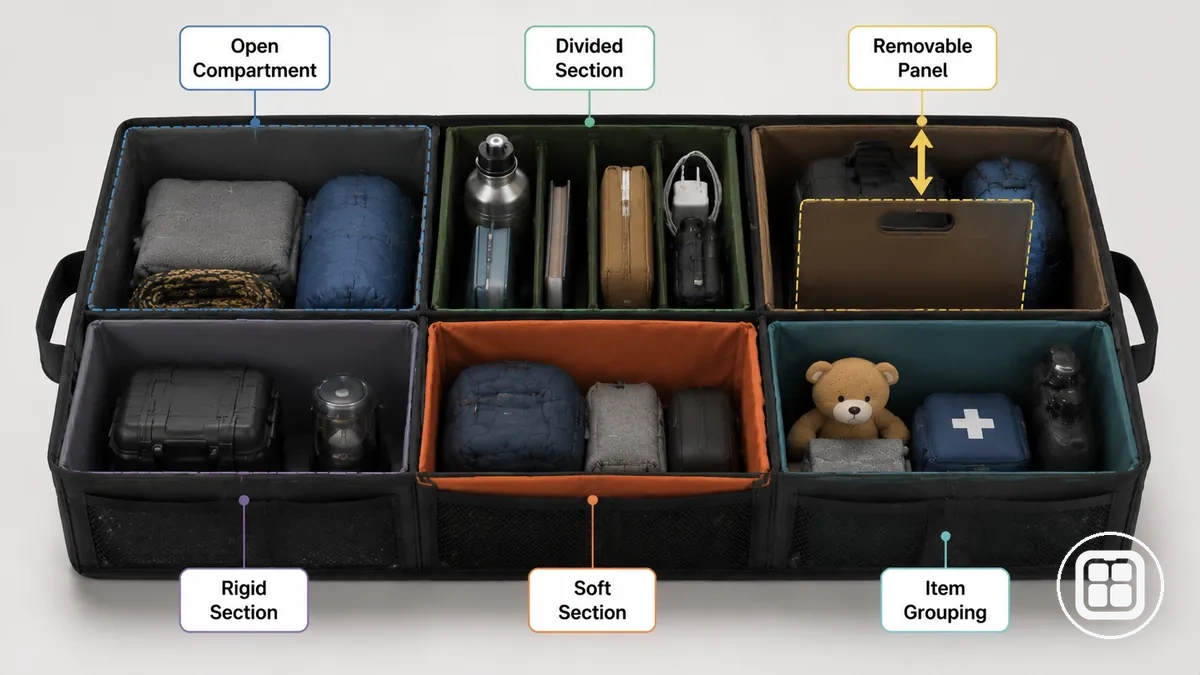
Different compartment formats influence item grouping, stability, and access in distinct ways. Open compartments support flexible grouping but reduce separation between items. Divided compartments improve structured separation and stability through fixed partitioning. Removable panels allow reconfiguration of storage sections, while rigid sections maintain fixed support and shape retention. Soft sections adjust more easily to item shape but may reduce structural stability depending on load.
These formats can be compared through how they affect storage conditions and outcomes under use. Open formats prioritize access, while divided formats prioritize separation and controlled organization. Rigid and soft sections define how much support or compression is applied to stored items during use.
The table below connects each compartment format to its storage condition and resulting behavior, showing how format decisions shape practical storage outcomes.
| Compartment Format | Storage Condition | Storage Outcome |
|---|---|---|
| Open compartments | Unsegmented flexible space | Fast access, lower item separation |
| Divided compartments | Fixed internal partitions | Structured grouping and higher stability |
| Removable panels | Reconfigurable sections | Adaptive item grouping based on needs |
| Rigid sections | Fixed structured support | Consistent shape retention and stability |
| Soft sections | Flexible compressible storage | Adaptive fit with variable support levels |
Open bins, divided sections, and removable panels
Open bins, divided sections, and removable panels define how flexibility, separation, and access shape storage behavior inside the main compartment of a car organizer. Each format changes how items are grouped and how easily they can be reached during mixed item storage.
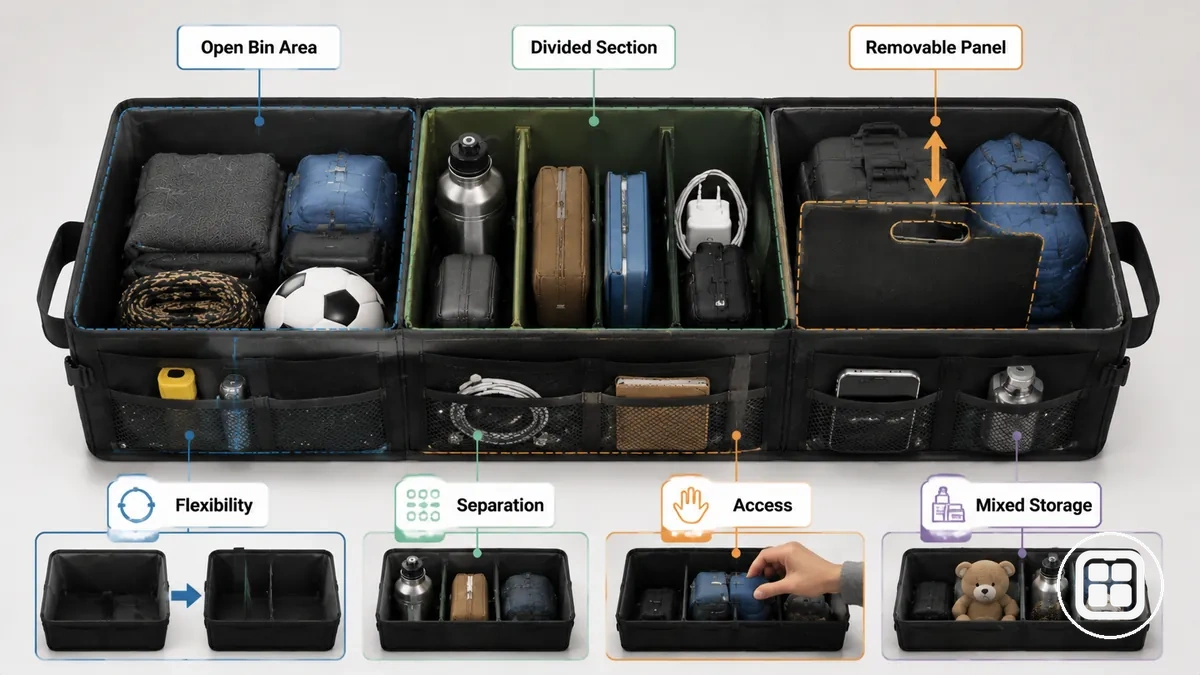
Open bins, divided sections, and removable panels differ in how they control item grouping and access. Open bins allow flexible placement with fast access but weaker separation. Divided sections increase separation by creating fixed zones for smaller items. Removable panels adjust the layout, allowing changes in spacing and structure for mixed item storage.
- Open bins: High flexibility with quick access but limited separation between items.
- Divided sections: Strong separation that improves structured grouping and keeps items stable.
- Removable panels: Adjustable layout that supports mixed item storage and changing access needs.
Soft-edge and rigid-edge compartment behavior
Soft-edge and rigid-edge describe how compartment boundaries influence shape retention, compression, and item support inside a car organizer. Edge behavior determines how storage space holds structure and how items remain positioned during use.
Soft-edge behavior typically allows more compression, which can help when storing loose accessories or irregularly shaped items. Rigid-edge behavior maintains stronger shape retention, increasing item support for structured objects such as bottles or boxes. The overall effect depends on item weight, organizer design, and placement conditions.
The contrast below shows how edge behavior affects storage performance in local terms.
| Soft-edge | Rigid-edge |
|---|---|
| Flexible wall behavior with compression under load | Structured wall behavior with strong shape retention |
| Lower fixed support, adapts to item shape | Higher item support, maintains defined storage zones |
| May show more collapse behavior under heavier load | More stable under structured placement of items |
| Better for loose accessories and mixed storage | Better for bottles, boxes, and rigid items |
Small-item storage zones and external pockets
Small-item zones and external pockets define how visibility, containment, and access are structured for frequently used items inside a car organizer. They determine how quickly items can be seen, separated, and reached during use.
Pocket placement changes access behavior by separating visible storage from closed containment areas. Mesh pockets support visibility for small items that need to stay identifiable, while side pockets help manage loose accessories that may shift or roll. Cup-holder areas stabilize bottles with localized containment, and lidded sections reduce exposure by adding closure. Quick-reach zones improve access speed for items that are used frequently during travel.
The relationship between pocket type and storage outcome can be understood through how each zone balances visibility, containment, and access under mixed storage conditions.
| Pocket Type | Item Condition | Outcome |
|---|---|---|
| Mesh pockets | Small items requiring visibility | Improved visibility and fast identification |
| Side pockets | Loose accessories needing containment | Controlled storage with reduced movement |
| Cup-holder areas | Bottles needing stability | Localized containment with reduced spill risk |
| Lidded sections | Items needing partial closure | Reduced exposure with added containment |
| Quick-reach zones | Frequently accessed items | Faster access with minimal retrieval effort |
Mesh pockets, side pockets, and quick-reach sections
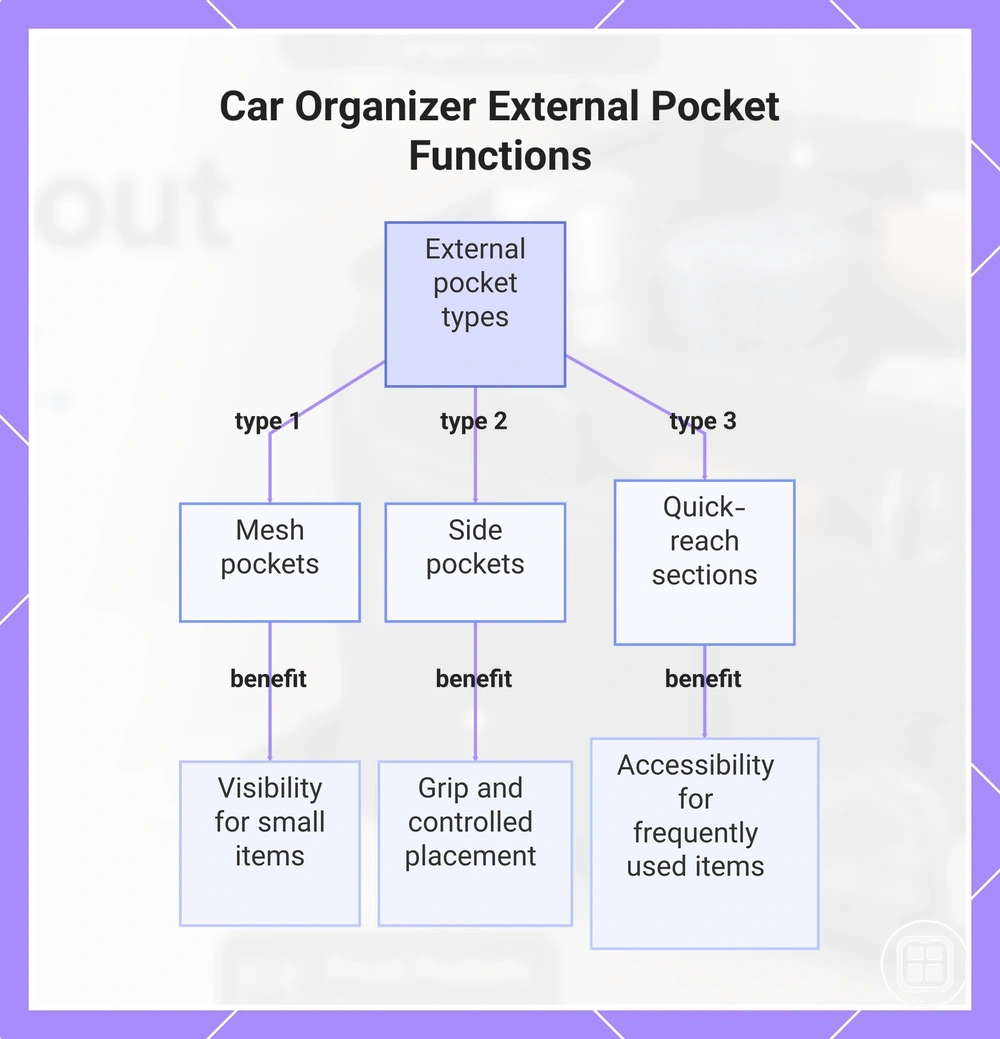
Mesh pockets, side pockets, and quick-reach sections define how small items are organized through visibility, grip, and accessibility inside external storage areas of a car organizer. These zones mainly improve retrieval and visibility for small items and loose accessories rather than changing core storage capacity.
Mesh pockets typically improve visibility for small items like cables and wipes, making contents easier to identify and retrieve. Side pockets usually support better grip and controlled placement for items such as documents or snacks, helping reduce movement. Quick-reach sections prioritize accessibility for frequently used loose accessories, reducing retrieval time during use.
- Mesh pockets support visibility for cables and wipes, making small items easier to locate during use.
- Side pockets improve grip for documents and snacks, helping keep loose accessories more stable.
- Quick-reach sections improve accessibility for frequently used items, reducing retrieval effort.
- External pockets organize access and visibility but do not increase main storage capacity.
This chart shows the three main types of external pockets in a car organizer and their specific functional benefits for organizing small items and loose accessories.
Cup holders, covered sections, and lidded storage areas
Cup holders, covered sections, and lidded storage areas define containment-focused zones that manage how items are held, stabilized, and partially concealed inside a car organizer. They provide containment through opening size, closure behavior, and depth, rather than increasing overall storage capacity. :contentReference[oaicite:0]{index=0}
These areas are typically used for bottles, cups, and small tools that may roll, tip, or require partial concealment during movement. Cup holders rely on controlled opening size and depth to support stability for bottles and cups, while covered sections reduce exposure for sensitive items. Lidded storage areas add closure-based containment, but their effectiveness depends on correct alignment between lid, item size, and internal depth.
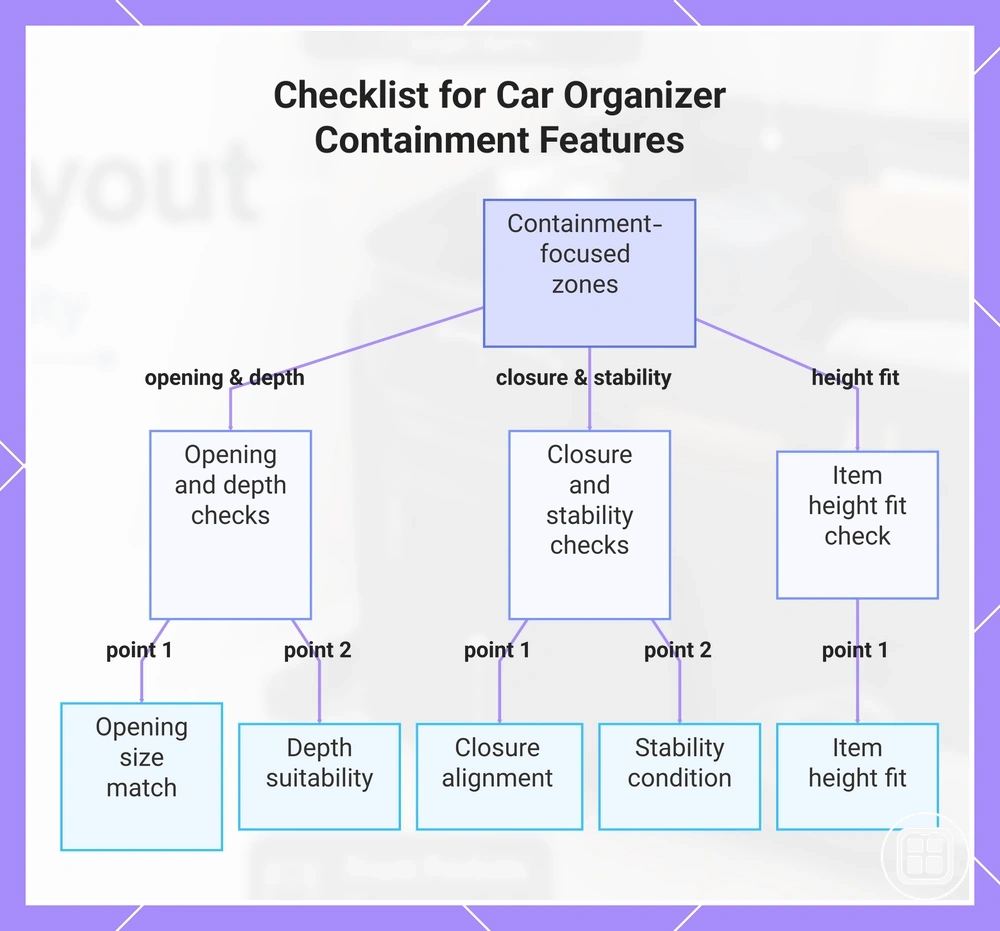
The following mini-checklist clarifies whether a containment feature is suitable for a given item:
- Opening size match: confirms whether cup holders or lids fit the bottle or cup diameter.
- Closure alignment: checks whether the lid closes without forcing or displacing the item.
- Depth suitability: ensures the item sits securely without excessive movement.
- Stability condition: verifies whether the holder section reduces tipping during motion.
- Item height fit: ensures taller bottles or tools remain properly supported.
This chart shows the key checks to determine if a cup holder, covered section, or lidded storage area is suitable for a given item.
Capacity and usable volume inside the organizer
Capacity and usable volume inside a car organizer refer to the practical storage volume that remains after internal layout elements such as dividers, pockets, wall thickness, and folding behavior take up space. Usable volume represents the real storage space available for items after these structural elements reduce continuous internal space.
Stated capacity can differ from real storage space because usable volume is affected by factors like compartment count, depth, dividers, wall thickness, and collapsibility. Dividers and pockets split the interior into smaller zones, while folding behavior and material structure can further reduce uninterrupted storage areas. Item shape and bulk also influence how efficiently the remaining space can be used in practice.
The comparison below shows how structural elements affect the difference between stated capacity and usable volume in everyday use conditions.
| Factor | Effect on Internal Space | Impact on Usable Volume |
|---|---|---|
| Dividers and pockets | Split internal space into sections | Reduce continuous real storage space |
| Wall thickness | Takes up internal structure space | Decreases usable storage volume |
| Compartment count | Increases segmentation | Affects item distribution flexibility |
| Depth | Defines vertical storage limits | Controls stacking and fit efficiency |
| Folding behavior | Alters shape when not fully expanded | Changes effective usable capacity |
| Item shape | Occupies space differently | Determines real storage efficiency |
Large-capacity layouts versus compact compartment density
Large-capacity layouts versus compact compartment density describe a trade-off between open volume and item separation in car organizer storage design. Large-capacity layouts prioritize open volume with fewer divisions, while compact compartment density increases divisions to improve item separation. This changes how bulky items and small items are arranged and accessed within the same storage system.
The choice between these layouts depends on how storage needs shift between bulky items and small items, as well as how much access friction is acceptable during use. Available space and item mix determine whether flexible open volume or structured compartment density is more appropriate for the situation.
The comparison below highlights how layout scale, divisions, and access behavior differ between the two storage approaches in practical use conditions.
| Large-capacity layouts | Compact compartment density |
|---|---|
| Higher open volume with fewer divisions | Higher number of divisions with structured separation |
| Better accommodation for bulky items | Better organization for small items |
| Lower item separation with flexible space usage | Higher item separation with controlled placement |
| Lower access friction for large objects | Higher access organization for multiple small items |
| More suitable for mixed bulky storage | More suitable for dense small-item control |
Collapsible layouts and space after folding
Collapsible layout refers to a foldable storage structure in a car organizer that changes between active capacity and reduced volume when folded. Active capacity describes the usable storage space when the organizer is fully expanded, while folded size refers to the compact storage footprint created through fold lines and panel support. These two states are structurally fixed and differ based on how the collapsible layout is positioned, not on usage intensity. :contentReference[oaicite:0]{index=0}
Collapsible layouts affect flexible use by allowing the organizer to shift between expanded storage and compact storage conditions. In expanded form, compartments provide full active capacity for storage, while in folded form, reduced volume helps minimize storage footprint and unused space. Flexible use depends on how fold lines guide the transition and how panel support behaves during partial or full folding states, with outcomes varying by configuration rather than fixed performance assumptions.
Fold behavior check for collapsible layouts:
- Fold lines: confirm clean folding alignment across storage zones
- Panel support: check whether structure maintains shape during folding transitions
- Collapsed footprint: evaluate how much space is reduced in stored form
- Partial-fold behavior: assess stability when not fully expanded or fully collapsed
- Active capacity: confirm usable space when fully expanded
Matching storage layout to item groups
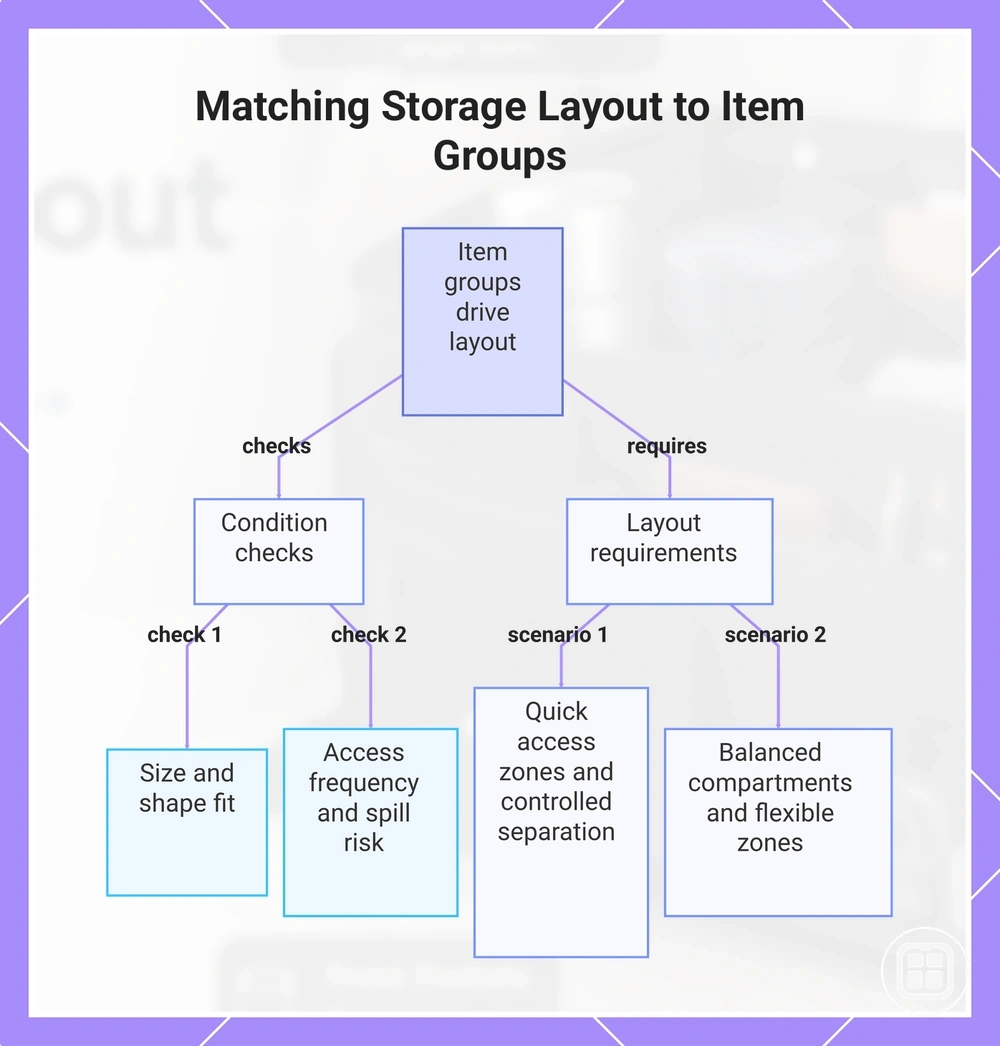
Item groups should directly drive storage layout selection because size, shape, spill risk, access frequency, and separation need determine how storage performs in real use. Storage layout depends on how these item groups interact with available compartments, not on a fixed rule. When item groups are mismatched with layout, storage organization becomes less efficient in daily use conditions. :contentReference[oaicite:0]{index=0}
For daily use and travel, item groups often include frequently accessed objects such as bottles, electronics, and personal accessories. These use cases depend on access frequency and spill risk, since items may shift during movement. Storage layout choices in these scenarios typically focus on quick access zones and controlled separation to support routine handling during travel conditions.
For family items, emergency storage, and mixed-use setups, item groups usually combine tools, documents, and shared essentials with different sizes and shapes. These situations increase separation need because items must remain organized under varying conditions. Storage layout selection in these cases depends on balancing structured compartments with flexible storage zones to handle mixed item behavior.
To evaluate storage layout suitability, item group conditions should be checked before selection. This ensures that size, shape, and access needs are aligned with layout structure and reduces mismatch between expected and actual storage behavior.
- Item size compatibility with available storage space
- Item shape fit within compartments or open zones
- Spill risk level and containment requirement
- Access frequency for daily use or travel routines
- Separation need for mixed or grouped storage
- Visibility requirement for quick item identification
- Containment need for loose or unstable items
Overall storage layout choice depends on how item groups behave across daily use, travel, family items, and emergency storage scenarios. The most suitable layout is the one that aligns separation need and access frequency with real item behavior rather than fixed assumptions.
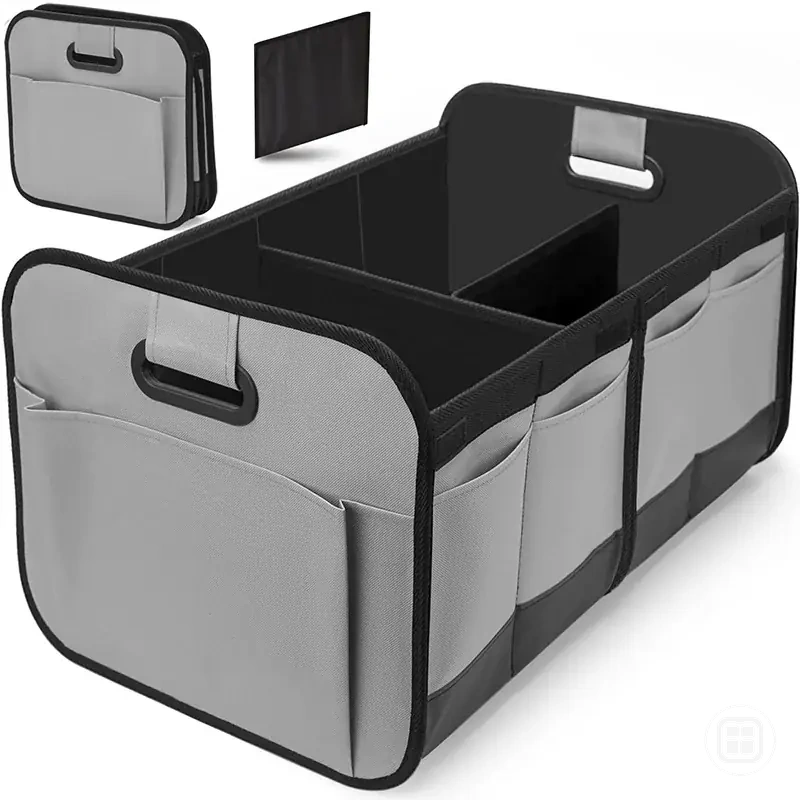
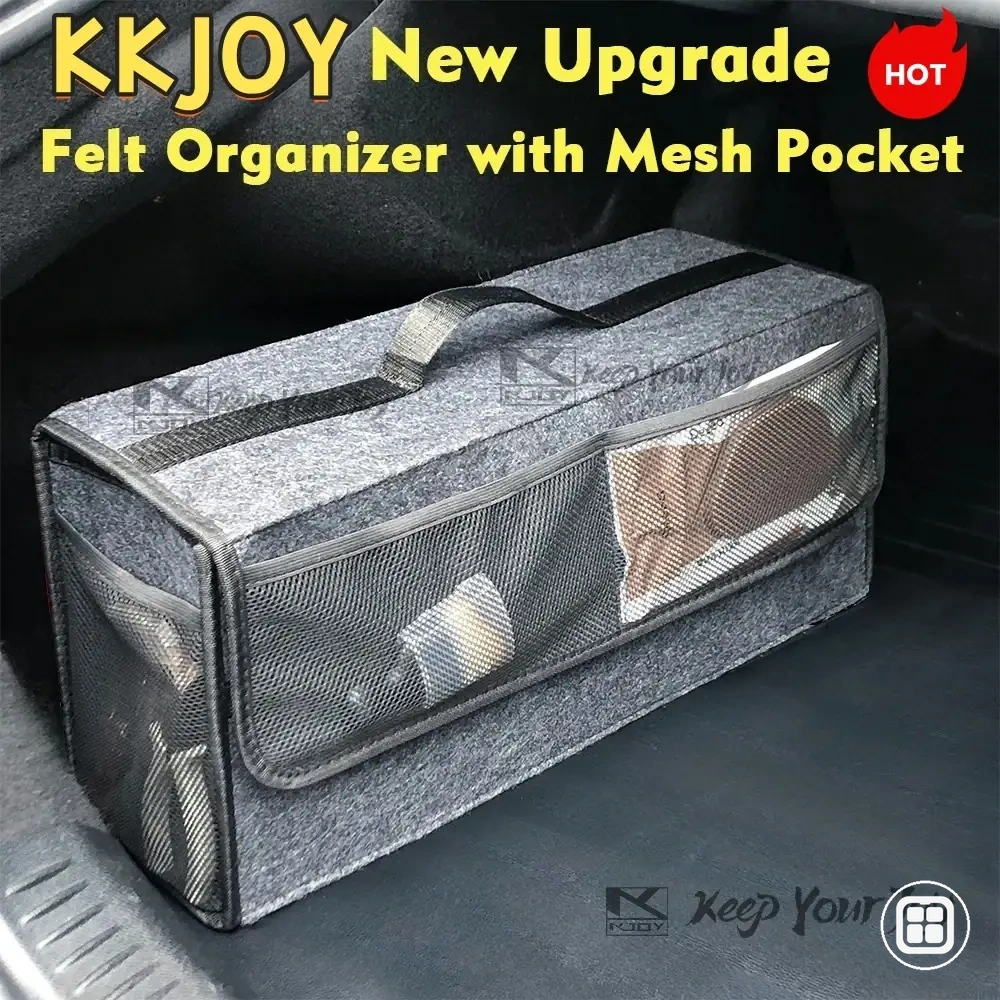
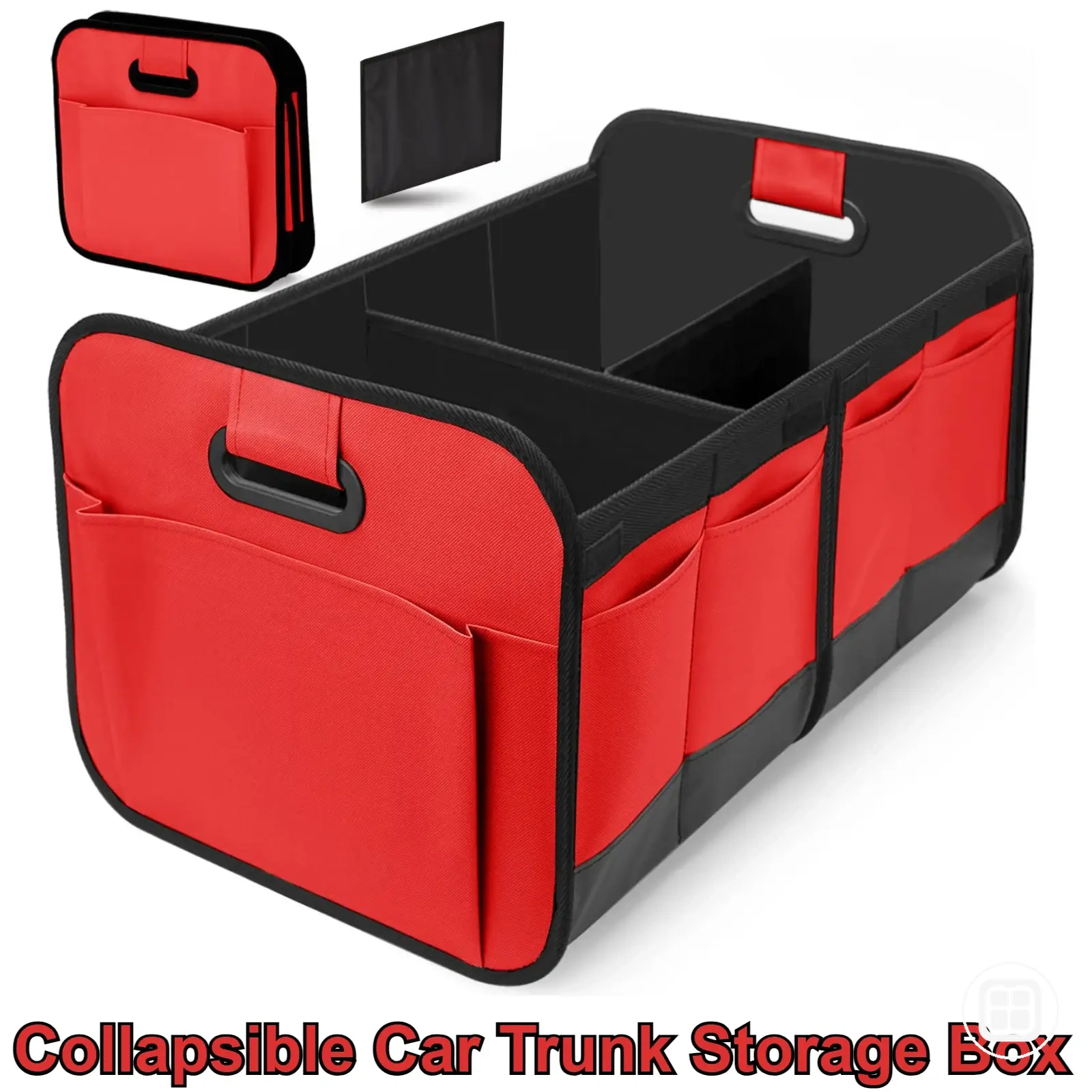
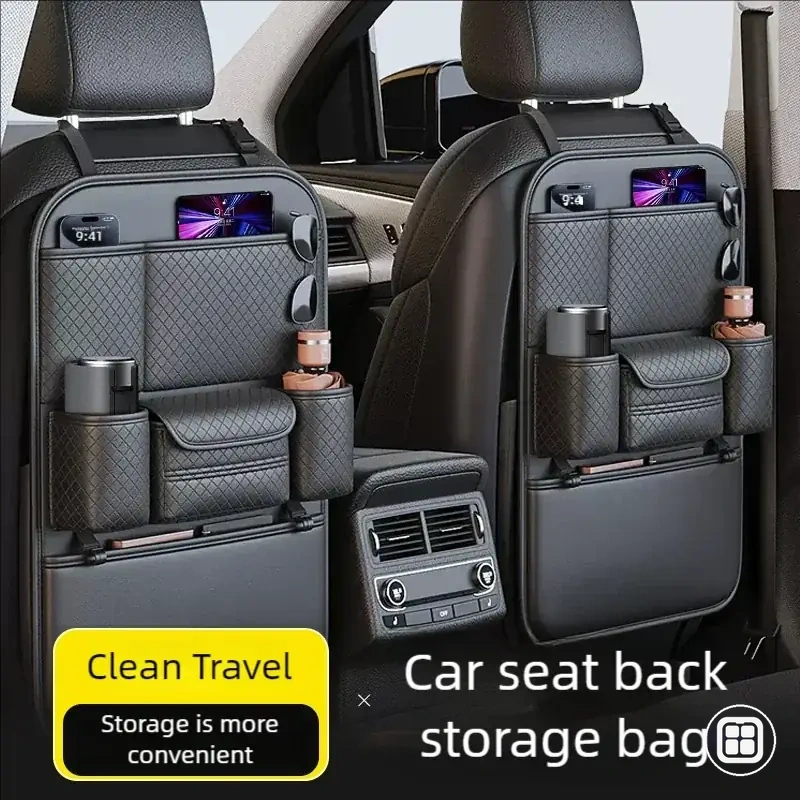
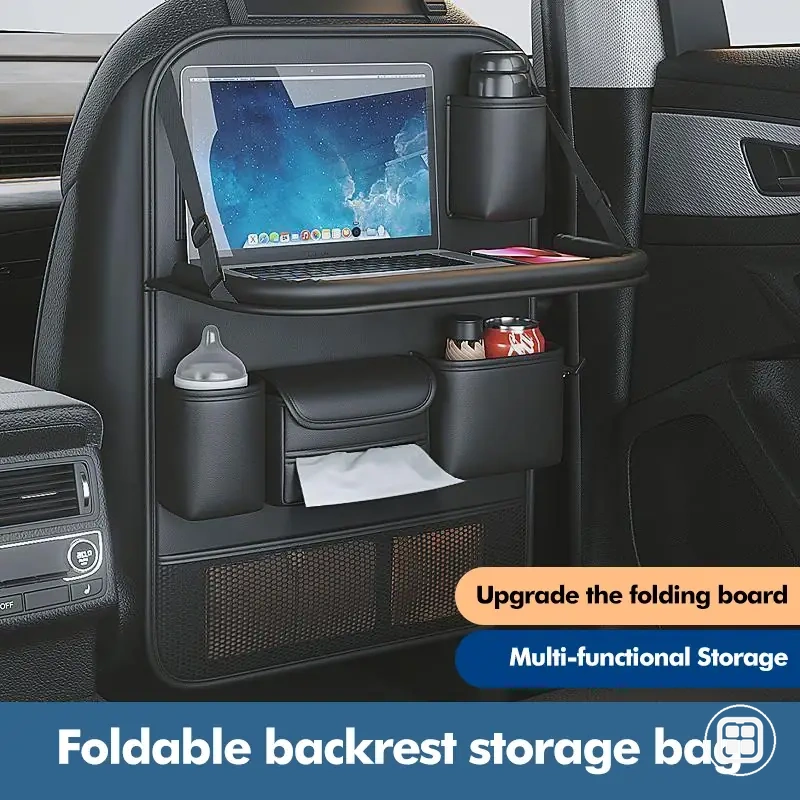
Here are product examples that may make comparison easier. Before buying, always review the compatibility criteria, essential features, and product details.
This chart shows how item group conditions and usage scenarios determine storage layout selection.
Groceries, tools, emergency gear, documents, and loose accessories
Item type directly changes storage requirements because groceries, tools, emergency gear, documents, and loose accessories differ in containment need, visibility need, weight, shape, and access frequency. These differences determine how compartments, pockets, and separation zones should behave within the storage layout rather than following a uniform structure.
- Groceries: Higher spill risk and flexible shape increase containment need, so storage layouts with stronger containment behavior in open compartments or covered zones are typically more suitable.
- Tools: Higher weight and rigid shape increase separation need, so structured sections with defined support and controlled organization are typically more appropriate.
- Emergency gear: Higher access frequency and urgency increase visibility need, so quick-reach storage zones are typically more suitable for faster retrieval.
- Documents: Flat shape and protection requirement increase containment need, so side pockets or flat storage zones with protective behavior are typically more appropriate.
- Loose accessories: Irregular shape and mixed sizes increase variability, so flexible compartments with balanced visibility and containment need are typically more suitable.
Mixed item sizes that need separate storage zones
Mixed item sizes that need separate storage zones depend on how small items, tall items, heavy items, and fragile items interact with an open storage area. Separate storage zones help when sorting and retrieval become inconsistent due to size differences and access needs. This is typically relevant when mixed item sizes create uneven usable volume and movement inside the storage layout. :contentReference[oaicite:0]{index=0}
A common assumption is that adding more compartments always improves organization. In practice, excessive division can reduce usable volume and make access more fragmented. Separate storage zones should be used only when mixed item sizes create clear sorting or retrieval issues. One open storage area may be more efficient when items are uniform, while divided zones become useful only when variation in size and fragility requires structured separation.
Before choosing separate zones, the following conditions help evaluate whether mixed storage benefits from division:
- Item height: tall items may require dedicated vertical space to avoid blocking access.
- Item weight: heavy items often need more stable support zones for controlled placement.
- Fragility: fragile items benefit from separation to reduce impact during movement.
- Access frequency: frequently used items may need easier and faster reach zones.
- Usable volume impact: over-division can reduce available storage efficiency in tight layouts.
Access and visibility inside the storage layout
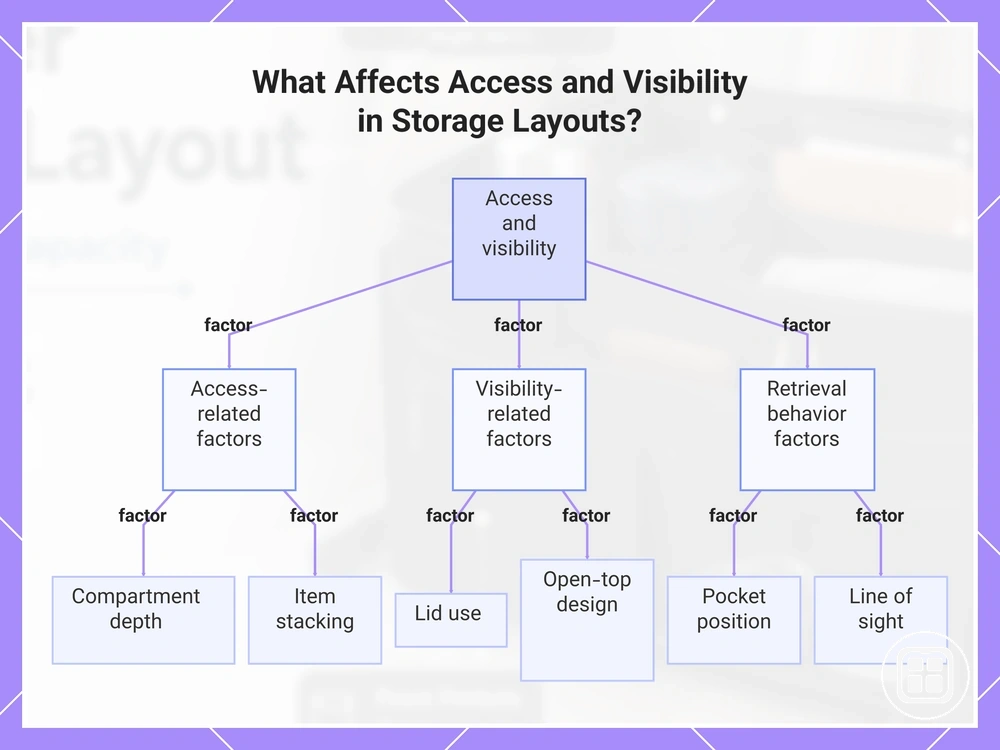
Access and visibility inside a storage layout are direct outcomes of design features that control how items can be seen, reached, and retrieved during normal use. Access depends on how pathways to items are structured, while visibility depends on whether items remain in the line of sight or are hidden by layout elements. :contentReference[oaicite:0]{index=0}
In deeper compartments, access may become slower because compartment depth increases reach distance and can reduce direct line of sight. Pocket position also changes retrieval behavior, as higher or side placement may improve or limit visibility depending on how items are stacked. Open-top design typically improves visibility, while lid use can partially or fully block direct view of stored items. Item stacking also affects access because layered items may require removal of upper objects before reaching lower ones.
To evaluate how a storage layout supports retrieval, access and visibility can be checked through key structural factors. This helps identify whether the layout improves or restricts quick reaching and clear viewing of stored items rather than focusing on usage habits.
- Compartment depth: deeper layouts may reduce immediate access and slow retrieval
- Pocket position: side or elevated placement can affect how easily items are seen and reached
- Lid use: covers may reduce visibility and create partial or full hidden storage
- Item stacking: layered placement can block access to lower items
- Line of sight: clear visual paths improve visibility and faster retrieval
- Open-top design: exposed layouts generally improve both access and visibility
This chart shows the main structural factors that influence access and visibility when retrieving items from a storage layout.
Layout constraints that reduce storage usefulness
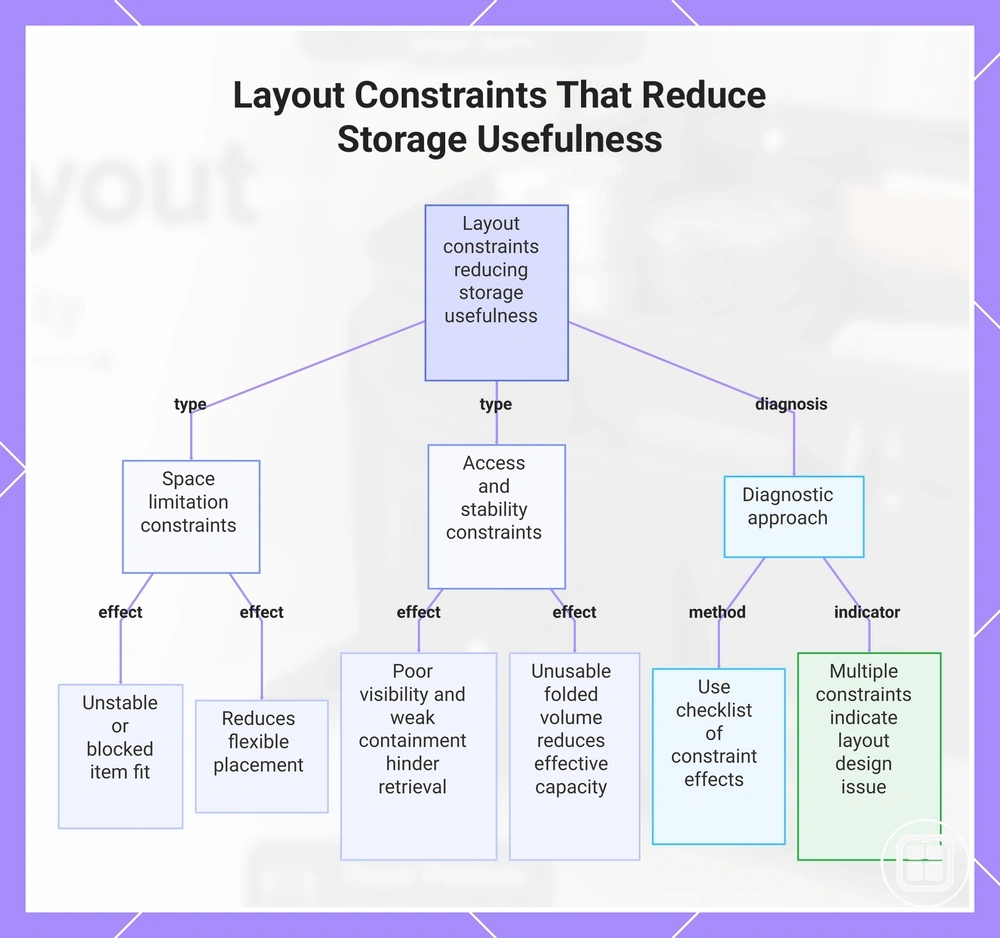
Storage usefulness can fail even when a car organizer appears to offer enough space because layout constraints change how compartments behave during real use. These layout constraints affect storage usefulness by limiting how items fit, stay visible, and remain accessible, even when capacity alone seems sufficient. :contentReference[oaicite:0]{index=0}
Storage usefulness is reduced when shallow pockets, narrow dividers, and over-segmentation restrict usable space inside the layout. Shallow pockets limit how securely items sit, narrow dividers reduce usable width for mixed items, and over-segmentation splits space into too many small zones. Together, these layout constraints reduce flexible placement and make storage behavior less efficient despite available capacity alone.
In other cases, poor visibility, weak containment, and unusable folded volume further reduce practical storage performance. Poor visibility hides items behind layered sections, weak containment allows loose movement inside compartments, and unusable folded volume reduces effective space when the structure is collapsed. These conditions often create retrieval difficulty even when the organizer appears spacious at first glance.
To identify whether layout constraints are responsible, storage usefulness can be diagnosed through structured checks that focus on how design affects access and fit. The checklist below clarifies how each constraint translates into practical storage impact rather than general assumptions.
- Constraint: shallow pockets → Likely cause: limited depth → Practical effect: unstable placement → Check: item fit depth
- Constraint: narrow dividers → Likely cause: restricted width → Practical effect: blocked or tight item fit → Check: usable compartment width
- Constraint: over-segmentation → Likely cause: excessive partitioning → Practical effect: reduced flexible storage → Check: number of usable zones
- Constraint: poor visibility → Likely cause: blocked line of sight → Practical effect: delayed retrieval → Check: item visibility paths
- Constraint: weak containment → Likely cause: low structural support → Practical effect: loose item movement → Check: stability during storage
- Constraint: unusable folded volume → Likely cause: collapse limits usable space → Practical effect: reduced effective capacity → Check: usable folded state
When multiple constraints appear together, storage issues are more likely driven by layout design than by capacity alone. Decision signals such as repeated item misplacement, reduced access efficiency, or loss of usable zones indicate that layout constraints are the primary limitation.
Here are product examples that may make comparison easier. Before buying, always review the compatibility criteria, essential features, and product details.
This chart groups layout constraints into space and access categories, and shows diagnostic indicators for identifying layout-driven storage issues.