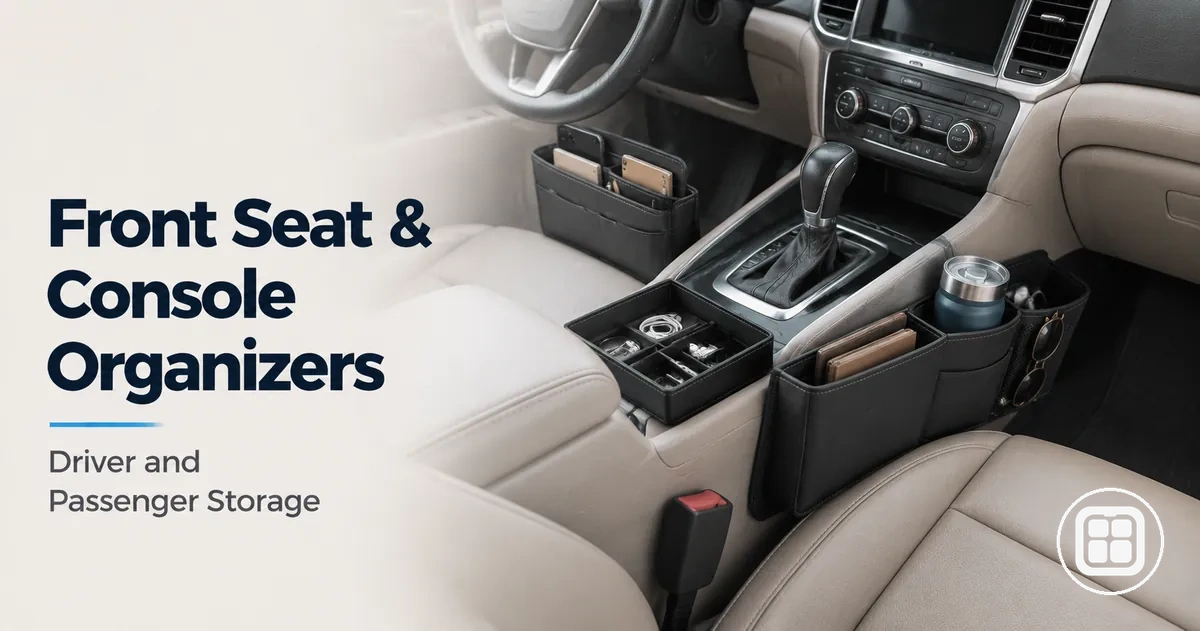
Front seat and console car organizers for front cabin storage
Front seat and console car organizers are storage accessories designed for organizing essential items within the front cabin storage area of a vehicle. They help structure everyday objects around the front seat car organizer and console car organizer positions while maintaining accessible placement for driver and passenger use, including seat gap organizer, between-seat organizer, cup holder organizer, passenger-side storage, and center console fit and access considerations.
In many vehicles, loose items such as phones, keys, and small containers can shift across the front cabin, affecting access and visibility during use. Front seat and console car organizers address this by structuring passenger-side storage and center console areas without extending into trunk or backseat storage contexts, which represent separate placement systems. Back to hub overview
Choosing between different front cabin storage formats depends on fit, access, and how frequently items are used during driving. Seat gap organizer and between-seat organizer configurations typically depend on clearance and movement space, while console car organizer and cup holder organizer options depend on center console structure and access reach for both driver and passenger.
Understanding these differences helps align storage needs with specific front cabin zones such as passenger-side storage, center console, and cup holder access points. The next step is evaluating how each placement affects usability, stability, and item accessibility based on vehicle layout.
What front seat and console car organizers solve inside the cabin
Front seat and console car organizers are storage accessories that keep frequently used loose items arranged and accessible within the driver area and passenger area of a vehicle’s front cabin storage space. They support small-item storage by reducing clutter around reach zones such as the center console and seat-side areas, where visibility and movement control can be affected during driving. These front cabin organizers are used specifically for keeping essential items within easy access rather than scattered across surfaces.

The main purpose of these storage solutions is to manage loose items that commonly shift inside the front cabin and interfere with organized access. Phones, keys, bottles, documents, charging accessories, wallets, sunglasses, and small bags often contribute to clutter when placed without structured storage, especially near the driver area and passenger area. When placed correctly, these organizers can help reduce clutter and may improve visibility and movement control during use.
- Phones and charging accessories kept within reach of the center console
- Keys and wallets stored to reduce clutter near seating areas
- Bottles and cups stabilized in cup holder zones
- Documents and small papers kept visible but contained
- Small bags positioned to avoid shifting during movement
This page focuses only on front cabin storage use cases and excludes trunk or backseat storage contexts, which represent separate placement systems.
Front cabin organizer types by placement
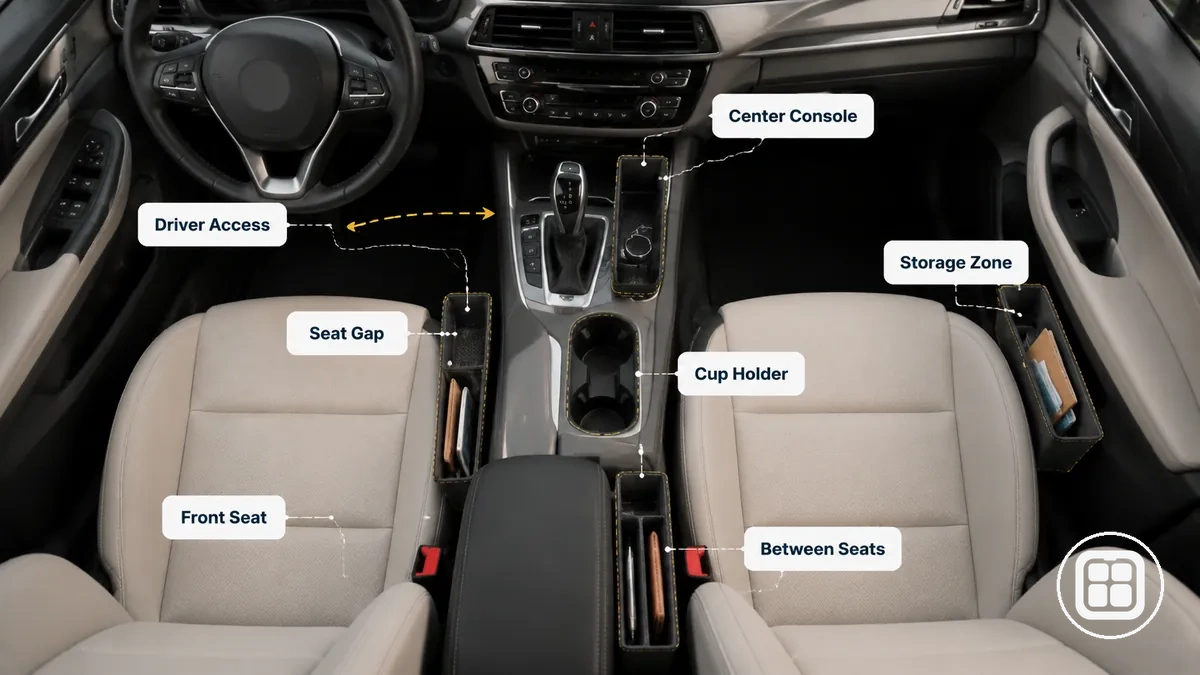
Front cabin organizer types are structured by placement, meaning each front cabin organizer type is defined by where it sits inside the vehicle’s front cabin storage area and how it supports access for driver and passenger use. A front seat organizer, console organizer, seat gap organizer, between-seat organizer, and cup holder organizer each follow an EAV pattern where type determines location, location determines accessibility conditions, and fit depends on available cabin space. This placement-based structure helps separate how each format behaves inside the driver area and passenger area, where placement determines access and fit checks.
Understanding front cabin organizer types by placement requires mapping each organizer format to its typical location and the storage role it supports before evaluating fit differences. The table below organizes front seat organizer, console organizer, seat gap organizer, between-seat organizer, and cup holder organizer into placement-based categories, separating how each one functions without ranking or preference logic.
The following diagram illustrates front cabin organizer types by placement and shows where each format sits inside the cabin. It highlights the relationship between seat zones, console area, and storage positions for clearer spatial understanding.
| Placement type | Typical location | Common stored items | Main fit concern |
|---|---|---|---|
| Front seat organizer | Driver or passenger seat side | Phones, small bags, documents | Seat clearance and reach space |
| Console organizer | Center console / armrest area | Keys, charging accessories, wallets | Console shape and access space |
| Seat gap organizer | Gap between seat and console | Small items, cards, phones | Narrow space width and movement |
| Between-seat organizer | Between driver and passenger seats | Bags, devices, mixed small items | Stability during seat movement |
| Cup holder organizer | Cup holder zone | Bottles, cups, compact items | Cup diameter and holder depth |
This placement view clarifies how each front cabin organizer type fits into specific interior zones before exploring broader category variations. Explore other types based on different vehicle placement structures.
Front seat organizers for passenger-side storage
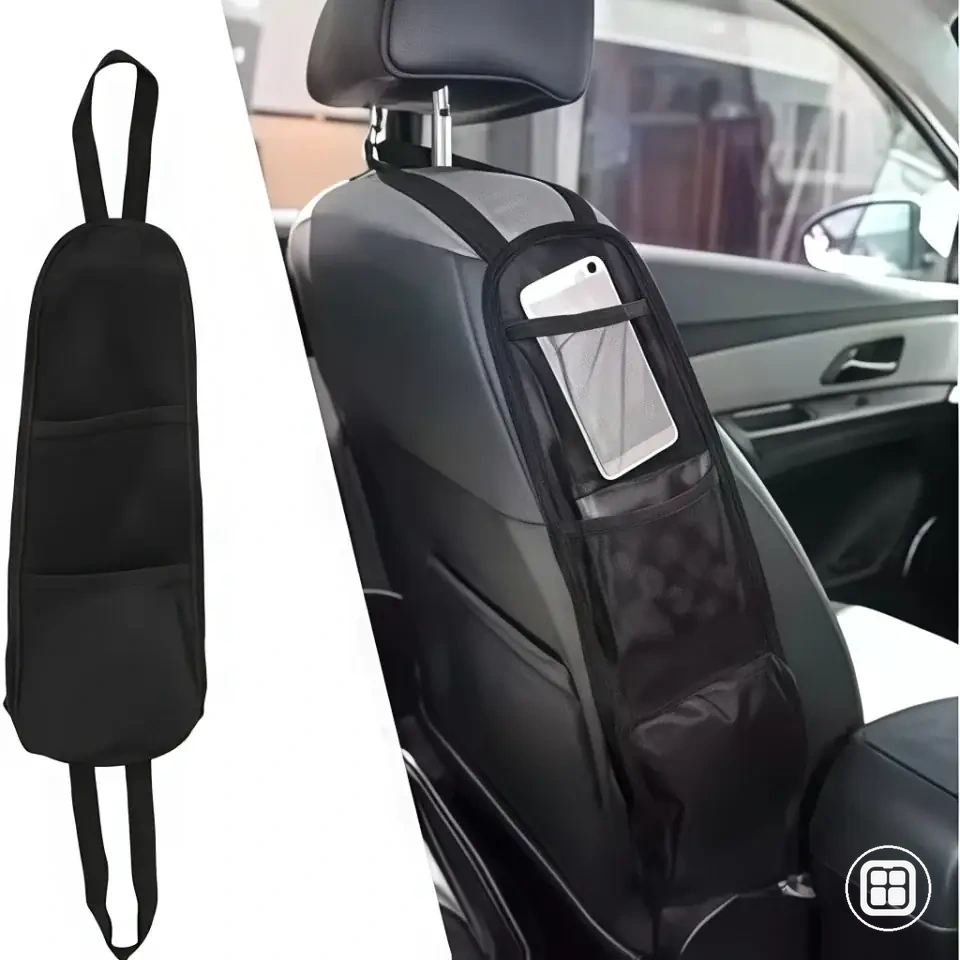
Front seat organizer on the passenger-side storage area positions small items within reach of the passenger seat while keeping the driver area visually clear. This passenger-side storage setup uses available front seat space to separate frequently accessed items from shared console areas, with visibility and reach shaped by how close the passenger seat is to the center cabin zone.
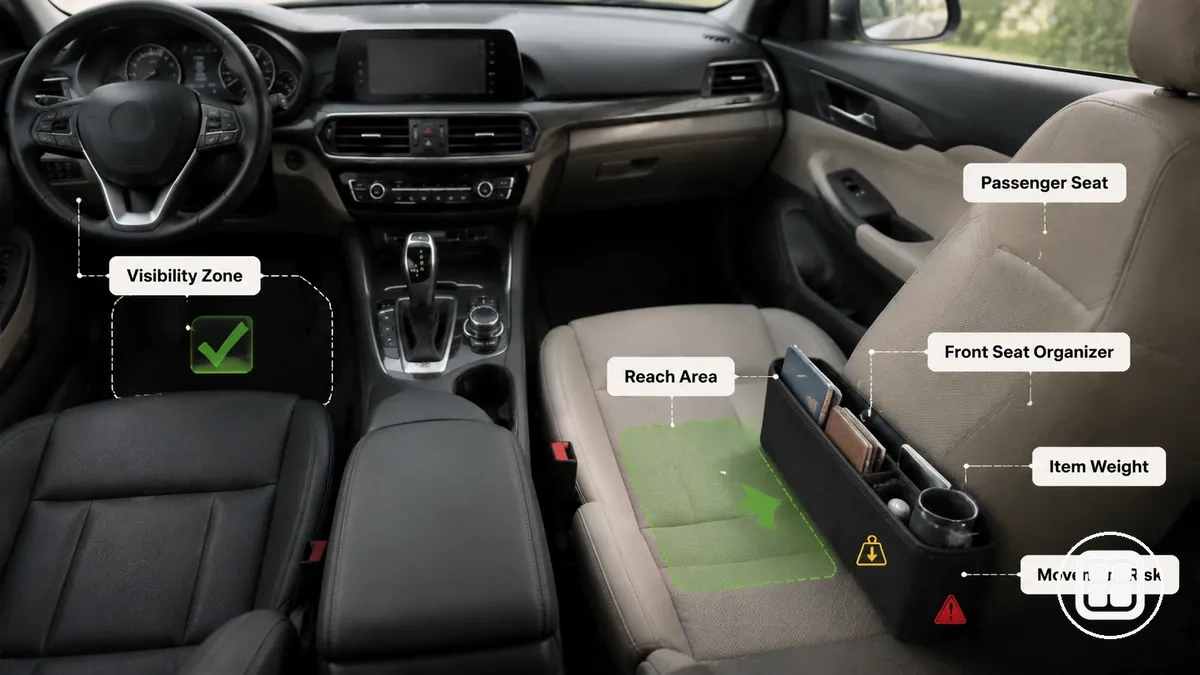
Passenger-side storage in a front seat organizer depends on passenger seat availability, item weight, access frequency, and movement risk during travel. Lighter items with frequent access are typically easier to manage, while heavier items or loosely placed bags may increase movement risk depending on how the seat is used during a trip.
Center console organizers for shared cabin access
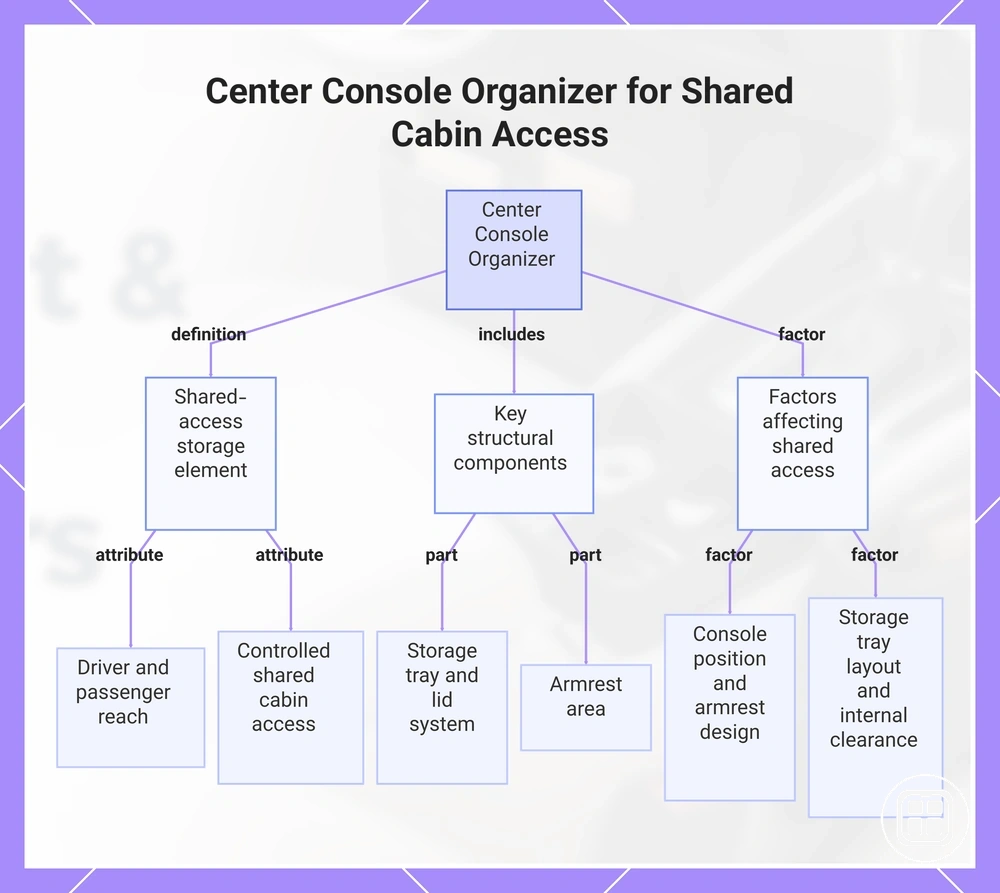
A center console organizer is a shared-access storage element placed in the console position, allowing both driver reach and passenger reach to access items stored within the armrest area. It defines storage around a storage tray structure and lid access system that sits between the front seats, enabling controlled shared cabin access without separating usage between driver and passenger sides.
Shared cabin access depends on console position, armrest design, and storage tray layout, since these factors influence how the center console organizer behaves during use. In many cases, items such as keys, charging cables, and small essentials are placed near the armrest for quick access from both seats, while lid access or internal tray partitions may affect how easily the space is shared. Fit and access conditions vary with console shape and internal clearance, so shared reach is not identical across all vehicle layouts.
This chart explains the definition, key structural components, and factors that influence shared cabin access for a center console organizer.
Seat gap and between-seat organizers for narrow spaces
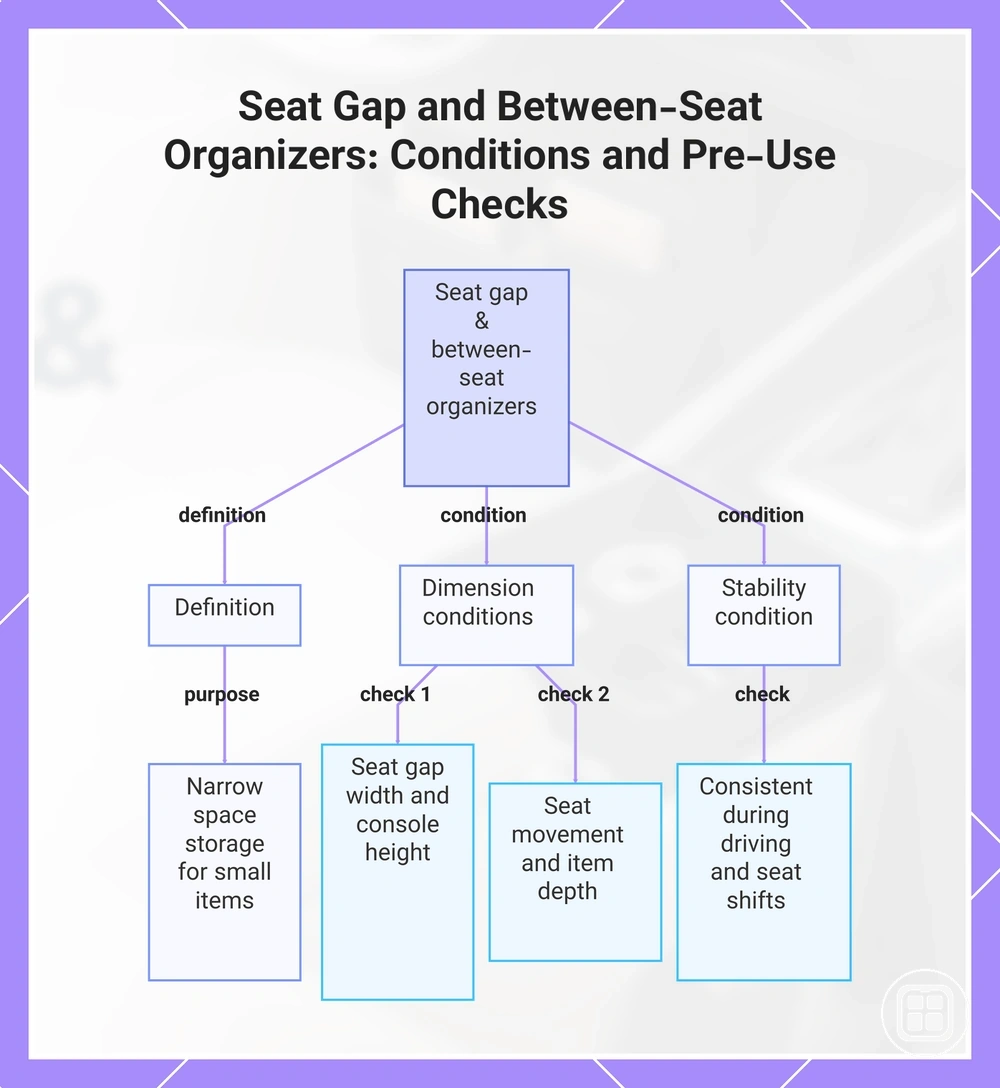
Seat gap organizer and between-seat organizer refer to narrow space storage formats that use the area beside the seat gap or between front seats to hold small items within limited clearance zones. These organizers depend on narrow space conditions where seat gap width, console height, seat movement, and item depth determine how the storage fits and functions, while stability affects whether items remain positioned during use.
Seat gap and between-seat organizers depend on narrow-space conditions such as the following checks before use:
- Seat gap width must allow placement without forcing or obstructing seat rails
- Console height should not prevent proper alignment with the organizer body
- Seat movement should not compress or displace the organizer during adjustment
- Item depth must match available narrow space to avoid obstruction or tilt
- Stability should remain consistent during driving conditions and seat shifts
This chart shows the definition of seat gap and between-seat organizers and the key conditions and checks to verify before use.
Cup holder organizers for small-item access
A cup holder organizer is a compact storage format that uses existing cup holder space to support small-item access within the front cabin. Cup holder diameter and usable depth determine how the organizer fits, while item stability, drink access, and driver reach define how usable the space remains during driving. This setup supports limited storage rather than replacing broader console or seat-based organizers.
When a cup holder is shallow, narrow, or positioned close to controls, small-item access may become restricted and drink access can be partially affected depending on placement. In such cases, a cup holder organizer is often used to separate light essentials while maintaining basic accessibility.
- Phone placement for quick small-item access
- Keys positioned for short driver reach
- Coins stored for limited movement inside the holder
- Cards or small items kept stable during driving
- Light bottles or cups depending on cup holder diameter and depth
Cup holder organizer suitability varies by cup holder diameter, usable depth, and interior position within the console area. :contentReference[oaicite:0]{index=0}
Storage features that matter near the driver and passenger
Storage features near the driver and passenger are evaluated based on how they support access, containment, and item type within the front cabin. Storage features such as pockets, dividers, cup holders, phone slots, document sections, zippers, straps, anti-slip surfaces, and open-access compartments each influence how quickly items can be reached and how securely they remain in place during use. These features work through an EAV logic where feature design affects item separation, accessibility, and movement control, and usefulness depends on item type and access need.
These storage features can be grouped into essential features and optional features based on how frequently they are used and how much control or containment they provide. The table below separates these features by purpose and usage condition, helping distinguish essential features from optional features based on access priority and item handling needs.
| Feature | Helps with | Useful when | Watch out for |
|---|---|---|---|
| Pockets | Small-item containment | Loose items need separation near seats | Overfilling can reduce access speed |
| Dividers | Item separation | Multiple items require structured spacing | Can limit flexible storage space |
| Cup holders | Drink and small-item placement | Frequent drink or small item access is needed | May restrict space for larger items |
| Phone slots | Quick device access | Navigation or calls require easy reach | Size limits device compatibility |
| Document sections | Paper organization | Documents must stay flat and accessible | Bulky storage reduces flexibility |
| Zippers | Secure closure | Items need containment during movement | Slower access compared to open storage |
| Straps | Placement stability | Organizer must stay fixed during movement | Improper tension may reduce stability |
| Anti-slip surfaces | Movement resistance | Items tend to shift during driving | Effectiveness varies by surface material |
| Open-access compartments | Fast retrieval | Frequent access is prioritized over security | Less protection for loose items |
| Closures | Securing items | Items need protection during movement | Can slow access speed |
Pockets, compartments, holders, and quick-access sections
Pockets, compartments, holders, and quick-access sections define how separation, visibility, and retrieval speed are controlled inside front cabin storage layouts. These elements influence how items are distributed through pocket depth, compartment count, holder shape, and whether access is open or closed, which directly affects how quickly items can be located and retrieved during use.
- Pockets: Pocket depth controls how items are separated and how quickly small items can be retrieved from seat-side storage zones.
- Compartments: Compartment count influences item separation and visibility, especially when multiple small items need structured placement.
- Holders: Holder shape affects how items such as phones or bottles fit and how easily they can be accessed from driver or passenger reach.
- Quick-access sections: Open or closed access determines retrieval speed and the balance between convenience and item protection during movement.
Phone, keys, bottles, documents, and daily carry storage
Phones, keys, bottles, documents, wallet, charger, and sunglasses in the front cabin require different storage behavior because each item varies in size, access frequency, and containment need. These differences affect how they are placed within pockets, compartments, holders, and quick-access sections in daily carry storage. As a result, item type changes the storage requirement rather than relying on a single uniform layout.
The mapping below shows how common daily carry items relate to storage needs and movement considerations inside the front cabin.
- Phone → high access frequency and visibility need → phone slots or quick-access sections → may shift if not secured during movement
- Keys → small-item containment requirement → compact pockets → can create noise or scratch risk if loosely placed
- Bottles → stability and upright holding need → cup holders → may tilt depending on holder shape and driving movement
- Documents → flat storage and visibility requirement → document sections → may bend if placed in open compartments
- Wallet → compact containment need → pockets with sufficient depth → may shift if storage is too open
- Charger → cable organization and separation need → structured compartments → may tangle without defined routing
- Sunglasses → protection and quick access need → closed or padded holders → may scratch if placed in open sections
Fit and clearance conditions for front seat and console organizers
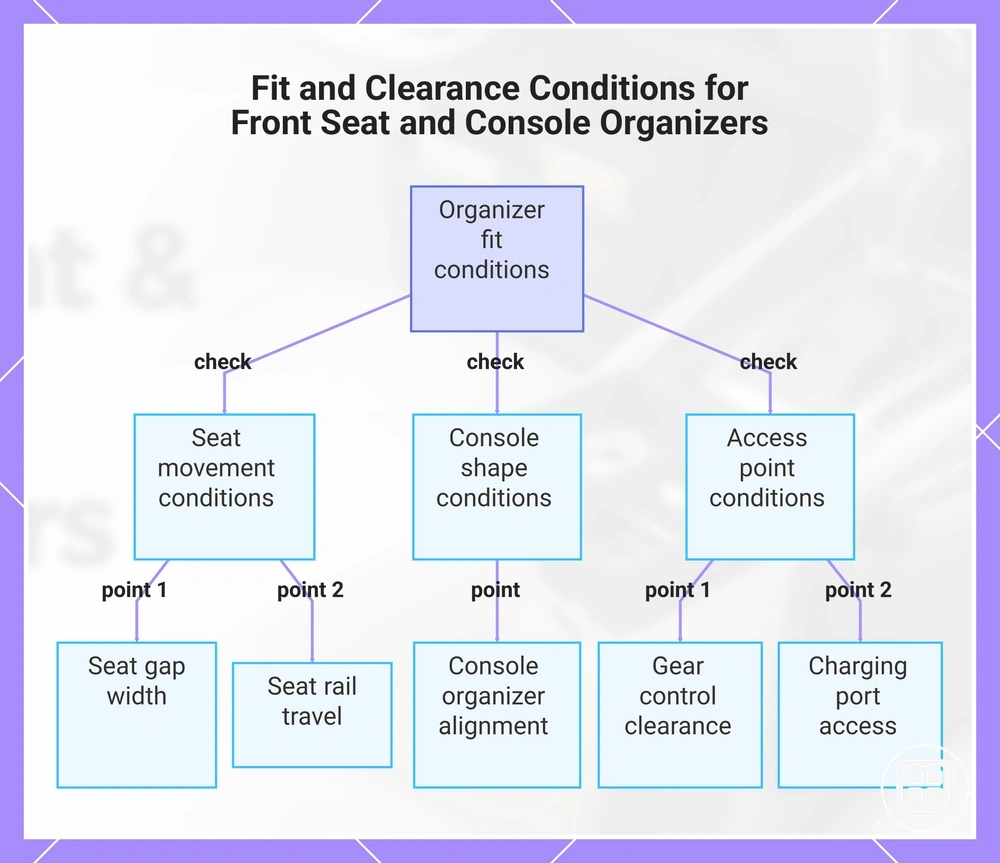
Fit for a front seat organizer or console organizer depends on usable cabin space rather than simple placement, and it varies across vehicle model, trim, cabin layout, and organizer design. Clearance conditions around seat movement, console shape, and access points determine whether the organizer can sit without blocking front seat organizer or console organizer usability. Fit and clearance must therefore be evaluated as conditional rather than universal compatibility.
Before selecting a front seat organizer or console organizer, a fit check should focus on how cabin space supports movement and access. The checklist below verifies seat movement, console shape, and access points, since these factors directly affect usability within the cabin space and can influence control access and comfort.
- Seat gap width → cabin space condition → determines whether front seat organizer placement avoids obstruction → affects seat movement usability
- Seat movement (rail travel) → clearance condition → checks whether seat movement is preserved → prevents interference during adjustment
- Console shape → fit attribute → evaluates console organizer alignment → impacts stability and placement accuracy
- Armrest clearance → access condition → ensures usable space around armrest → supports uninterrupted arm movement
- Cup holder access → usability condition → checks whether access remains open → affects drink placement functionality
- Charging port access → clearance condition → verifies access remains unobstructed → maintains device usability
- Gear control clearance → safety outcome condition → ensures no interference near controls → preserves driving operation space
This chart shows the key fit and clearance conditions to verify when selecting a front seat or console organizer, grouped by seat movement, console shape, and access points.
Console shape, seat gap width, and front cabin space
Console shape, seat gap width, and front cabin space determine whether a console organizer sits correctly and how stable it remains during use. Fit is shaped by these physical constraints, so console shape, seat gap width, and available cabin space must be measured and inspected against the specific vehicle configuration rather than assumed as uniform. This makes sizing a vehicle-specific condition rather than a fixed standard.
The checklist below organizes what to measure or inspect to evaluate sizing accuracy and placement suitability within the front cabin.
- Console shape → inspect structural form → determines whether the console organizer aligns without forced placement or instability
- Seat gap width → measure physical gap size → affects whether a front seat organizer fits without compression or obstruction
- Front cabin space → inspect overall usable clearance → determines whether there is enough room for stable placement
- Seat height difference → compare seat and console levels → affects alignment and positioning stability during use
- Cabin floor obstruction → inspect floor area elements → determines whether placement is blocked or uneven
- Side clearance → measure lateral space → affects whether movement or access becomes restricted after installation
Armrest, gear control, charging port, and cup holder access
Armrest, gear control, charging port, and cup holder access determine whether a front cabin organizer preserves usable interaction with key cabin controls after placement. Even when a front seat or console organizer fits physically, blocked access to these points can reduce usability depending on how the organizer sits within the cabin layout, so physical fit is not enough if access is blocked.
The checklist below helps identify blocked access risks after placement and focuses on how nearby controls and access points remain usable in real conditions.
- Armrest → check opening range → ensure armrest movement is not restricted by organizer position or blocked access
- Gear control → inspect shift movement → confirm gear selector is not partially blocked during operation due to placement
- Charging port → verify cable access → ensure ports remain reachable without bending, strain, or blocked access
- Cup holder access → check drink placement → confirm cup insertion and removal is not restricted by organizer position
- Handbrake → inspect engagement space → ensure handbrake movement is not obstructed by nearby storage placement
- Seatbelt buckle → verify latch access → ensure buckle remains reachable and not hidden or pressed by the organizer
- Control reach → check cabin controls → confirm climate and infotainment controls remain reachable without interference
Front seat organizer vs console organizer vs seat gap organizer
Front seat organizer vs console organizer vs seat gap organizer depends on the storage problem and cabin layout rather than a universal performance advantage. Each format is defined by a different placement and access style, which changes how it supports daily items inside the front cabin. The better option depends on where clutter builds up and how the cabin space is structured.
The comparison below organizes front seat organizer, console organizer, and seat gap organizer by placement, best use case, space needed, access style, and main limitation. The table focuses on how each storage type behaves under different conditions rather than ranking one as superior, since use-case needs vary by vehicle layout and access requirement.
| Format | Placement | Best use case | Space needed | Main limitation |
|---|---|---|---|---|
| Front seat organizer | Passenger-side seat area | Frequent access to small items and visible storage near seat | Moderate seat-side clearance | May reduce legroom or side movement space |
| Console organizer | Center console / armrest area | Shared access for driver and passenger essentials | Fits within console cavity | Can limit access to armrest or internal console space |
| Seat gap organizer | Gap between seat and console | Preventing dropped items and using narrow space | Minimal gap width required | Limited storage capacity and tight fit dependency |
How to choose a front seat or console car organizer
Choosing a front seat organizer or console car organizer depends on clutter location, cabin space, access frequency, passenger use, control clearance, storage capacity, and stability. The right selection is based on how these conditions match the vehicle layout and daily storage behavior rather than a fixed preference.
Clutter location determines whether storage is needed beside the passenger seat or within the center console area, since each placement option supports different access styles. Items that gather near seating edges often suit a front seat organizer, while shared-access items align more with a console car organizer, making placement the first selection cue.
Fit, control clearance, and passenger use shape whether the organizer remains practical after installation. A tight cabin space may limit placement options, while insufficient control clearance can restrict armrest or console usability, and passenger use may influence how shared the storage needs are. Selection depends on maintaining usable space and stable positioning under real driving conditions.
The checklist below turns selection needs into practical checks before reviewing any product options. These checks help translate storage requirements into clear evaluation points aligned with cabin layout and usage conditions.
- Clutter location → identify where items accumulate → matches front seat or console placement → determines primary organizer type
- Access frequency → check how often items are used → high frequency requires easier reach → influences placement choice
- Cabin space → evaluate available interior clearance → limited space restricts larger organizers → affects fit outcome
- Control clearance → verify armrest and console movement space → obstruction indicates poor compatibility → affects usability
- Passenger use → assess shared vs individual access → shared use favors console layout → shapes selection direction
- Storage capacity → estimate item volume → higher volume needs structured compartments → determines organizer size
- Stability → check movement during driving → unstable placement reduces practicality → affects final suitability
Commuters, small car users, shared front-seat setups, and users carrying many small items may require different priorities based on daily usage patterns. Selection depends on aligning these scenarios with clutter location, cabin space, access frequency, and control clearance.
Here are product examples that may make comparison easier. Before buying, always review the compatibility criteria, essential features, and product details.
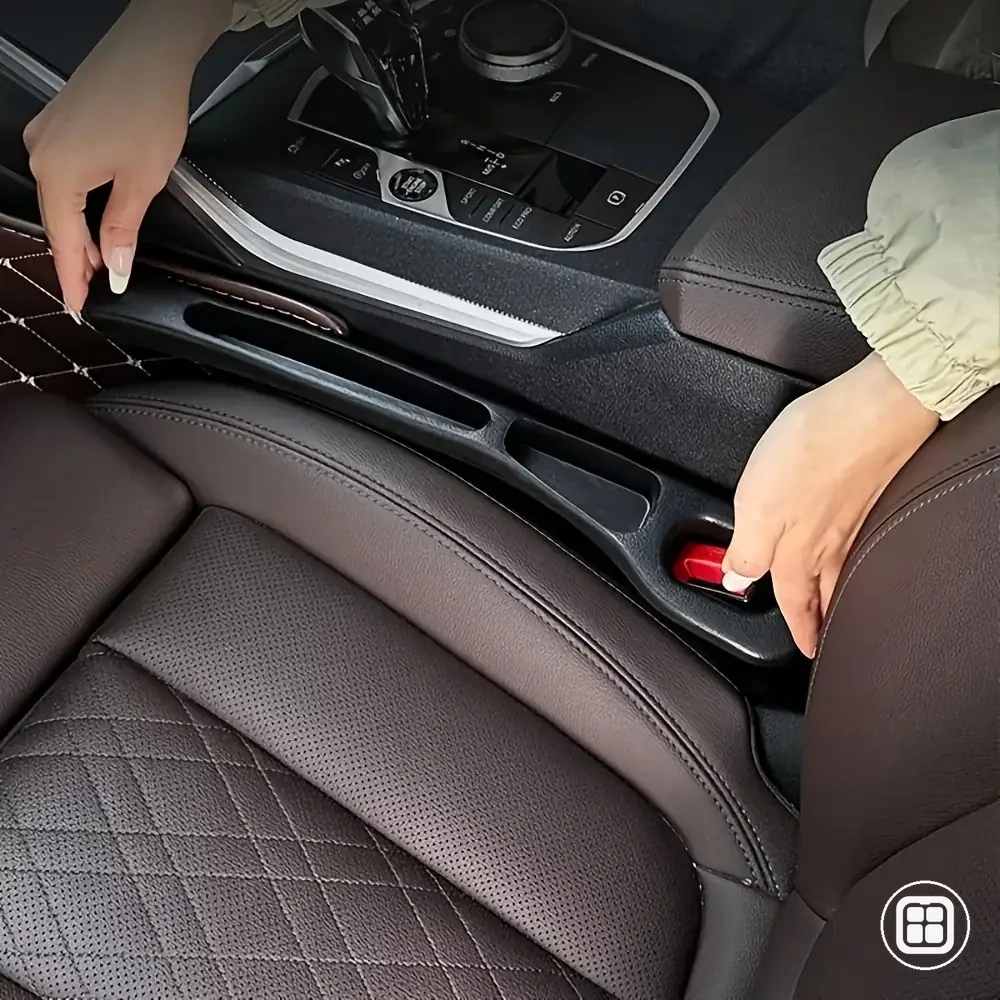
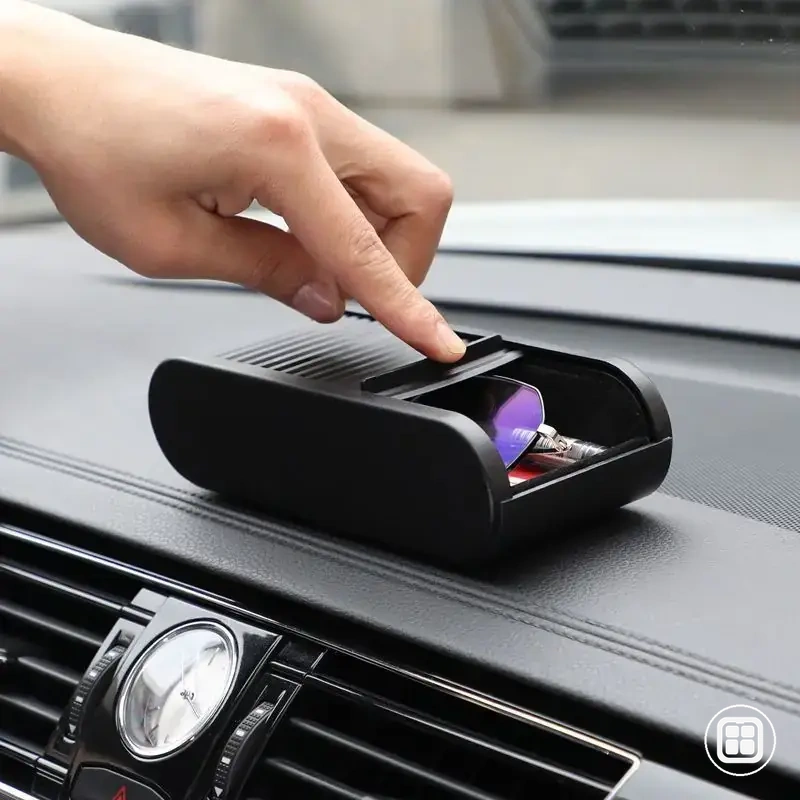
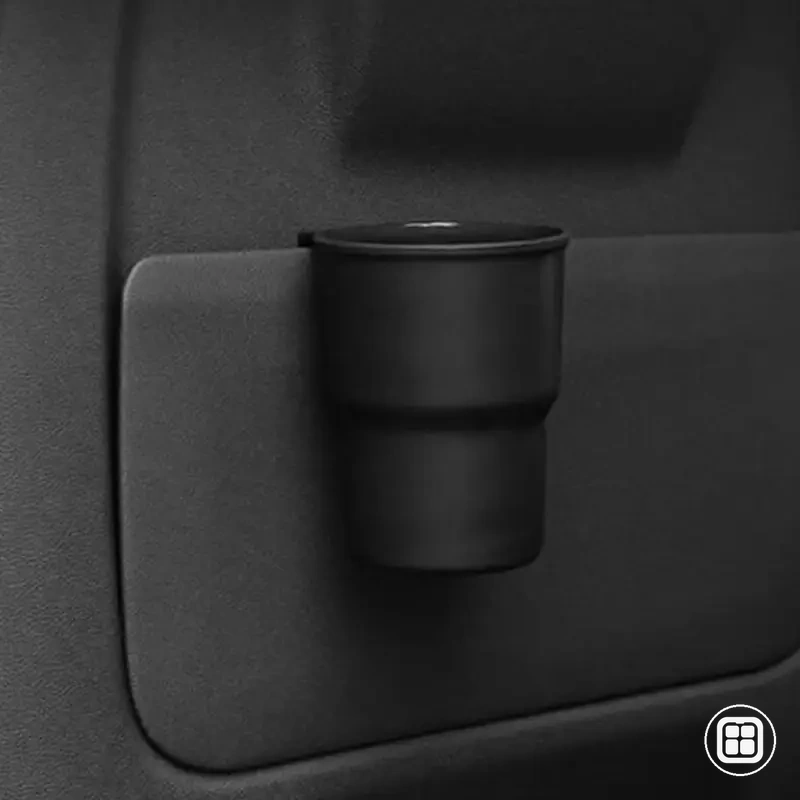
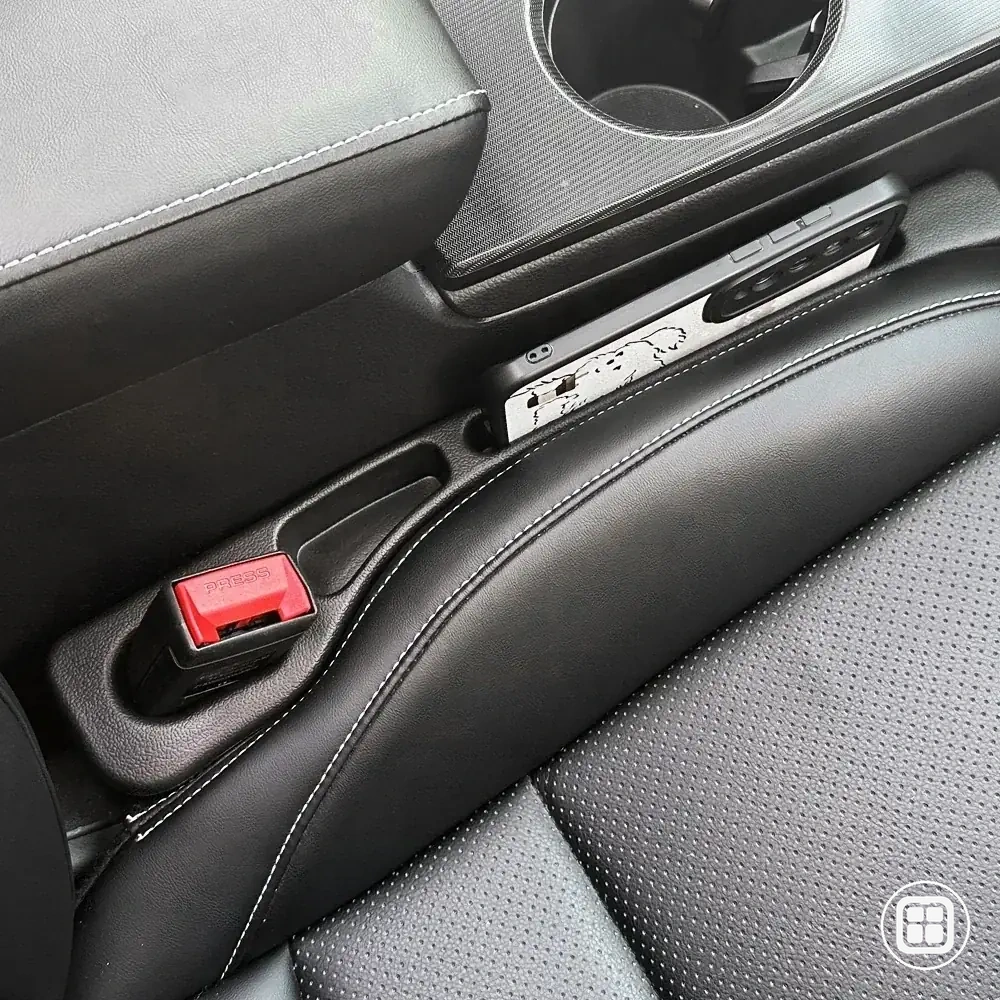
This chart shows the key checks for selecting the right car organizer based on placement, space, and usage factors.
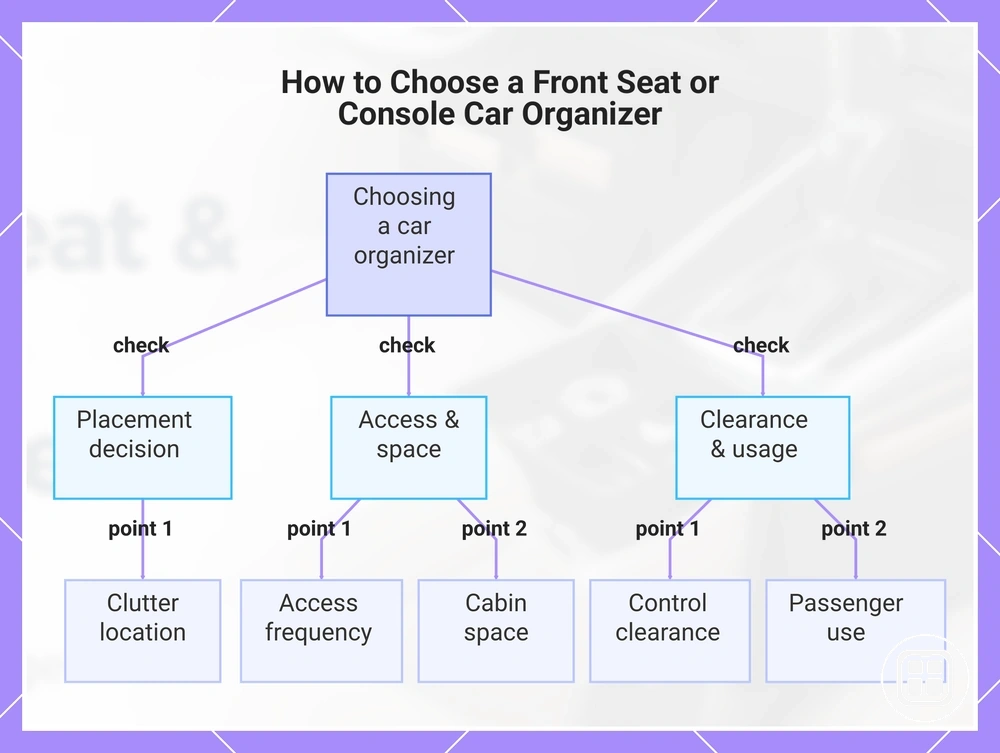
Choose by clutter location and access frequency
Choosing by clutter location and access frequency narrows the front seat organizer or console car organizer decision by matching where items collect and how often they are reached. Clutter location defines where storage demand builds, while access frequency defines how quickly items must be reached during daily use. This separation helps distinguish frequent-access items from occasional storage needs based on real usage patterns.
The list below maps clutter location and access frequency to likely organizer format after one lead-in sentence that links location-based clutter patterns with organizer selection.
- Dashboard-adjacent items → clutter location near front controls → typically align with console car organizer → when access frequency is high and short-reach is needed
- Passenger-side clutter → clutter location near seat edge → typically align with front seat organizer → when access frequency is moderate to frequent and side reach is preferred
- Console clutter → clutter location in central cabin area → typically align with console car organizer → when shared access between driver and passenger is required
- Dropped items near seat gap → clutter location in narrow space zones → typically align with seat gap organizer → when access frequency is occasional but retrieval must be fast
- Small items needing frequent reach → clutter location varies across cabin touchpoints → may align with either front seat organizer or console car organizer → when access frequency is high and repeated reach cycles are needed
Choose by passenger use, driver reach, and cabin movement
Choosing by passenger use, driver reach, and cabin movement narrows the organizer decision by evaluating how people interact with the front cabin during real driving conditions. Passenger use defines whether storage must support a seated passenger’s legroom and access, while driver reach defines how quickly items can be accessed without overextending. Cabin movement includes entry and exit behavior as well as seat movement, which together determine whether an organizer format stays practical during everyday use.
Passenger use directly affects how much passenger legroom and shared access can be preserved, especially when a front seat or console organizer sits near seating edges. Driver reach influences whether items remain usable without interrupting steering or armrest use, while cabin movement determines whether the setup interferes with entry and exit flow. In shared-use scenarios, the balance between driver reach and passenger use becomes more important, while movement constraints decide final suitability.
- Driver-only use → prioritize driver reach → console or nearby placement → when passenger use is minimal and cabin movement is unaffected
- Shared front-seat use → balance passenger use and driver reach → console car organizer → when shared access and armrest use are both required
- Frequent passenger use → prioritize passenger legroom → front seat organizer → when side access is preferred and entry and exit must remain clear
Practical use and secure placement in the front cabin
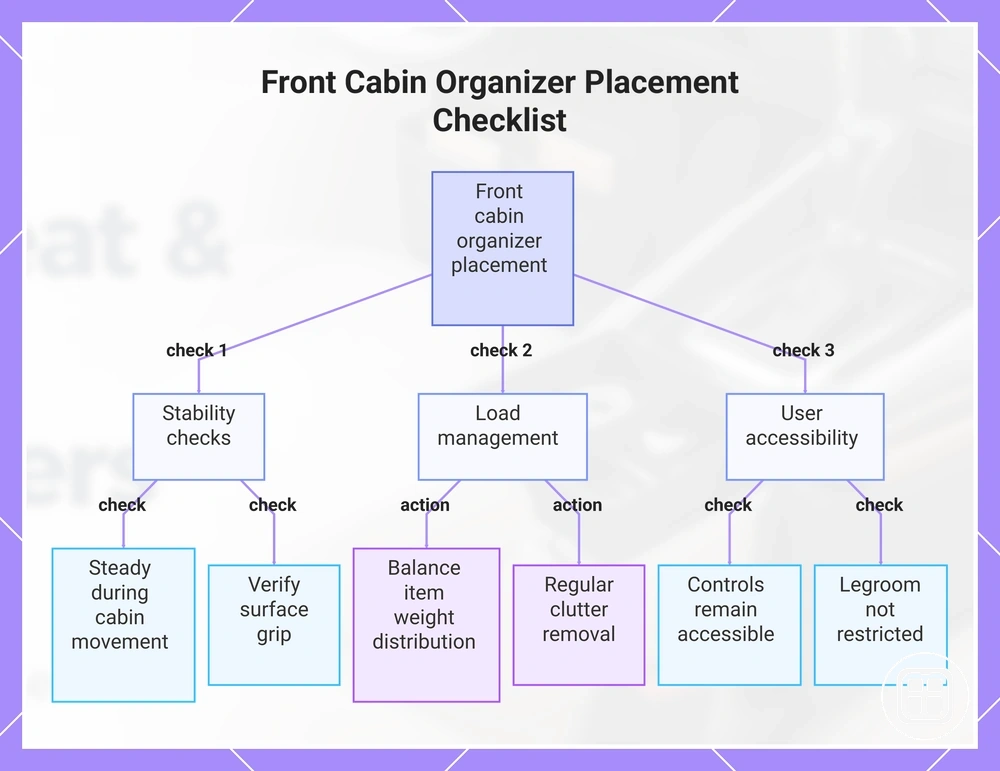
Practical use and secure placement of a front cabin organizer depends on cabin layout, item load, and how stable positioning interacts with everyday movement inside the vehicle. A front cabin organizer may shift in behavior when item weight distribution is uneven or when non-slip contact is weak across the placement surface. In real usage, secure placement depends on layout and item load rather than a fixed configuration.
The checklist below organizes practical use actions after selection, focusing on stable positioning, access, and daily maintenance. It stays within front cabin use and avoids installation-level or troubleshooting guidance.
- Stable positioning → check whether the front cabin organizer remains steady during normal cabin movement → helps maintain consistent everyday use behavior
- Item weight distribution → place heavier items in balanced compartments → reduces shifting caused by uneven load during driving
- Non-slip contact → verify surface grip between organizer and console or seat area → supports more stable placement under movement conditions
- Control access → ensure gear controls, cup holders, and charging ports remain reachable → preserves functional usability during driving
- Passenger comfort → confirm passenger legroom is not restricted → supports shared front cabin use without limiting movement
- Clutter removal → regularly remove unnecessary items → helps maintain visibility and reduces excess load inside the organizer
This chart shows the main checks and actions for stable and practical placement of a front cabin organizer in the vehicle.