
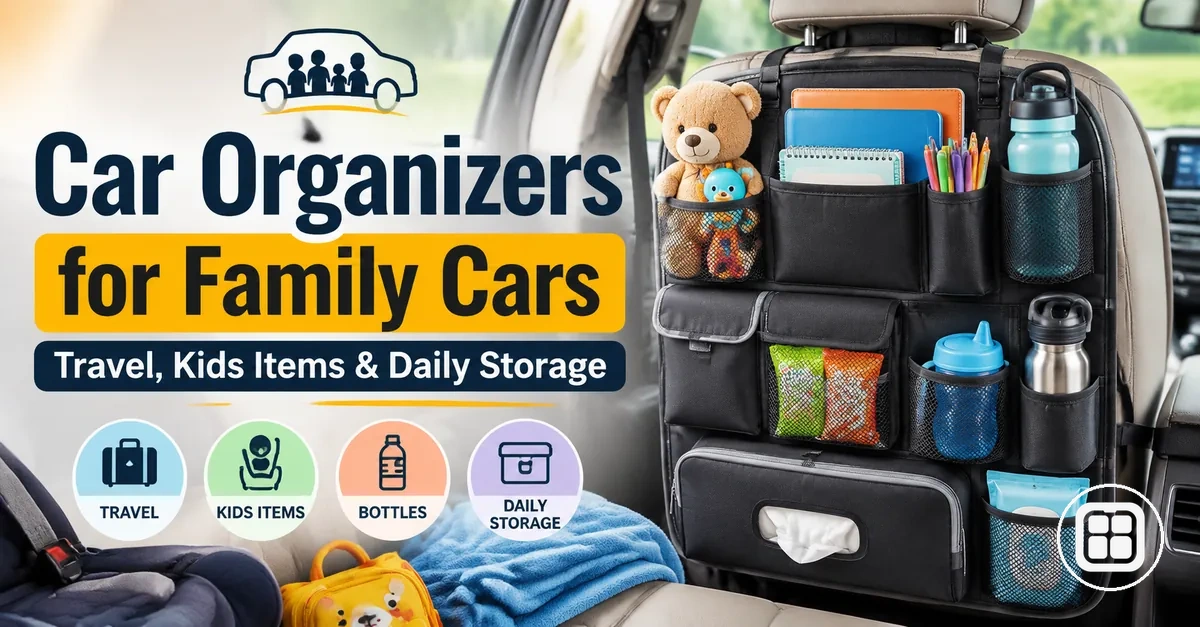
Car Organizers for Family Cars
Car organizers for family cars are storage systems designed to manage everyday items such as kids’ toys, snacks, bottles, wipes, and travel essentials inside a shared vehicle space. They help reduce scattered clutter by creating structured storage across areas like the backseat, trunk, and cabin zones. In this context, family car organization becomes a practical decision problem shaped by how items are stored, accessed, and separated during daily routines and travel use.
The decision around family car organizers depends on how placement, storage capacity, compartments, and access control interact with real family needs. Backseat setups often support child access for small items, while trunk storage typically handles larger or less frequently used items. Front-seat or console areas may serve parent essentials that require controlled reach. These choices usually vary by family routine, passenger age, and how much clutter builds up in different parts of the vehicle.
This page supports understanding how family storage needs translate into organizer selection without focusing on individual products. It focuses on how different usage conditions inside a family car influence what type of storage approach may be suitable in each situation. The goal is to provide a clear framework for evaluating storage behavior before moving into more detailed sections on placement, features, and usage patterns.
Family car organizers can be understood as part of a broader vehicle storage system where function depends on how well items are separated and accessed rather than how many features are included. This foundation helps guide the next sections, which explore specific storage needs and how they shape practical organization decisions inside everyday family vehicles.
Family storage needs a car organizer should solve
Family storage needs a car organizer should solve refer to the core in-vehicle storage demands created by kids, daily items, and shared travel essentials inside a family car. These needs focus on how storage, access, and separation reduce clutter across the backseat, trunk, and cabin areas. Family car organizers help structure how items like snacks, bottles, toys, and wipes are stored so access stays manageable and clutter does not spread across the vehicle. These organizers solve access, sorting, and clutter problems.
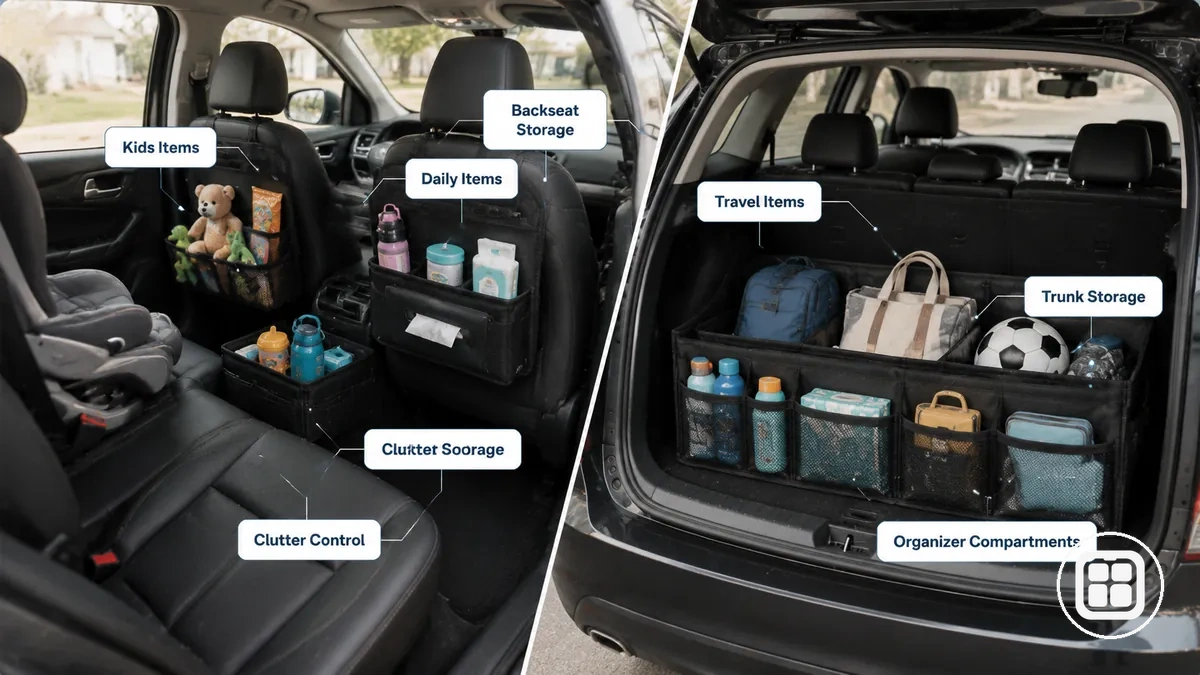
These family storage needs usually differ between daily use and travel conditions. Daily items such as school bags, bottles, and small essentials require frequent access, often from the backseat or front compartments. Travel items like luggage, groceries, or emergency supplies tend to sit in trunk storage where access is less frequent but volume is higher. The right setup depends on passenger needs and item load, so the ideal arrangement may vary by routine and travel frequency.
The following breakdown shows how family storage needs translate into practical organizer requirements for daily and travel use:
- Kids’ items such as toys and snacks require easy access from the backseat to reduce in-vehicle clutter during travel.
- Bottles and wipes need stable compartments to prevent spills and maintain organized reachability during daily routines.
- Daily essentials like small bags and personal items benefit from front-seat or console storage to support quick access.
- Travel supplies including luggage and groceries require trunk-based storage to manage higher volume and reduce cabin crowding.
- Mixed-use compartments help separate daily and travel items to avoid clutter overlap inside the family car.
Daily clutter from kids, bottles, snacks, toys, and small essentials
Short family trips often turn the backseat of a family car into daily clutter from kids items, bottles, snacks, toys, wipes, chargers, and small essentials. These items move between seats and storage areas during the day and quickly create daily clutter when there is no clear storage location. A predictable storage setup inside the car helps reduce this spread and keeps items easier to manage during regular travel.
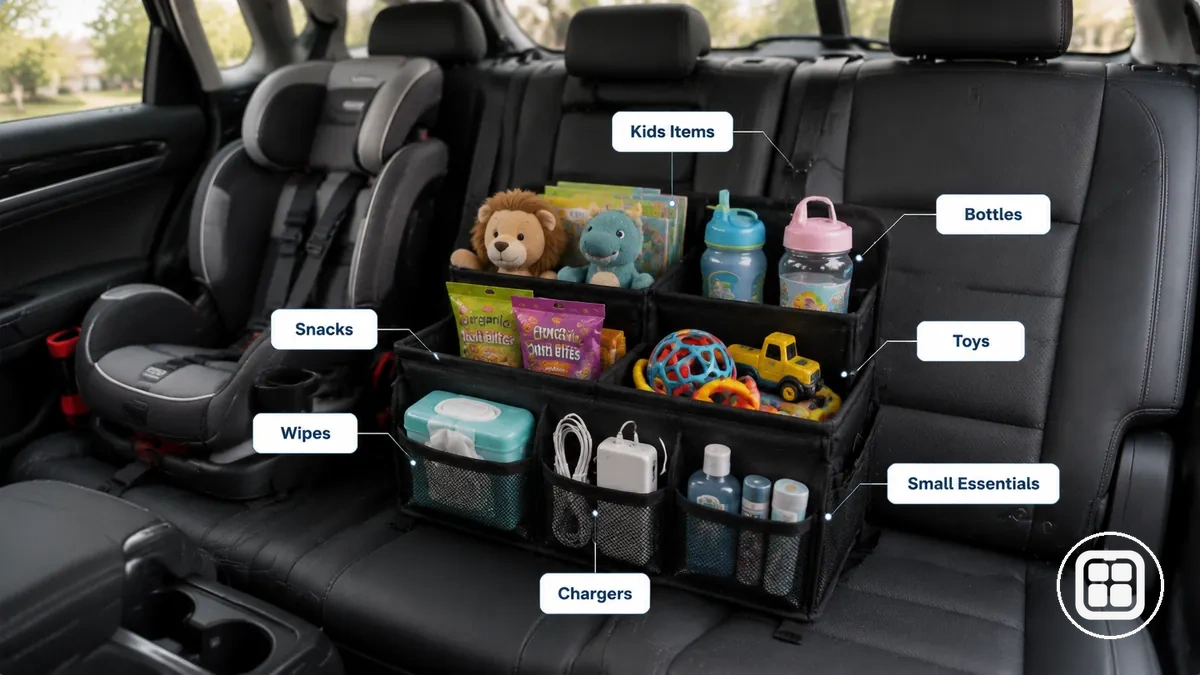
These daily-use items vary in how often they are needed and how quickly they must be accessed during travel. Bottles and snacks usually require fast access, while toys and wipes may stay in side pockets or backseat storage areas for repeated use. Chargers and small essentials often shift between front seat access and shared cabin storage location depending on who uses them. The right storage location depends on item frequency and which passenger needs access during the journey.
The following examples show how daily clutter items relate to access needs and storage location inside a family car:
- Kids items like toys need backseat access to reduce repeated reaching from front seats.
- Bottles require stable cup or pocket storage to reduce movement and spill risk during travel.
- Snacks need quick-access compartments to support frequent use during short trips.
- Wipes benefit from central cabin pockets for easy access by both driver and passengers.
- Chargers and small essentials often fit front-seat or console storage for controlled access.
- Mixed daily clutter can be separated by storage location to reduce overlap and confusion.
Travel storage for bags, groceries, emergency items, and trip supplies
Travel storage for bags, groceries, emergency items, and trip supplies refers to how a family car organizes bulk travel items during family travel instead of everyday use. These travel storage needs depend on trip length, passenger load, and available cargo space inside the vehicle. Items are typically placed in the trunk or cargo space so they remain separated from daily clutter in the cabin and do not interfere with passenger access.
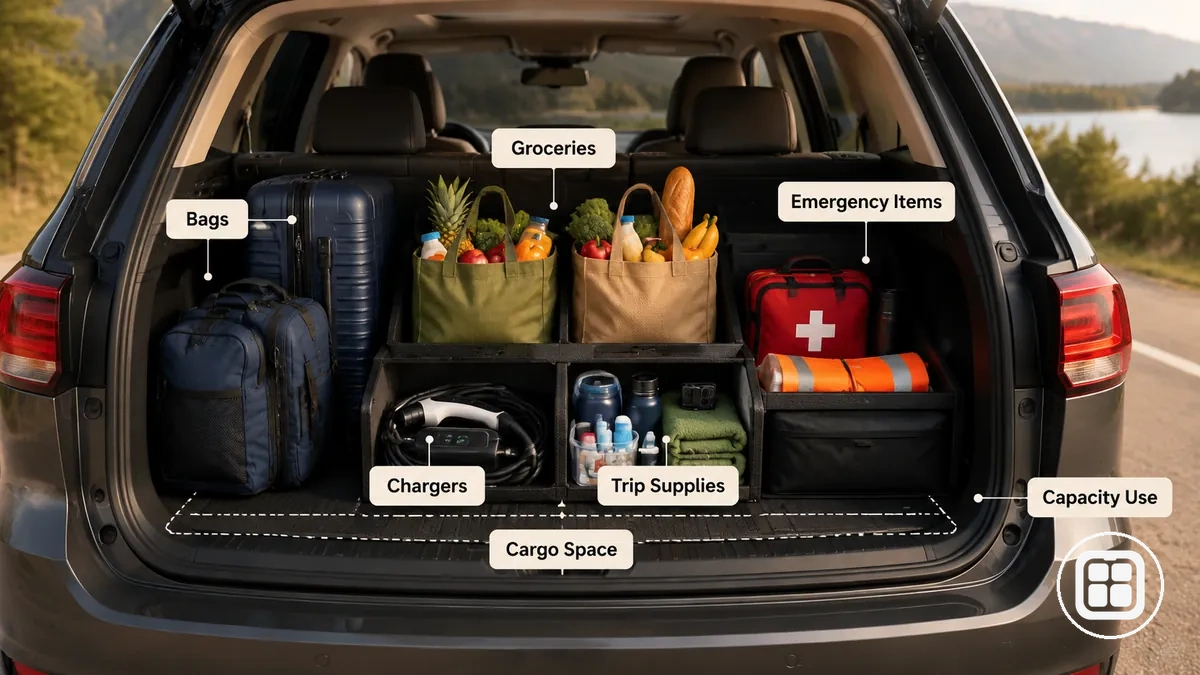
Travel storage changes based on capacity requirements, access timing, and cargo space distribution. Bags and groceries usually need stable placement due to their bulk and shifting risk, while emergency items and chargers require more immediate access during family travel. Trip supplies are often stored deeper in the trunk and accessed mainly after arrival. Longer trips or higher passenger load typically require more separation between items and more controlled stability depending on available space.
The following mini-checklist shows how travel storage items relate to capacity, access, and storage outcomes inside a family car:
- Bags → higher capacity need → stored in trunk → stable placement during movement
- Groceries → medium capacity need → trunk or cargo space → reduced shifting risk
- Emergency items → low to medium capacity → accessible trunk zone → quick access when needed
- Chargers → low capacity need → cabin or front access zone → reachable during travel
- Trip supplies → variable capacity → deeper cargo space → used mainly after arrival
Best placement zones for family car organizers
Placement zones for family car organizers depend on how access, item type, and clutter control needs vary inside a family car. Different placement zones support different usage patterns, especially when multiple passengers share storage space during travel. The most effective placement usually depends on who needs access to the items and how often they are used.
Backseat, trunk, front seat, and console areas each function as distinct storage zones with different access levels and limitations. The backseat often supports children’s items and daily-use objects, while the trunk is used for bulk storage and lower-frequency items. Front seat and console areas are typically reserved for driver or parent essentials that require quick reach. These placement zones work together to balance access, capacity, and clutter control across the vehicle.
The comparison below shows how each placement zone differs based on access, item type, and storage limitation:
| Placement zone | Best family use | Access strength | Main limitation |
|---|---|---|---|
| Backseat | Kids items, snacks, toys | High passenger access | Limited space and crowding risk |
| Trunk | Bags, groceries, bulk items | Low to medium access | Not reachable during driving |
| Front seat | Parent essentials, quick-use items | High driver access | Can create cabin clutter |
| Console | Chargers, small essentials | High immediate access | Very limited storage capacity |
Backseat access for children and rear passengers
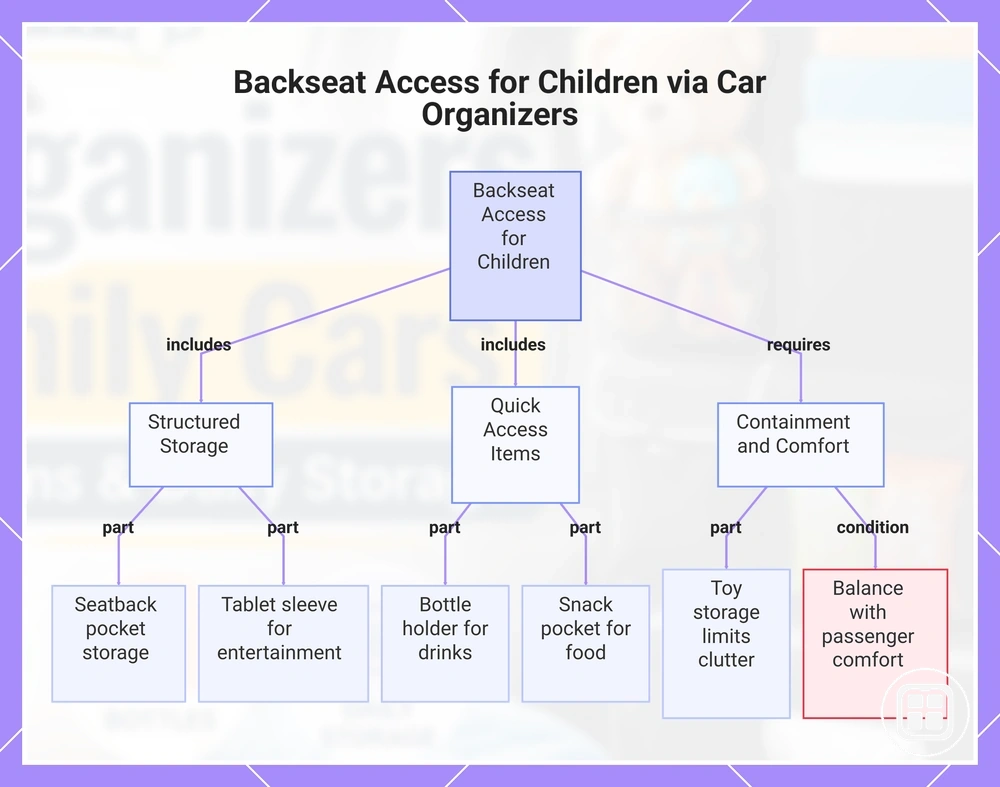
Backseat access for children and rear passengers refers to how family car organizers support reachability from the rear seating area, especially for children and other passengers using the backseat. This access depends on how seatback pockets, tablet sleeves, bottle holders, toy storage, and snack pockets are positioned within reach. Backseat access is useful when children need to reach items without shifting position excessively, and it supports basic clutter control inside the family car.
Seatback pockets and tablet sleeves usually support structured storage for rear passengers, allowing children to access entertainment and small items within reachability limits. Bottle holders and snack pockets may support quick access for drinks and food, while toy storage helps contain smaller items in a controlled area. These features improve organization, but reachability should remain balanced with passenger comfort. Backseat access should not interfere with passenger comfort or driver attention during travel.
- Seatback pockets → store small items → rear reachability → reduces loose clutter
- Tablet sleeve → holds entertainment items → child access → keeps items organized
- Bottle holder → supports drinks → quick reach → may reduce spill risk
- Toy storage → contains small toys → backseat access → limits floor clutter
- Snack pockets → holds food items → easy reach → improves cabin organization
This chart shows how family car organizers support backseat access through storage features and the need to balance reachability with passenger comfort.
Trunk storage for bulky family loads
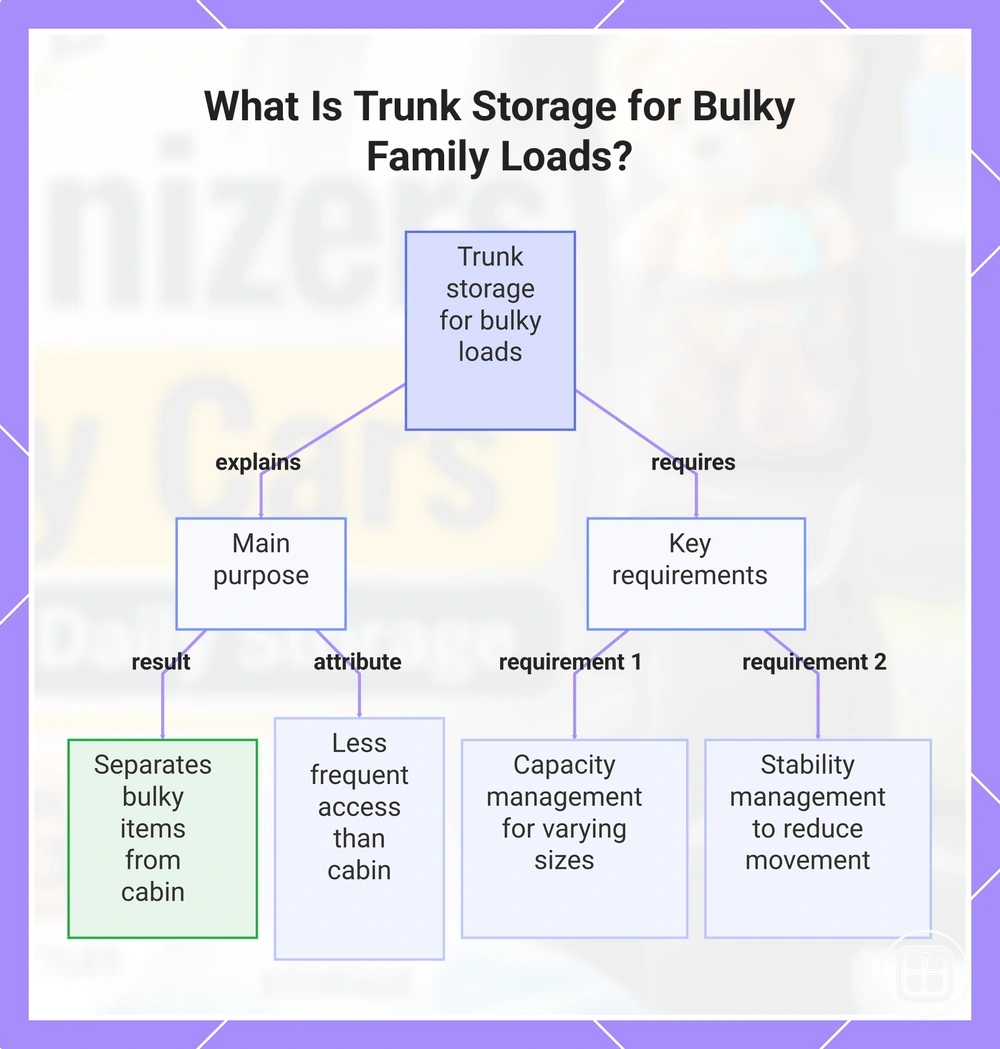
Trunk storage refers to a dedicated storage zone in a family car used for bulky family loads that are not needed during frequent cabin access. It separates larger items from the seating area so passengers can use the cabin space more comfortably, while keeping heavier loads in the cargo space where access is less immediate.
This type of trunk storage focuses on managing capacity and stability for items that vary in size and weight. Bags, groceries, sports items, emergency kits, and travel supplies are typically placed in this storage zone because they require structured positioning to reduce movement during travel. It is generally used for less frequent access compared to cabin storage zones.
- Bags → high capacity need → moderate stability requirement → stored securely for travel movement
- Groceries → medium capacity need → higher stability requirement → placed to reduce shifting
- Sports items → variable capacity need → moderate stability requirement → grouped for organized cargo space
- Emergency kits → low to medium capacity need → high stability requirement → positioned for controlled access
- Travel supplies → high capacity need → moderate stability requirement → stored for long-trip load management
This chart explains the purpose and key requirements of trunk storage for bulky family loads.
Front seat and console access for parent essentials
Front seat and console access refers to how front seat and console storage supports parent essentials by keeping frequently used items within controlled and stable reach. It organizes items like phone, wallet, documents, wipes, chargers, keys, bottles, and small emergency items so they remain accessible without spreading into loose cabin clutter. This creates a structured parent-controlled access point for daily travel needs.
Phone, wallet, documents, keys, and chargers typically require quick access but must remain in stable and non-obstructive positions to avoid interference with controls or passenger space. Wipes, bottles, and small emergency items may need conditional reach depending on the trip, but they still require secure placement to reduce movement inside the cabin. Safe use depends on keeping front seat and console storage organized so visibility and controls remain clear, especially when the vehicle is in motion.
Organizer features that matter most for family use
Organizer features that matter most for family use are those that affect how items are separated, accessed, and kept stable during daily travel. Organizer features such as compartments, pockets, cup holders, tablet sleeves, capacity, foldability, easy cleaning, and secure attachment influence how well family use needs are managed inside the car. Their value depends on item type, user access patterns, and available vehicle space, so effectiveness varies by family use conditions.
These organizer features can be understood more clearly when connected to real usage outcomes like reachability, spill control, and clutter reduction. The table below links each feature to its typical condition, possible benefit or risk, and how it may influence selection decisions in a family context.
| Feature | Family-use condition | Benefit or risk | Selection signal |
|---|---|---|---|
| Compartments | Multiple items stored together | Improves separation and reduces clutter, but may limit space flexibility | Choose when mixed item storage is frequent |
| Pockets | Small items like phone or wipes | Improves reachability but can become overloaded | Choose for frequent small-item access |
| Cup holders | Bottles used during travel | Supports spill control depending on placement stability | Choose when drink access is regular |
| Tablet sleeves | Rear passenger entertainment | Keeps devices organized but limits flexible storage use | Choose for structured device storage needs |
| Capacity | Varied family load sizes | Supports storage volume but may reduce accessibility when overfilled | Choose based on typical load variation |
| Foldability | Changing storage requirements | Improves adaptability but may reduce structural rigidity | Choose for flexible space usage |
| Easy cleaning | Frequent spills or snack use | Reduces maintenance effort depending on material type | Choose for high-use family environments |
| Secure attachment | Moving vehicle conditions | Improves stability but depends on correct installation | Choose to reduce shifting during travel |
Compartments, pockets, cup holders, and tablet sleeves
Compartments, pockets, cup holders, and tablet sleeves are small organizer features that separate family items based on item fit and access frequency inside a vehicle. These organizer features help structure storage by assigning specific spaces for small essentials, bottles, and rear passenger items. This separation supports clearer organization and reduces mixing of items during daily family use.
Compartments usually handle grouped items that need separation, while pockets support small essentials like keys, phone, or wipes depending on how often they are accessed. Cup holders are mainly used for bottles where reachability and spill control matter, and tablet sleeves support structured screen storage for rear passengers. Their usefulness varies depending on item type, user behavior, and access frequency during travel.
The following points summarize how each feature connects to item fit, access condition, and limitation:
- Compartments → small mixed items → medium access frequency → improves separation but may reduce flexible space use
- Pockets → phone, wipes, keys → high access frequency → improves reachability but can become overloaded
- Cup holders → bottles → frequent access → supports reachability but depends on placement stability
- Tablet sleeves → tablets for rear passengers → low to medium access frequency → improves structure but limits quick repositioning
Capacity, foldability, easy cleaning, and secure attachment
Capacity, foldability, easy cleaning, and secure attachment are larger functional attributes that shape how family car organizers perform over time inside real vehicle use. Capacity relates to storage volume and weight handling, while foldability depends on a collapsible structure that helps manage space when the organizer is not in use. Easy cleaning connects to washable surfaces that support maintenance, and secure attachment relies on straps, buckles, and a non-slip base for stability during movement. These attributes affect usability over time depending on how the organizer is loaded and used.
These attributes should be evaluated based on practical conditions such as load size, cleaning frequency, and surface stability inside the vehicle. Capacity and weight handling influence how much a family can store before performance changes, while foldability affects how easily the storage layout can be adjusted or removed. Easy cleaning and secure attachment become more relevant in spill-prone use or uneven surfaces, and outcomes depend on load, material, and vehicle surface conditions.
| Attribute | Useful condition | Watch-out | Decision signal |
|---|---|---|---|
| Capacity | Family travel with higher item volume | Overloading may reduce accessibility and stability | Choose based on typical storage volume and weight handling needs |
| Foldability | Changing storage needs or limited space | Collapsible structure may reduce rigidity when fully loaded | Choose when flexible space use is required |
| Easy cleaning | Frequent spills or snack usage | Washable surfaces still require regular maintenance | Choose when maintenance effort needs to be minimized |
| Secure attachment | Moving vehicle conditions and mixed loads | Straps, buckles, and non-slip base depend on correct setup | Choose when stability during travel is important |
| Weight handling | Heavier or mixed family cargo | Exceeding limits may affect structure and stability | Choose based on expected load weight and usage pattern |
How to choose a family car organizer
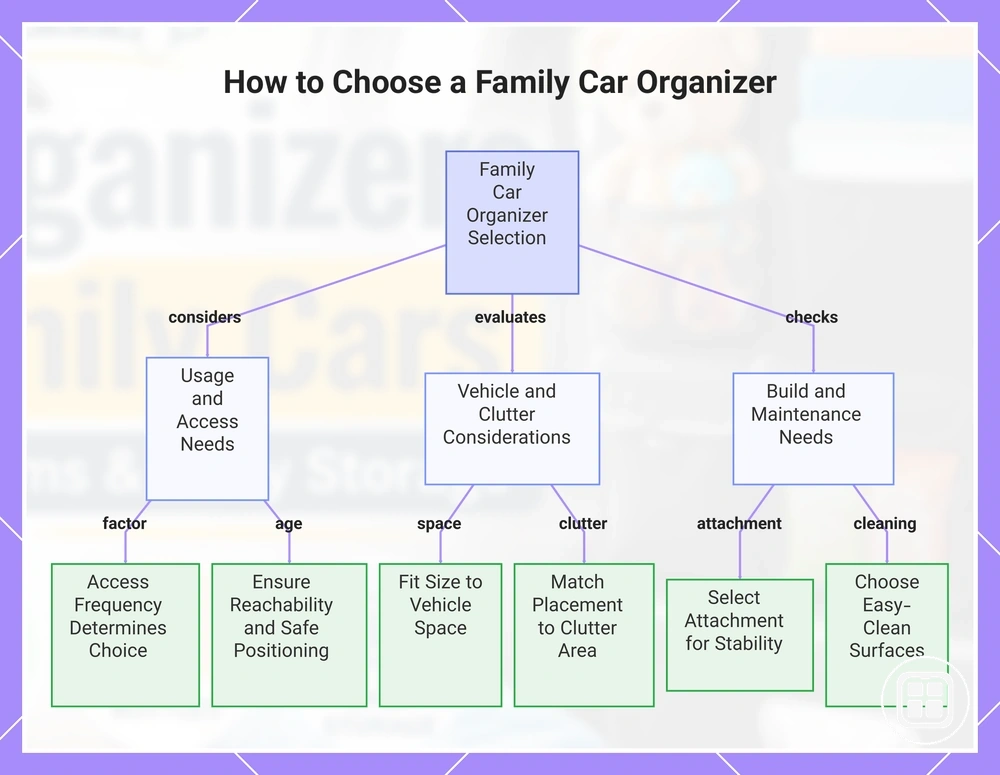
Choosing a family car organizer depends on family routine, vehicle space, and access needs inside the car. The family routine such as school runs, errands, or travel shapes how often items are used and how quickly they need to be reached. Passenger age and clutter location also influence how you choose a family car organizer, along with capacity, attachment method, and cleaning needs, so the decision depends on practical use conditions rather than a single format.
To choose a family car organizer, it helps to match selection criteria with real driving situations and storage needs. Each decision should connect a condition to a clear outcome based on how the vehicle is used. The checklist below organizes the main criteria for a structured buying decision.
Mini-checklist:
- Family routine → school runs, errands, or travel → choose based on how often items need access
- Passenger age → children or adults → prioritize reachability and safe access positioning
- Vehicle space → trunk, backseat, or console limits → select size that fits available space
- Clutter location → front or rear cabin mess → match organizer placement to problem area
- Capacity → light daily use or heavier load → choose storage volume based on usage level
- Attachment method → straps, buckles, or non-slip base → select based on stability needs
- Cleaning needs → frequent spills or snacks → prefer easy-clean surfaces for maintenance ease
This chart shows the three main criteria groups for selecting a family car organizer: usage and access needs, vehicle and clutter considerations, and build and maintenance needs, along with their recommended outcomes.
Match organizer type to family routine and clutter location
Matching organizer type depends on how family routine interacts with clutter location inside the car. School runs, grocery trips, and weekend travel each create different storage pressure across toys, snacks, bags, and emergency items. The organizer type should follow where clutter actually appears and how it is used during daily movement, so routine and clutter location should lead the choice.
This selection works by linking use patterns to specific storage needs rather than treating any organizer format as universal. Family routine defines how often items are used, while clutter location defines where they collect in the vehicle. The conditional cases below translate these patterns into organizer type decisions.
- If school runs create toys and snacks mainly in the backseat → consider a seatback or rear-access organizer type → because it supports frequent child reach without spreading items across seats.
- If grocery trips concentrate bags in the trunk → consider a cargo or trunk organizer type → because it helps stabilize heavier items in a fixed storage zone.
- If weekend travel mixes bags and trip supplies across cargo space → consider a modular or expandable organizer type → because it adjusts to changing storage volume.
- If toys and snacks consistently accumulate in rear seating areas → consider a compartment-based organizer type → because it separates small items by access point.
- If emergency items need controlled parent access → consider a front-console or central organizer type → because it keeps critical items within quick reach.
Balance child access, parent control, and cargo flexibility
A common assumption is that child access, parent control, and cargo flexibility can be optimized at the same time. In reality, a family car organizer usually requires trade-offs between child access (reach for toys and snacks), parent control (parent-only items like documents and emergency items), and cargo flexibility (removable storage for bags and trunk space). The right balance depends on passenger age, reach needs, cargo load, and storage control, forming a clear child access–parent control–cargo flexibility trade-off.
This decision changes based on how often items are accessed, who should control them, and how much cargo space is needed. The comparison below breaks down how each priority affects organizer behavior and the main watch-out in real use conditions.
| Priority | Useful organizer behavior | Watch-out |
|---|---|---|
| Child access | Supports quick reach for toys, snacks, and rear-seat items | May reduce parent control over access and placement order |
| Parent control | Keeps parent-only items like documents and emergency items in controlled storage zones | May reduce immediate reach for rear passengers |
| Cargo flexibility | Uses removable storage to adapt trunk space for changing cargo load | May reduce fixed organization and stability during frequent movement |
:contentReference[oaicite:0]{index=0}
Comparing family car organizer options
Comparing family car organizer options depends on placement, access needs, and clutter type inside the vehicle. Backseat, trunk, front-seat, and console setups each represent different family organizer options based on how children, parents, and cargo interact with storage space. Large-capacity and quick-access choices vary by placement and limitation, so options should be compared by use difference rather than product names.
The comparison below groups family organizer options by real-world usage conditions. It focuses on placement, access behavior, and storage limitation so each option can be narrowed down through a clear decision signal.
| Option | Best family condition | Main strength | Main limitation | Decision signal |
|---|---|---|---|---|
| Backseat | Children with snacks and toys | Supports direct child access and rear organization | Limited space and may reduce seating comfort | Choose when child reach and rear access are priorities |
| Trunk | Grocery trips and bulky travel loads | Supports large-capacity storage and load stability | No access during driving | Choose when cargo load and trunk storage matter most |
| Front-seat | Driver or parent essentials | Quick access for frequently used items | Can add cabin clutter if overloaded | Choose when immediate reach is required |
| Console | Small essentials like keys and devices | Central quick-access storage point | Very limited storage capacity | Choose when compact access is needed |
| Large-capacity | Family travel with mixed cargo load | Handles varied storage volume efficiently | May reduce organization of small items | Choose when storage flexibility is priority |
| Quick-access | Frequent item retrieval during travel | Optimized for fast reach and convenience | Limited depth and structured storage | Choose when speed of access is critical |
Backseat organizers versus trunk organizers for family trips
Backseat organizers versus trunk organizers for family trips compare in-cabin passenger reach with rear cargo capacity. Backseat organizers support passenger reach for toys and snacks during travel, while trunk organizers focus on storing bulky items and travel loads. The decision depends on whether family trips require in-cabin access or stronger cargo capacity, creating a clear access-versus-capacity distinction.
Family trips vary by trip length and the mix of items carried, such as toys, snacks, bags, and other travel supplies. Backseat organizers are usually aligned with frequent passenger access needs, while trunk organizers support heavier loads and longer trip storage. The comparison below shows how both options differ in travel use conditions and removal convenience.
| Backseat organizer | Trunk organizer | |
|---|---|---|
| Access | High passenger reach for toys and snacks | Low access during travel, usually stop-based |
| Best items | Toys, snacks, small travel essentials | Bags, bulky items, travel cargo |
| Capacity | Limited in-cabin storage space | High cargo capacity for larger loads |
| Limitation | Can reduce seating comfort if overloaded | No immediate access while driving |
| Family-trip fit | Better when passenger reach and snack access are needed | Better when trip length requires bulk storage |
Large storage capacity versus quick-access compartments
Large storage capacity versus quick-access compartments compares storage volume with reachability in family car organizers. Large storage capacity often supports bulk items, while quick-access compartments prioritize reachability for frequently used essentials. These two functions are not the same, because more space does not automatically improve access speed, so capacity and reachability are separate decisions.
Family use depends on how often items are needed and how storage design distributes access across compartments. Large bins typically suit less frequent access for bulky items, while quick-access compartments focus on small essentials used during travel. The table below shows how different storage designs affect access frequency and decision outcomes.
| Storage design | Best item type | Access frequency | Decision effect |
|---|---|---|---|
| Large bins | Bulky items and travel supplies | Low frequency | Prioritize storage volume over quick reach |
| Divided compartments | Separated small items | Medium frequency | Balance organization and controlled access |
| Small pockets | Phones, wipes, small essentials | High frequency | Optimize for quick access and reachability |
| Bottle slots | Drinks and bottles | High frequency | Support stable and fast reach during travel |
| Open-access sections | Frequently used mixed items | High frequency | Prioritize immediate reach over storage depth |
Using family car organizers without adding clutter
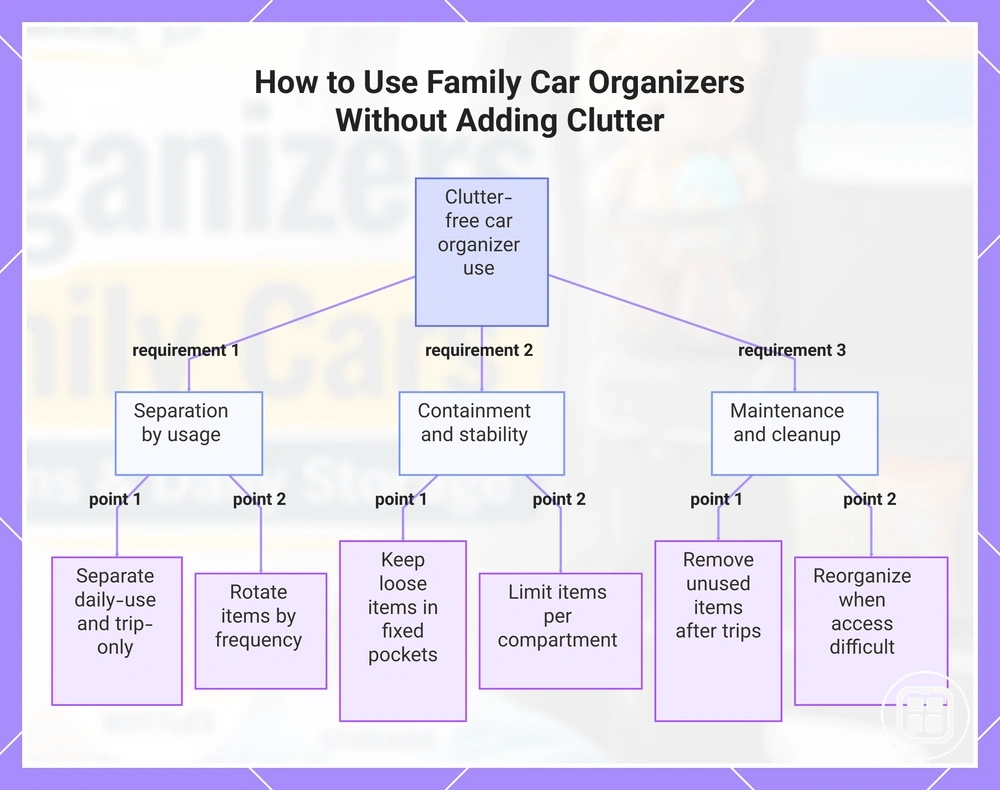
Using family car organizers reduces clutter only when items are separated by frequency, access, and removal needs. If daily-use items and trip-only storage are mixed, organizers can turn into loose-item containers instead of structured storage. Loose items can reduce stability inside compartments and pockets, especially during movement. The way organizers are used over time determines whether they reduce clutter or gradually collect unnecessary items.
Sorting by frequency, access, and removal helps keep using family car organizers practical and controlled. Daily-use items need consistent placement, while trip-only storage should stay limited to prevent overflow. The checklist below explains how habits, conditions, and item limits affect clutter outcomes during use.
- Separate daily-use items from trip-only storage → keeps frequent access items organized → reduces mixed clutter in compartments
- Maintain loose items inside fixed pockets or sections → improves stability during travel → prevents shifting clutter inside the organizer
- Limit items per compartment → avoids overfilling storage zones → keeps organizer space usable over time
- Remove unused items after trips → supports cleanup rhythm → prevents accumulation of unnecessary objects
- Rotate stored items based on frequency → ensures relevant items stay accessible → reduces long-term clutter buildup
- Reorganize when access becomes difficult → restores structure → improves item visibility and reachability
This chart shows the key strategies and specific actions to prevent clutter when using family car organizers, based on sorting items by frequency, access, and removal.
Separate daily-use items from trip-only storage
Separating daily-use items from trip-only storage depends on item frequency and access needs inside using family car organizers. Daily-use items such as school items, snacks, wipes, and chargers need frequent access, while trip-only storage like travel bags, blankets, groceries, and emergency supplies is used less often. Mixing these groups can increase clutter and reduce stability inside storage zones. Item frequency is the main rule for deciding how separation should be maintained over time.
Daily-use items should remain in accessible storage zones, while trip-only storage should stay in less frequently accessed areas of the vehicle. This separation helps reduce clutter buildup and keeps using family car organizers more structured during regular use. The checklist below shows how item groups, frequency, storage zones, and clutter effects connect in practice.
- School items → daily-use items → accessible storage zone → reduces repeated search clutter during travel
- Snacks → daily-use items → front or reachable storage zone → improves quick access and reduces seat clutter
- Wipes → daily-use items → quick-access storage zone → prevents loose-item buildup in compartments
- Chargers → daily-use items → central storage zone → reduces cable clutter and improves reachability
- Travel bags → trip-only storage → trunk storage zone → keeps cabin space clear and reduces bulk clutter
- Blankets → trip-only storage → cargo storage zone → prevents seating area overcrowding
- Groceries → trip-only storage → trunk storage zone → improves load stability and reduces cabin clutter
- Emergency supplies → occasional-use items → controlled storage zone → ensures access without mixing with daily items
Keep loose items stable, reachable, and easy to remove
Keeping loose items stable, reachable, and easy to remove depends on how they are controlled inside using family car organizers. Loose items such as small accessories or everyday objects can shift during movement if they are not secured with straps, non-slip bases, lids, or suitable pocket depth. Item weight also affects how easily they stay in place, especially during turns or stops. Stability, reachability, and easy removal together help reduce clutter and improve control during use.
Loose items become a risk when they move freely across storage zones or block access during driving. Driver reach and passenger access must stay clear so items do not interfere with controls or visibility. Storage should support controlled movement rather than unrestricted shifting, with a focus on the non-obstruction rule for safe use inside the vehicle.
- Straps → unsecured loose items → may shift during movement → use to improve stability and reduce cabin clutter
- Non-slip bases → sliding accessories → may move during turns or braking → use to maintain stable placement on surfaces
- Lids → open containers → may spill or scatter contents → use to keep items contained and easy to remove
- Pocket depth → shallow storage → items may fall out during motion → use deeper pockets for better retention
- Item weight → heavier loose items → may shift under braking → place in lower, stable storage zones
- Driver reach / passenger access → poorly placed items → may obstruct controls or visibility → keep in non-interfering storage zones
:contentReference[oaicite:0]{index=0}
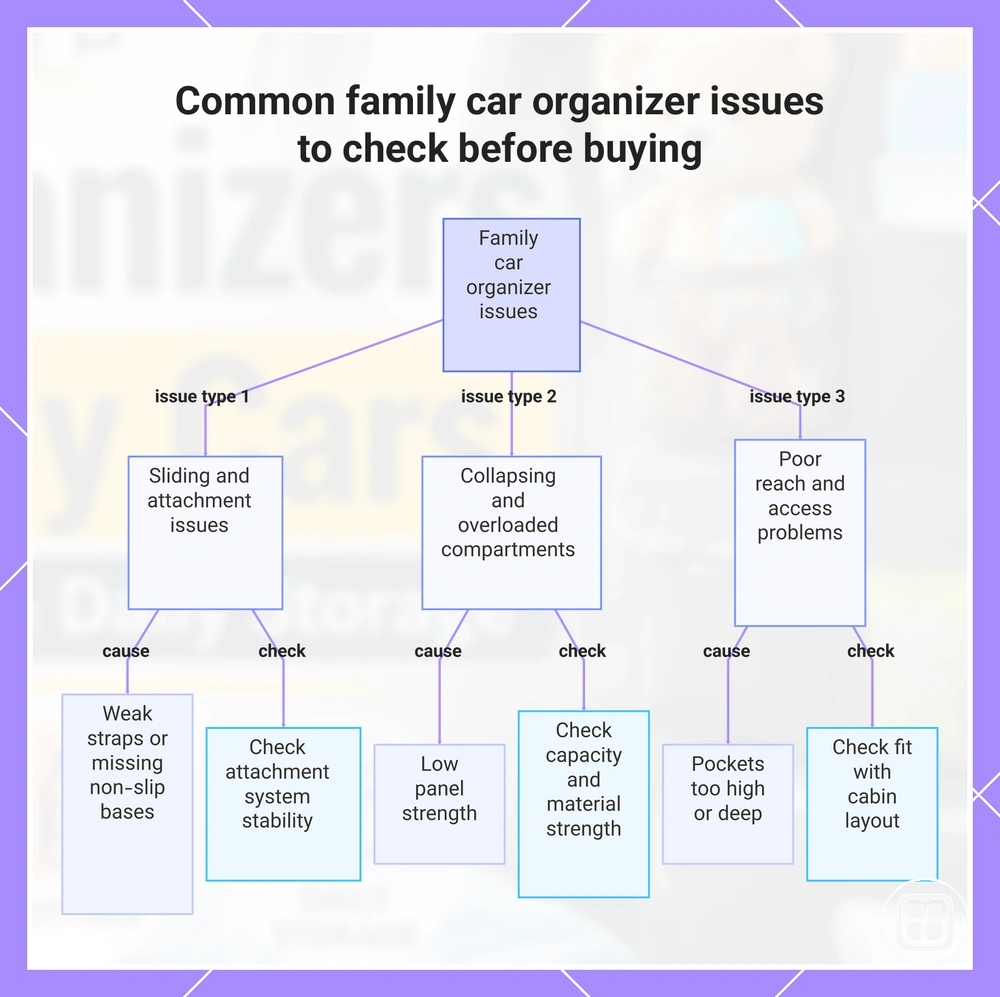
Common family car organizer issues to check before buying
Common family car organizer issues to check before buying usually come from fit, load, attachment, access, or overuse. These common issues affect how stable and usable the organizer will be inside real family use conditions, so checking them early helps reduce mismatch between expectations and actual performance.
Sliding and attachment issues happen when the organizer does not hold firmly on the vehicle surface. This may be caused by weak straps or missing non-slip bases, which can lead to movement during turns or braking. Check before buying how the attachment system supports stable placement under load, as this affects whether the organizer stays fixed during use.
Collapsing and overloaded compartments can occur when panel strength is too low for the expected load. When storage sections are filled beyond their support limit, the structure may lose shape or become unstable. Check before buying the capacity level and material strength, since load handling directly affects long-term usability.
Poor reach, child access problems, and blocked space often come from poor fit or wrong placement inside the vehicle. If pockets are too high or deep, or if the organizer blocks seat movement, access becomes difficult for both driver and passengers. Check before buying how the design fits passenger position and cabin layout to avoid access limitations.
Overall, most common family car organizer issues can be reduced by checking fit, attachment, load capacity, and access layout together before selection. These checks help identify whether the organizer matches real family use conditions or may create practical limitations after installation. Source reference: :contentReference[oaicite:0]{index=0}
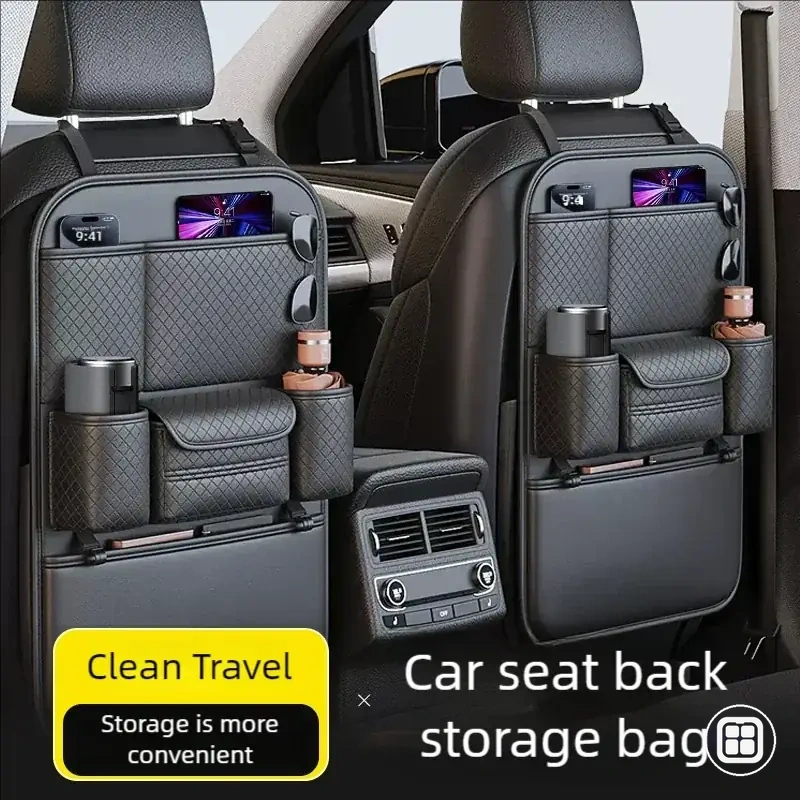
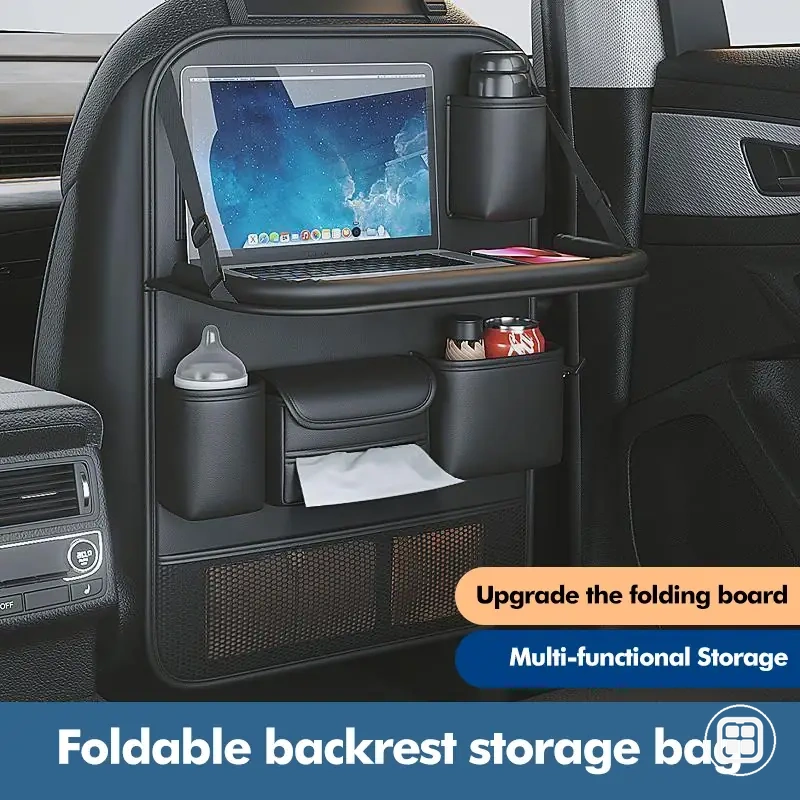
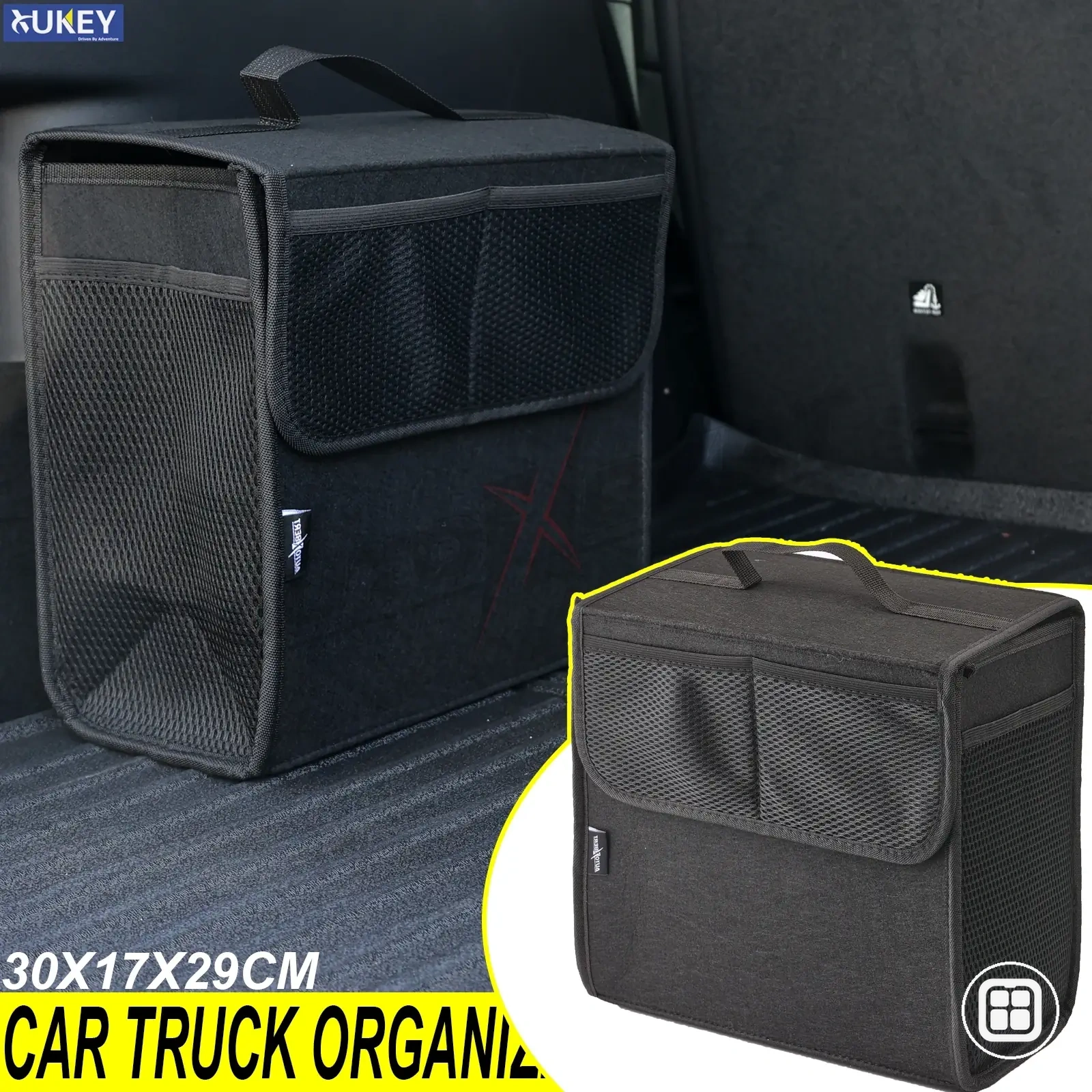
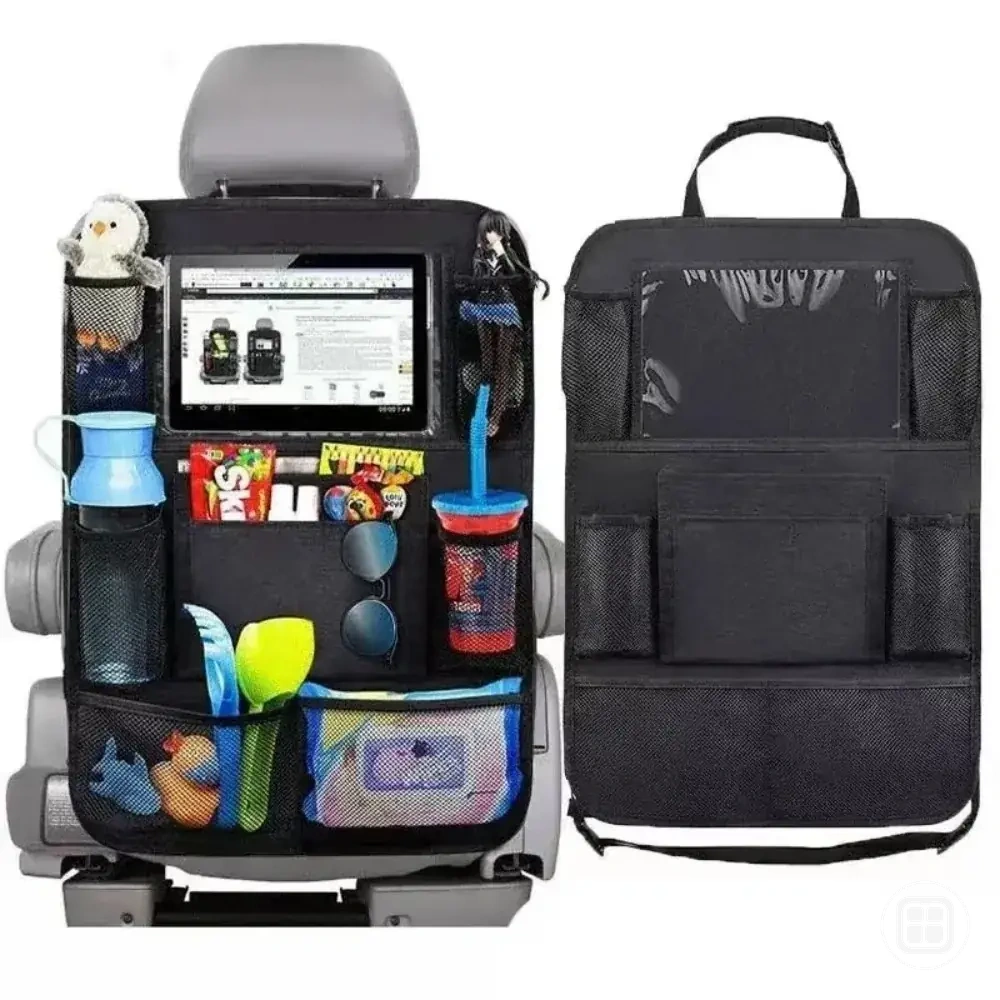
Here are product examples that may make comparison easier. Before buying, always review the compatibility criteria, essential features, and product details.
This chart shows the main issues that affect car organizer usability during family use, including attachment, load capacity, and access problems, along with checks to perform before purchase.
Sliding, collapsing, and overloaded compartments
Sliding, collapsing, and overloaded compartments in family car organizers usually happen when load balance and attachment are not aligned with real use conditions. When sliding, collapsing, and overloaded compartments appear, the likely cause is a mismatch between base grip, straps, panel strength, compartment weight, and item distribution during movement. These issues often become more visible under repeated vehicle motion and uneven loading.
Variation in sliding, collapsing, and overloaded compartments depends on vehicle surface texture and how the organizer structure responds to stress. Softer or uneven surfaces can reduce grip, while uneven item distribution can increase pressure on specific compartments. In many cases, prevention depends on balancing load and improving attachment consistency rather than relying on a single structural factor. :contentReference[oaicite:0]{index=0}
- Sliding | weak base grip or loose straps | check contact with vehicle surface and strap tension | may indicate movement risk during turns or braking
- Sliding | uneven vehicle surface interaction | check placement stability and friction points | suggests reduced grip under motion
- Collapsing | low panel strength under load | check material rigidity and support structure | may deform when weight increases
- Collapsing | uneven item distribution | check how load is spread across sections | signals structural stress concentration
- Overloaded compartments | excessive compartment weight | check total load per section | may reduce usable space and stability
- Overloaded compartments | poor item distribution balance | check balance across compartments | increases strain on organizer structure
Poor access for children, passengers, or front-seat users
Poor access for children, passengers, or front-seat users happens when organizer placement and reach distance do not match how people actually use the car interior. When poor access appears, children may struggle to reach items like snacks or toys, passengers may find storage hard to use, and front-seat users may face limited visibility or reach for essentials. These issues often make an otherwise useful organizer less practical in daily use.
Access depends on passenger position, item type, and pocket height, so poor access can vary between child reach, parent-only items, rear passenger comfort, and front-seat essentials. Organizer placement also affects how easily items can be retrieved, especially when reach distance increases or when storage zones are not aligned with user flow. Buying checks should focus on how each user group interacts with the organizer before selection.
- Child reach | snacks or toys placed too high | check pocket height vs child seat position | may reduce independent access for children
- Passenger access | rear seat items placed too far back | check reach distance from seating position | can increase effort during use
- Front-seat essentials | items stored outside driver reach zone | check organizer placement near console or dash area | may limit quick access for front users
- Parent-only items | mixed with child-access storage | check separation of controlled vs shared storage | can create access confusion
- Organizer placement | misaligned with seating layout | check fit relative to seat movement and cabin space | may block or reduce practical usability