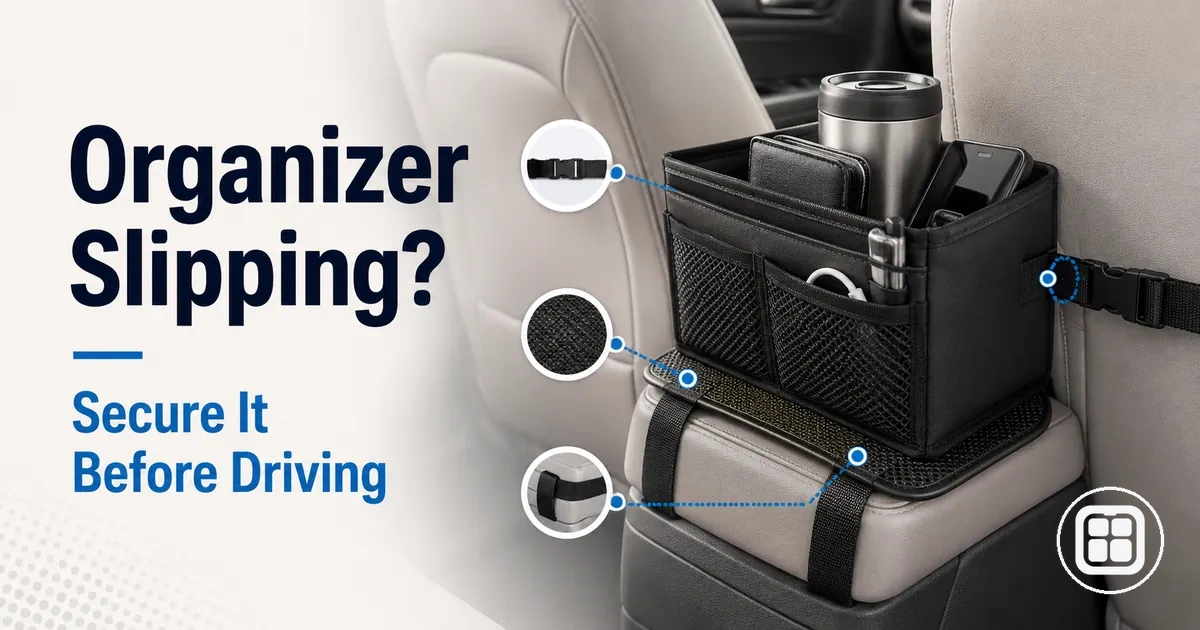
Car Organizer Slipping and Sliding Problems
When a car organizer keeps slipping or sliding, the likely cause is usually weak surface grip, loose straps, uneven weight distribution, or placement on a vehicle surface that lets movement build during driving. The organizer may shift, wobble, tip, or move out of place when braking, turning, or loading changes the pressure on its base. The cause should be diagnosed before trying to stabilize it.
A safe troubleshooting approach starts by checking how the car organizer contacts the vehicle surface, how its straps or attachment points hold tension, and how heavy items sit inside the compartments. A small amount of settling can happen in many cases, but recurring movement needs closer attention because it may affect secure use or make stored items harder to control.
Slipping and sliding mean the organizer changes position after it has been placed, while poor fit means the organizer does not suit the available space in the first place. Keep that boundary clear: this page focuses on movement after placement, not a full fit diagnosis. The next step is to identify the movement pattern before choosing a grip, strap, load-balance, or placement correction.
When a Car Organizer Is Actually Moving Out of Place
Visible position change is what defines a car organizer as moving out of place during driving, braking, turning, or loading. The organizer position changes relative to the vehicle surface rather than staying where it was originally placed. A brief settling movement can occur in some situations, while repeated movement follows a more noticeable pattern.
When a Car Organizer Is Actually Moving Out of Place often becomes clear during braking, turning, road vibration, or changes in stored load. A trunk organizer, seatback organizer, or floor-positioned organizer may show a visible position change under these conditions. The image below highlights what that movement pattern can look like by labeling an original position and a shifted position.
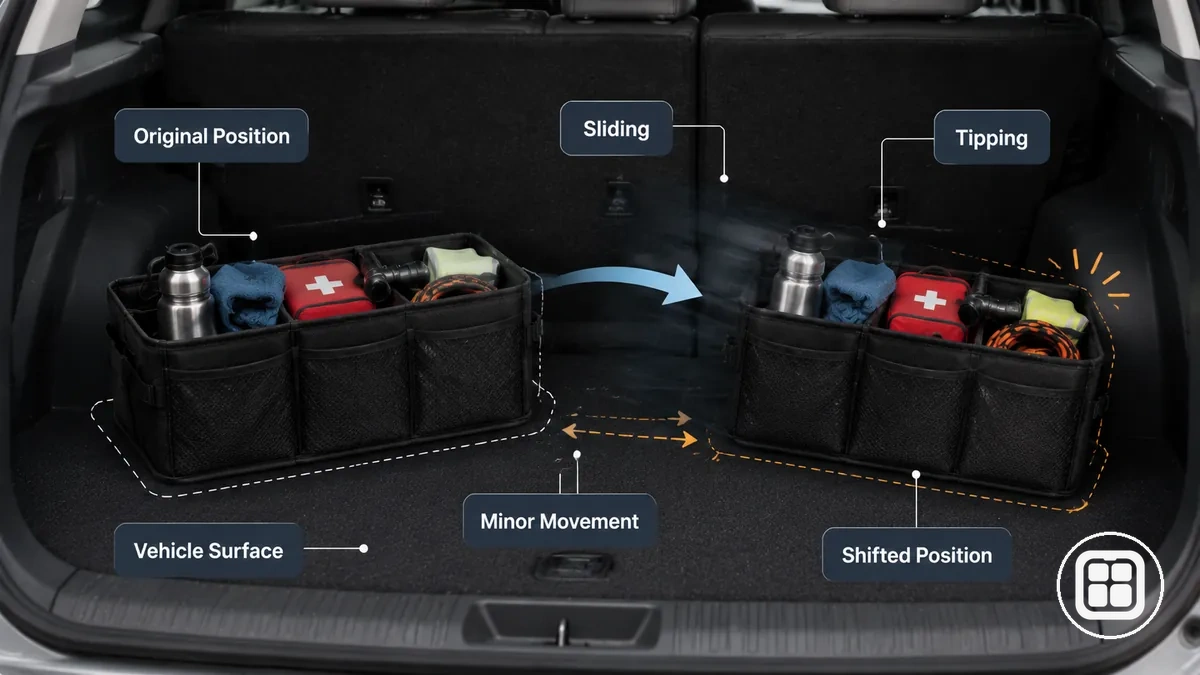
The checklist below separates movement symptoms by what changes and when the change occurs.
- Slipping: The organizer moves across the vehicle surface during braking or acceleration, which may suggest reduced grip between the base and the contact area.
- Sliding: The organizer changes position during turning or road vibration, which may indicate a repeating movement pattern rather than a one-time shift.
- Tipping: The organizer leans to one side when the stored load changes position, which may suggest that weight is not staying balanced.
- Shifting: The organizer changes location after loading, unloading, or driving movement, which may suggest that the original organizer position is not remaining consistent.
- Minor movement: The organizer settles slightly and then remains in roughly the same location, which may indicate normal settling rather than a repeated movement pattern.
For broader context on car organizer topics beyond movement recognition, see Back to hub overview.
Why Car Organizers Slide While Driving
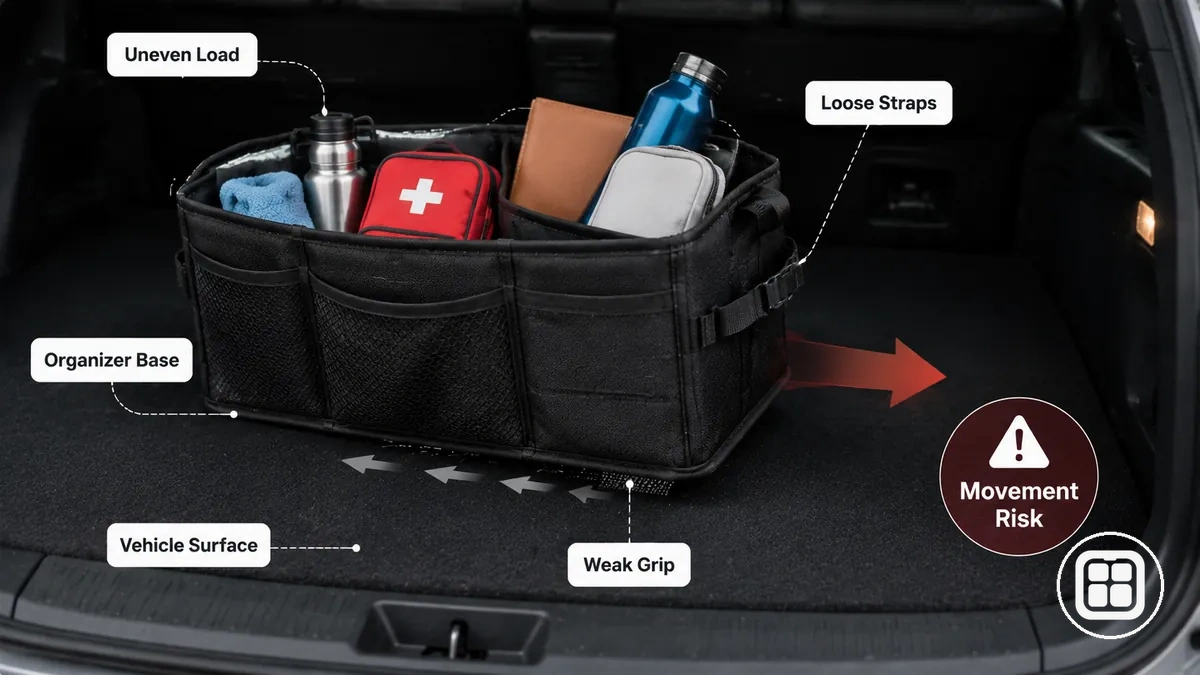
When car organizers slide while driving, the likely cause may be weak grip between the organizer base and the vehicle surface, loose securing points, uneven loading, or a mismatch between the base material and the contact area. More than one cause category can contribute to the same symptom, so the visible movement pattern should guide the check rather than assumptions about a single source.
Separating surface-related, strap-related, and load-related conditions helps narrow the likely cause before choosing a correction. A sliding organizer may react differently depending on the vehicle surface, attachment condition, and stored items. The image below highlights common movement forces and likely cause areas. The table organizes symptoms by likely cause and practical effect.
| Symptom | Likely cause | What to check | What it means |
|---|---|---|---|
| Organizer base slides across the surface | Weak grip or low friction | Contact between the organizer base and vehicle surface | Movement risk may be linked to reduced traction at the base |
| Side shifting during turns | Loose straps or securing points | Straps, buckles, and anchor locations | Movement may increase when attachment tension is inconsistent |
| Tipping during driving movement | Uneven loading or unbalanced load | Heavy items and compartment weight distribution | Shifting force may concentrate on one side of the organizer |
| Swinging or repeated movement | Loose securing points | Attachment condition and restraint stability | The organizer may continue moving instead of staying positioned |
| Movement after braking | Weak grip, uneven loading, or both | Base contact area and stored load placement | The symptom may indicate more than one likely cause category |
Low Grip Between the Organizer Base and Vehicle Surface
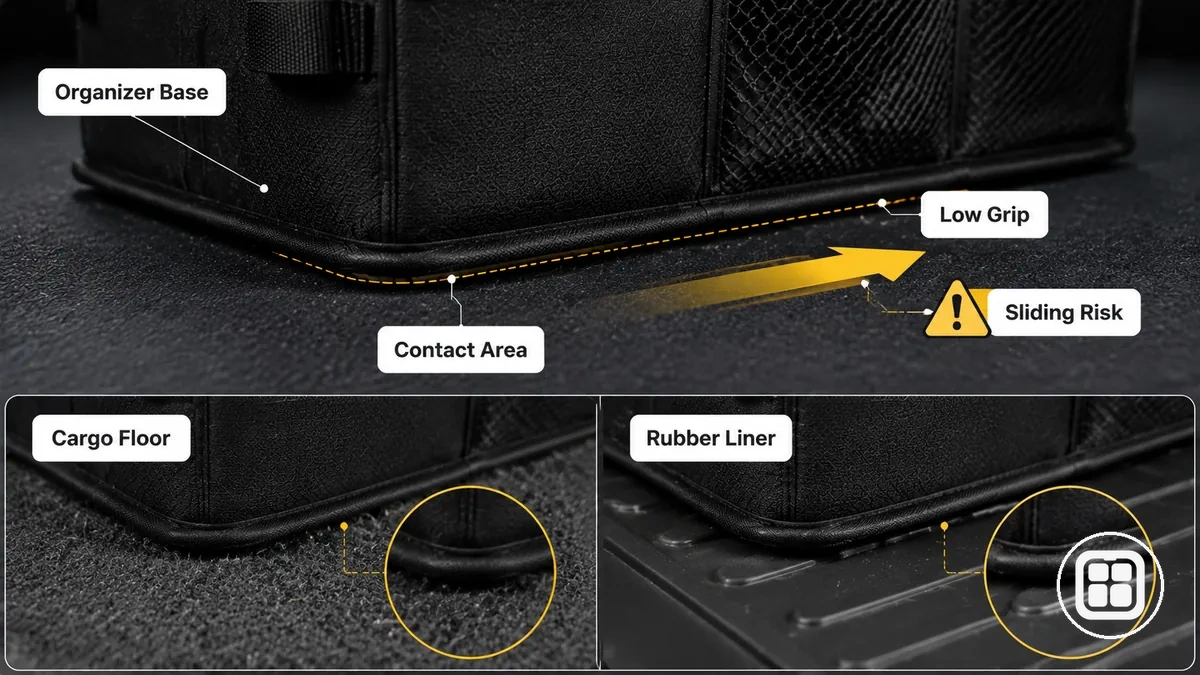
Low grip between the organizer base and vehicle surface allows the organizer base to move across the contact area instead of staying in position. When friction is reduced, base movement can occur more easily during normal driving forces. Sliding risk often depends on the condition of the vehicle surface and the quality of contact beneath the base.
The image below highlights the contact point where grip is lost between the organizer base and vehicle surface. A smooth cargo floor, fabric mat, or rubber liner may interact differently with the same organizer base because friction depends on grip texture, surface condition, and contact area. For example, a base that remains stable on carpet may show a higher sliding risk on a smoother plastic cargo floor. Movement risk can increase when weak contact reduces friction across the base-to-surface connection.
- Smooth cargo floor: May reduce friction; check whether the organizer base shifts across the surface.
- Fabric mat: Can change contact behavior; check for base movement during normal driving.
- Rubber liner: May provide a different grip texture; check whether sliding continues under the same conditions.
- Dust or debris: Can contribute to grip loss; check the contact area between the base and vehicle surface.
- Worn base material: May reduce effective contact; check for signs of reduced grip across the organizer base.
Loose Straps, Buckles, or Attachment Points
When an organizer shift occurs despite some base grip, loose straps, buckles, or attachment points may be allowing movement. A loose strap, incomplete buckle lock, or unstable securing point can reduce tension and allow the organizer to change position during driving. The next step is to inspect tension and lock points rather than assuming the base is the only cause.
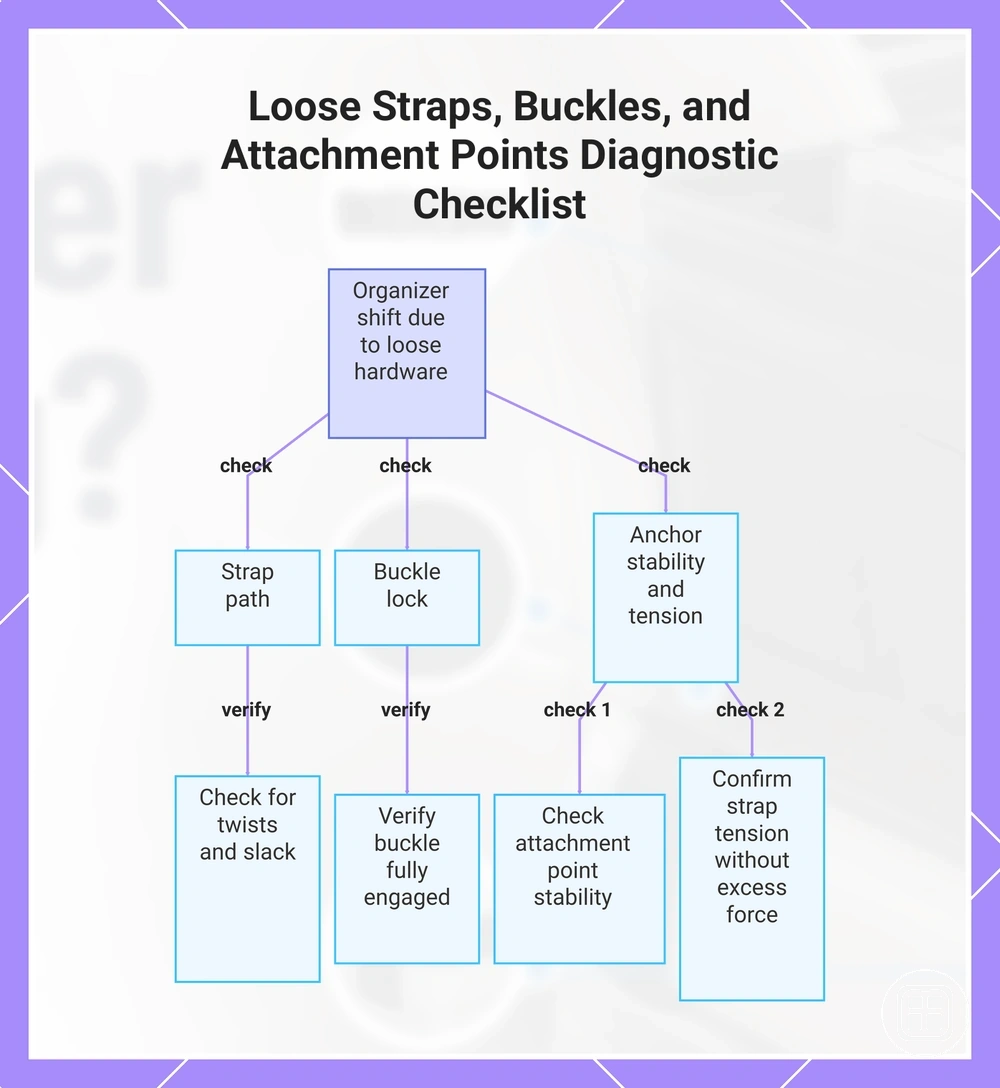
Even when the organizer base stays in contact with the surface, looseness in attachment hardware can permit movement through the strap path. Straps connected to headrests, cargo loops, seatback points, or other attachment points may behave differently depending on vehicle design and anchor stability. If adjustment is needed, tension should remain firm without placing strain on trim, fragile loops, or seat components. The checklist below verifies strap path, buckle lock, and anchor stability.
- Strap path: Check whether the straps follow a stable path without twists, slack, or obvious looseness.
- Buckle lock: Verify that each buckle lock is fully engaged and remains closed during normal movement.
- Anchor stability: Check whether the attachment points or cargo loops remain stable when light tension is applied.
- Tension: Confirm that straps hold the organizer securely without excessive force on trim, seat parts, or fragile loops.
- Post-check movement: Observe whether organizer shift continues after confirming strap path, buckle lock, and securing point stability.
This chart shows the three main areas to check when an organizer shifts despite base grip, and the specific verification steps for each.
Uneven Weight Distribution Inside the Organizer
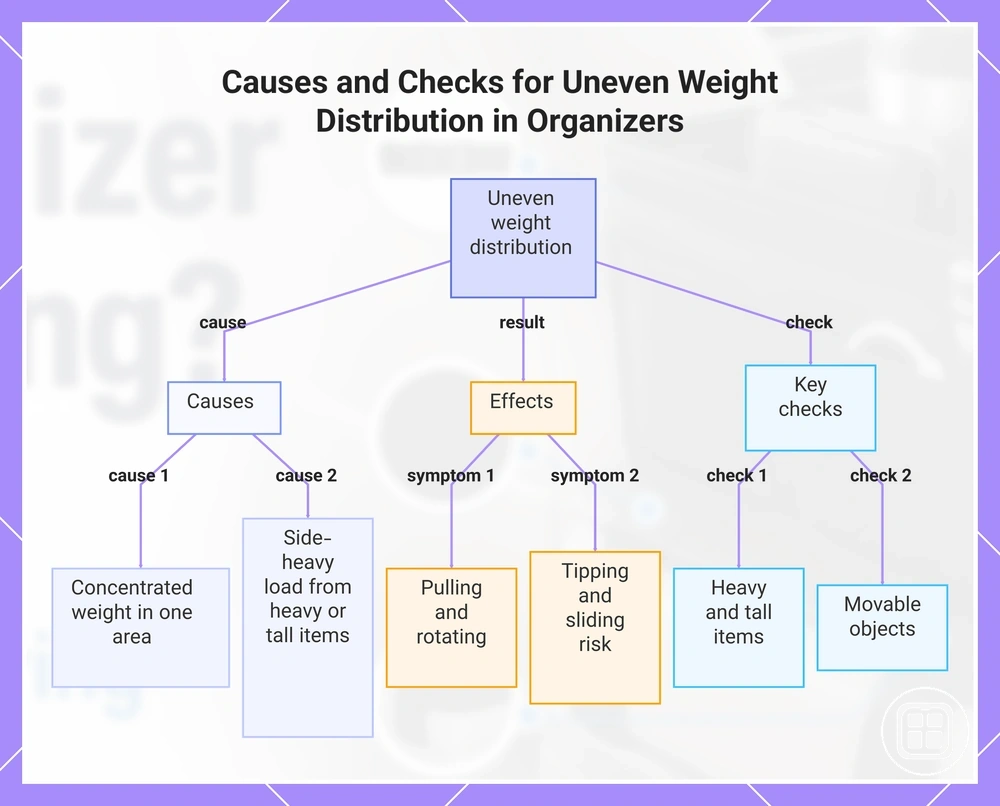
Uneven weight distribution inside the organizer can pull, rotate, or tip the organizer during vehicle movement. When stored items concentrate weight in one area, the center of gravity shifts away from a balanced position. Sliding and tipping risk often increase when load balance changes across the compartments.
When heavy items or tall items are placed on one side, a side-heavy load can increase tipping or sliding during braking, turning, or road vibration. For example, heavy items stored low and closer to the center may create a more balanced load than placing the same weight in a single outer compartment. Redistributing stored items across compartments can help reduce weight shift when imbalance contributes to movement.
- Heavy items: Check whether most weight is concentrated in one compartment or on one side.
- Tall items: Check whether item height raises the center of gravity and increases tipping risk.
- Rolling items: Check whether round objects can move and create a changing weight position.
- Liquids: Check whether container movement may contribute to load balance changes during driving.
- Loose objects: Check whether shifting items can create weight shift and affect movement outcomes.
This chart shows the main causes of uneven weight distribution inside an organizer and the key checks to identify if imbalance may cause movement during driving.
How to Stop a Car Organizer From Sliding
Stopping a car organizer from sliding usually starts with improving base grip, securing attachment points, and rebalancing items according to their placement. The most suitable correction depends on the diagnosed cause rather than applying multiple fixes at random. In many cases, one adjustment may reduce movement, while other situations may require cause-based fixing with combined support.
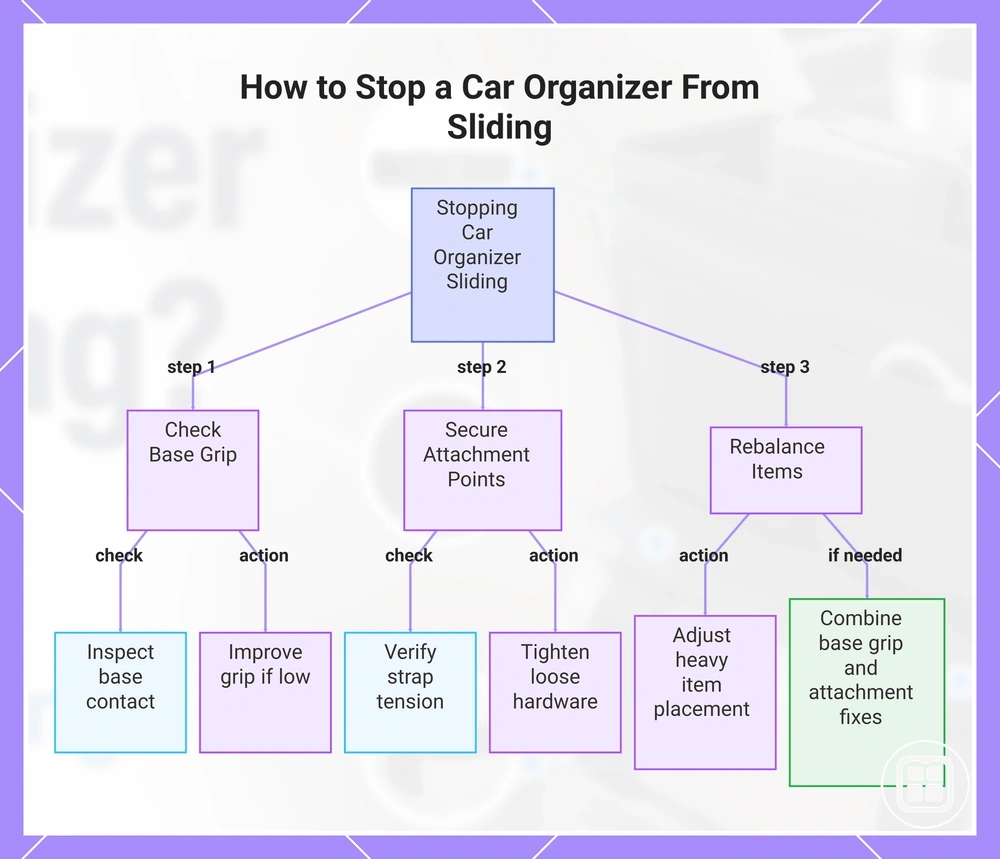
Start with simple low-risk checks before moving to stronger stabilization methods. Checking the affected part first helps connect the fix to the condition causing movement. The sequence below moves from surface contact and attachment security to load balance adjustments.
- Check base grip: Inspect the contact between the organizer base and the vehicle surface. If low grip is present, improving base-to-surface contact may help reduce movement when sliding is linked to friction loss.
- Secure attachment points: Verify that straps, buckles, and anchor points remain stable and properly tensioned. When attachment hardware is loose, securing these points may help stabilize the organizer.
- Rebalance items: Check whether heavy items are concentrated in one compartment or on one side. Adjusting placement may improve weight distribution and support better stability.
- Recheck movement: Observe whether sliding, tipping, or shifting continues after the initial correction. If movement remains, more than one condition may be contributing to the problem.
- Use combined support when needed: If reduced base grip and attachment looseness occur together, improving base grip while securing attachment points may provide greater stabilization than either action alone.
When one corrective action does not sufficiently reduce movement, a combined approach may help. For example, improving base grip can address surface-related movement, while secure attachment points and balanced item placement can support stability when multiple conditions contribute to sliding.
This chart shows the step-by-step process to diagnose and fix a sliding car organizer, starting with simple checks and progressing to combined corrections.
Add Non-Slip, Velcro, or Rubber Base Support
Adding base support can help reduce sliding by increasing friction between the organizer and the vehicle surface. Non-slip support works by improving the contact area and limiting unwanted movement across the surface. The suitability of a support type depends on surface compatibility and the material beneath the organizer.
When base grip remains limited, temporary support can provide additional friction, while a built-in non-slip base relies on the organizer's existing design. A non-slip support, Velcro-style base, or rubber base may perform differently depending on the contact area, removability requirements, and residue risk. The most suitable option depends on whether the vehicle surface and organizer base can work together under the intended conditions.
- Non-slip support: A grip mat or anti-slide base may increase friction across a larger contact area. Surface compatibility can vary depending on the vehicle surface material.
- Velcro-style base: May help stabilize an organizer on compatible fabric surfaces. Removability and residue risk can depend on the attachment method and surface condition.
- Rubber base: A rubber bottom may improve grip on certain cargo floors by increasing friction at the contact area. Results can vary with surface texture and material.
- Temporary support: Can be added or removed as needed, but effectiveness may depend on the condition of both the organizer base and vehicle surface.
- Built-in non-slip base: Uses the organizer's existing base design rather than an added support layer. Sliding reduction depends on the base material and surface compatibility.
Secure Straps and Buckles Without Unsafe Tension
Securing straps and buckles starts with using enough tension to reduce organizer movement without creating unsafe tension. Secure straps should hold the organizer in position while allowing buckles and attachment points to remain stable. Avoid over-tightening straps in a way that may place strain on trim, seat parts, or fragile loops.
When movement continues after adjustment, checking the strap route, buckle lock, anchor strength, and tension level can help improve stability. A proper tension check focuses on secure fastening rather than stronger force. Use the steps below to adjust straps and buckles safely and perform a post-adjustment check.
- Check the strap route: Make sure each securing strap follows a stable path without twists or excess slack. A consistent strap route may help maintain more stable organizer positioning.
- Verify the buckle lock: Confirm that each buckle lock is fully engaged and remains closed during normal use. A secure buckle lock can help limit unwanted movement.
- Check anchor strength: Fasten straps only to suitable stationary attachment points. Do not use weak or moving vehicle parts, as they may reduce stability or increase damage risk.
- Perform a tension and post-adjustment check: Tighten straps until they are secure, then check for remaining movement. If movement continues, adjust tension gradually rather than applying excessive force.
If the organizer does not have usable straps, or the vehicle does not provide suitable anchor points, a different stabilization method may be more appropriate than increasing strap tension.
Rebalance Heavy Items to Reduce Movement
Rebalancing heavy items starts with redistributing weight so sliding forces are less concentrated on one side of the organizer. Moving heavy items into lower compartments can help improve load balance during driving motion. When weight stays closer to the center, the center of gravity may remain more stable.
A side-heavy load can behave differently from a balanced load when braking, turning, or driving over uneven surfaces. For example, tools, bottles, or groceries placed in a single outer compartment may create more weight shift than the same items distributed across compartments. After redistributing items, perform a practical balance check by observing whether movement is reduced during normal driving conditions.
- Heavy items: Place heavier items in lower compartments when possible to support load balance and stability.
- Tall items: Check whether tall items raise the center of gravity and contribute to tipping during driving motion.
- Round items: Check whether bottles or other rolling items can move and create additional sliding forces.
- Liquid containers: Monitor whether changing liquid movement may contribute to weight shift inside the organizer.
- Loose objects: Secure or redistribute loose objects that may move during braking and increase organizer movement.
Sliding Problems by Organizer Placement
When organizer movement occurs, the likely cause may change with organizer placement because trunk, seatback, floor, and console area locations use different contact surfaces and attachment points. The same sliding symptom can come from different conditions depending on vehicle position. Diagnosing movement by placement helps narrow the likely cause before checking contact surfaces and attachment points.
A movement pattern often becomes easier to interpret when organizer placement is considered first. A trunk organizer that slides across a cargo floor may require a different check than a seatback organizer that shifts from strap movement. The table below compares placement, common movement pattern, likely cause, and a suitable check.
| Placement | Common movement pattern | Likely cause | Suitable check |
|---|---|---|---|
| Trunk | Sliding across the cargo floor | Reduced base grip on the contact surface or liner | Check base grip, contact surface condition, and load balance |
| Seatback | Swinging or shifting during driving motion | Loose straps or attachment point movement | Check strap tension, headrest attachment, and buckle condition |
| Floor | Forward, backward, or side movement | Limited friction between the organizer base and floor area | Check surface contact, base support, and item distribution |
| Console area | Shifting within a limited space | Reduced contact stability or changing item position | Check contact surface condition and movement within the storage area |
Trunk Organizers Sliding on Cargo Floors
Trunk organizers sliding on cargo floors often happens when the cargo-floor surface reduces base grip or when stored weight shifts during driving. A smooth cargo liner may allow more base movement than a textured or carpeted trunk floor, depending on the liner material and contact area. Start by checking the cargo floor, base grip, and stored weight before adjusting anything else.
During braking, cornering, or cargo loading, trunk movement may appear as sliding across the cargo area or shifting toward one side. Cargo loops can help with anchoring only when they are suitable for the organizer and vehicle setup. The checklist below keeps the diagnosis local to the trunk organizer and cargo-floor conditions.
- Floor surface: Check whether the cargo floor is smooth, textured, carpeted, or covered by a liner.
- Liner material: Check whether the cargo liner creates low friction between the trunk organizer and the surface.
- Base grip: Check whether the organizer base maintains contact or slides when the cargo area moves.
- Cargo loops: Check whether usable cargo loops are available without assuming every trunk has suitable anchoring.
- Load position: Check whether stored weight is concentrated on one side or shifting during braking and cornering.
Seatback Organizers Moving on Headrests or Seatbacks
When a seatback organizer moves on a headrest or seatback, the likely cause is often related to hanging support, strap tension, or item weight. A seatback organizer depends on stable headrest support and consistent buckle tension to remain positioned. Start by checking the support points where the organizer attaches to the seat.
During normal vehicle movement, sagging, swinging, or lower-corner movement can indicate that upper straps, lower straps, or stored item weight are affecting stability. Headrest posts, seatback angle, and pocket loading can change how the organizer hangs and responds to movement. Movement may be reduced with better lower stabilization, but complete elimination can depend on the available support points.
- Sagging: May indicate excess item weight, loose upper straps, or reduced headrest support.
- Swinging: May occur when buckle tension is inconsistent or the hanging position allows more movement.
- Side shifting: May suggest uneven strap tension or an off-center load inside the organizer pockets.
- Lower-corner lifting: May indicate limited lower straps or insufficient lower stabilization.
- Repeated movement: May point to a combination of seatback angle, strap tension, and stored item weight.
When Sliding Becomes a Secure-Use Concern
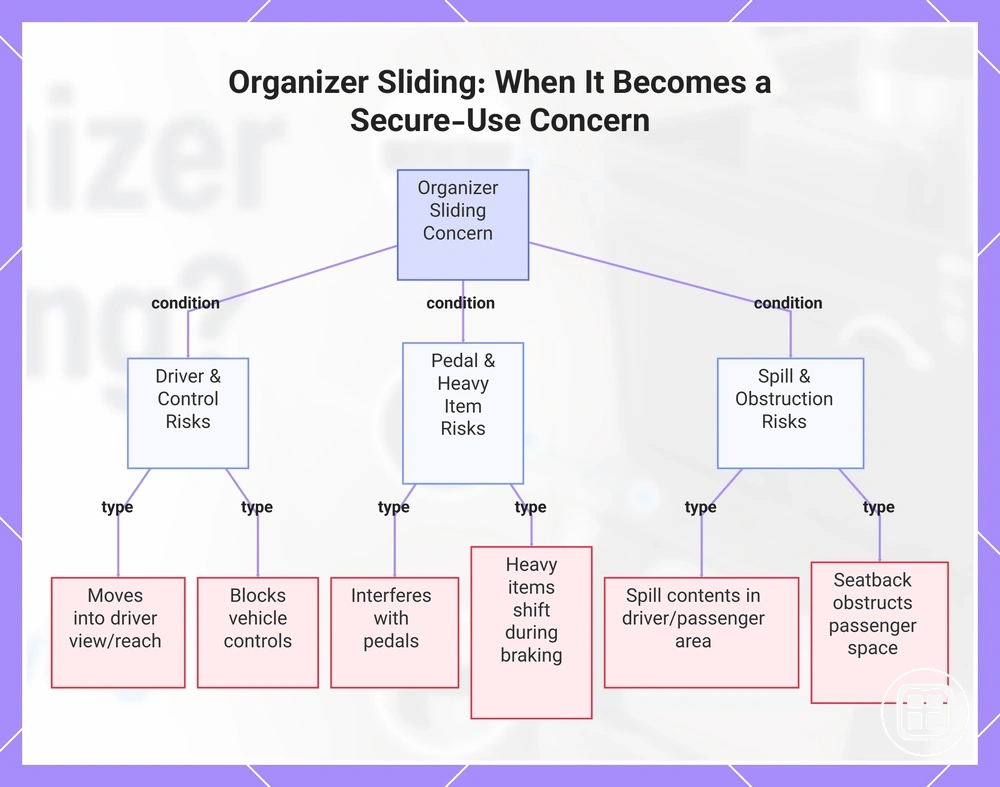
Sliding becomes a secure-use concern when organizer movement may cause driver distraction, spill contents, block controls, interfere with pedals, or shift heavy items during braking. Minor movement may remain an annoyance when the organizer stays contained and does not affect driver access, passenger space, or vehicle controls. The concern increases when organizer position, item weight, or sudden-stop movement creates practical risk conditions.
For example, a front-seat organizer that shifts into vehicle controls can become a safety concern. A footwell organizer becomes a concern if movement creates interference near pedals. A trunk organizer may need attention when heavy items shift during braking, while a seatback organizer may become a practical risk if movement reduces usable passenger space. The checklist below helps separate minor movement from secure-use risks.
- Caution: Treat sliding as a driver distraction concern if the organizer moves into the driver's view, reach area, or attention path.
- Caution: Treat movement as a secure-use concern when the organizer can block controls or interfere with normal vehicle operation.
- Caution: Treat any footwell movement near pedals as a concern and avoid organizer placement that may create interference.
- Caution: Check heavy items during braking or a sudden stop because stored weight can increase movement risk.
- Caution: Recheck spill contents if liquids, loose objects, or open containers can move into driver or passenger areas.
- Caution: Watch for passenger obstruction when a seatback organizer swings, sags, or shifts into usable space.
This guidance focuses on practical secure use and secure placement, not legal advice or crash-protection claims.
This chart identifies the conditions that make organizer sliding a secure-use concern, including driver distraction, control blockage, pedal interference, heavy item shift, spill, and passenger obstruction.
When a More Stable Organizer Design Is Needed
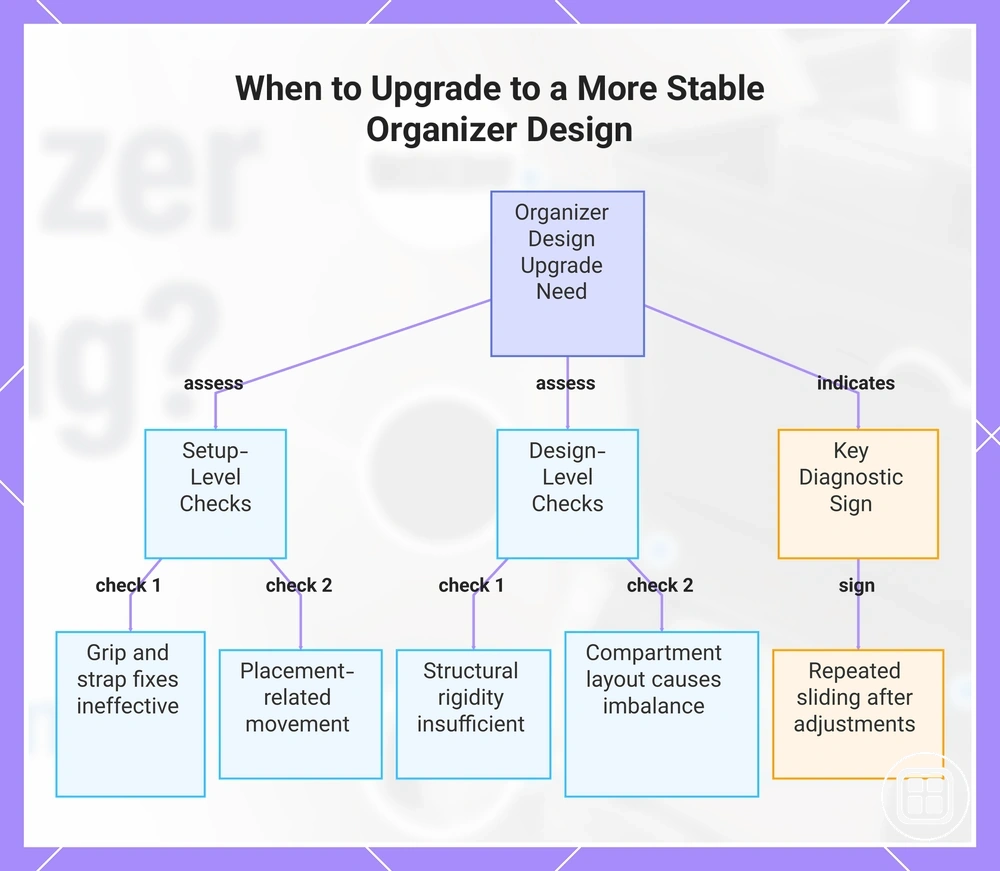
A more stable organizer design may be needed when grip fixes, strap checks, and load balancing still fail to reduce movement during normal driving conditions. Stability depends on how the organizer design interacts with placement, stored load, and available support points. Repeated sliding after basic fixes can indicate a design limitation rather than a setup issue.
When movement continues despite reasonable adjustment, evaluate the organizer design instead of repeating the same corrections. Base grip, strap system support, structure, compartment layout, and placement suitability can influence stability under the intended use condition. The checklist below helps assess whether the current setup can be improved or whether a different design approach may be more suitable.
If the current setup improves after small adjustments, further refinement may be more practical than a replacement decision. If repeated sliding continues under similar use conditions, a stronger design with improved support may deserve consideration. The decision should depend on whether the limitation comes from setup conditions or the organizer design itself.
- Base grip: If sliding continues after improving surface contact, stronger base grip may suggest that a more stable organizer design is needed.
- Strap system: If the strap system cannot maintain position despite proper adjustment, improved support may better match the use condition.
- Structure: If the organizer twists, bends, or loses shape during normal use, structural rigidity may influence stability.
- Compartment layout: If stored items repeatedly create imbalance despite load balancing, the compartment layout may not suit the intended load.
- Placement suitability: If movement remains linked to the installation location, a different design may better match the available space and support points.
- Repeated sliding: If movement returns after multiple reasonable adjustments, the issue may reflect a design limitation rather than a temporary setup condition.
This chart helps evaluate whether a more stable organizer design is needed by assessing setup conditions, design factors, and the key symptom of repeated sliding.