How to Use Car Organizers Effectively for Everyday Driving and Storage Use
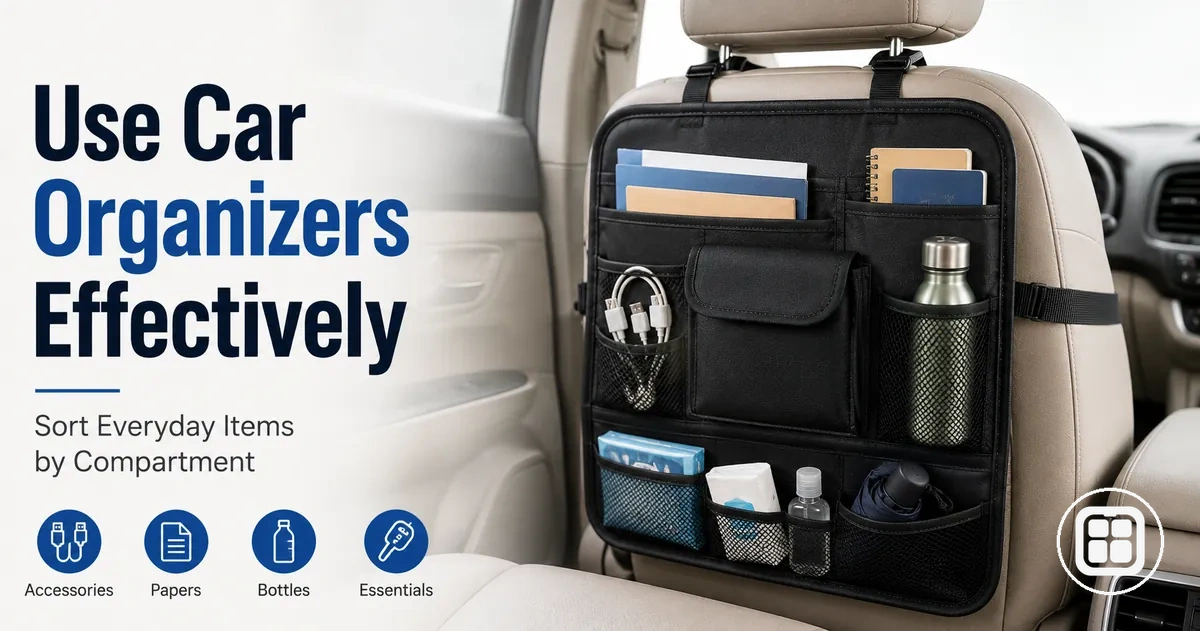
Car organizer usage starts with matching each item type to the right placement zone inside the vehicle. A practical in-car system sorts items by frequency, purpose, weight, and accessibility so the organizer setup supports normal driving behavior instead of becoming loose vehicle storage. Frequently reached items usually fit better in a front seat, console, or backseat compartment, while heavier or less urgent items often belong in trunk storage where load distribution can remain more stable. The right placement strategy depends on vehicle layout, organizer type, passenger space, and the items carried during daily use. Effective usage therefore means connecting organizer type, compartment choice, and placement zone before thinking about convenience. This creates a clear transition from general storage logic into where each organizer should sit inside the vehicle.
During commuting, travel, or errands, car organizer usage becomes most useful when the driver can predict where items are without searching across the cabin. A charger, document pouch, water bottle, small grocery bag, or travel accessory may need a different compartment because each item has a different access frequency and movement risk. In many cases, lightweight essentials work better near an accessibility zone, while bulky or spill-prone items may need a lower and more stable storage system. Driving behavior also affects the setup because sharp turns, repeated stops, passengers, and mixed loads can change how stable an organizer feels in use. The goal is not to fill every compartment, but to align item type with organizer location so the vehicle storage pattern supports access, comfort, and attention management. This same logic leads naturally into the next section, where the role of car organizers in everyday vehicle storage and in-car order becomes more specific.
Role of Car Organizers in Everyday Vehicle Storage and In-Car Order
Car organizers are storage tools designed to create structured vehicle storage by separating items into designated compartments that support accessibility and order. As explained in the Back to hub overview, their primary role is to organize frequently carried items so they are easier to locate and manage during daily vehicle use. Different organizer types serve different storage functions, and their compartment design can influence how items are grouped, secured, and accessed. A well-matched compartment layout may contribute to clutter reduction by giving commonly used belongings a consistent location. Organizers can also support stability by reducing uncontrolled item movement within the available storage area. Their role is centered on creating a more structured in-car environment rather than increasing the physical size of the vehicle.
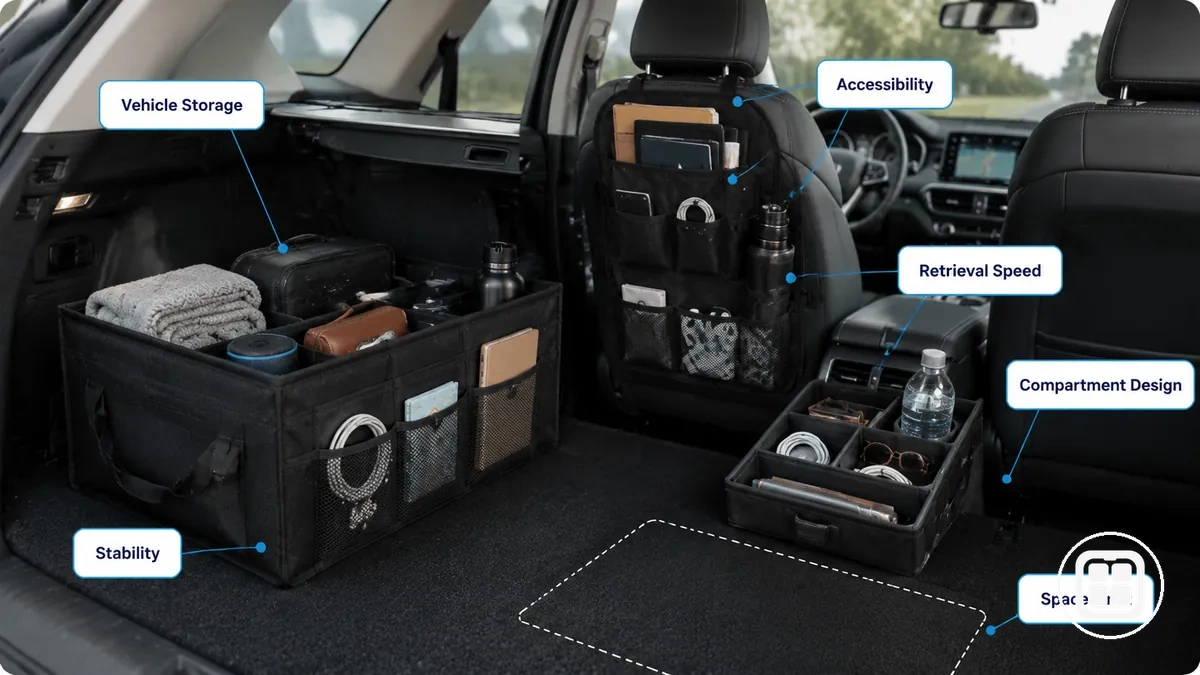
Car organizers often improve retrieval speed because items remain separated according to purpose, frequency of use, or storage priority. Accessibility, load stability, and spatial efficiency usually depend on how the organizer's compartment design aligns with the vehicle layout and the items being carried. A compartment intended for small essentials may support faster access, while a larger section can help keep bulkier items grouped together. However, organizers cannot solve vehicle space constraints, and their effectiveness may vary when storage demands exceed the available area. Their main value comes from supporting a clearer compartment layout structure that helps maintain order, supports clutter organization efficiency, and reduces unnecessary item movement. This functional role creates a practical foundation for deciding which items belong in specific organizer compartments during everyday use.
What to Store in Car Organizers for Practical Daily Use
Storage items in car organizers should usually be limited to frequently used, lightweight, and trip-relevant belongings that benefit from easy access during travel. The most suitable storage items often depend on driving habits, passenger needs, and trip purpose. Organizers can help separate items according to urgency level, compartment usage, and accessibility requirements so commonly used belongings remain easier to locate. Items that may roll, slide, or shift during driving can often be managed more effectively when placed in dedicated compartments. Loose objects left unsecured in the cabin may create distractions and reduce organization efficiency. Practical storage focuses on accessibility and relevance rather than carrying every possible item.
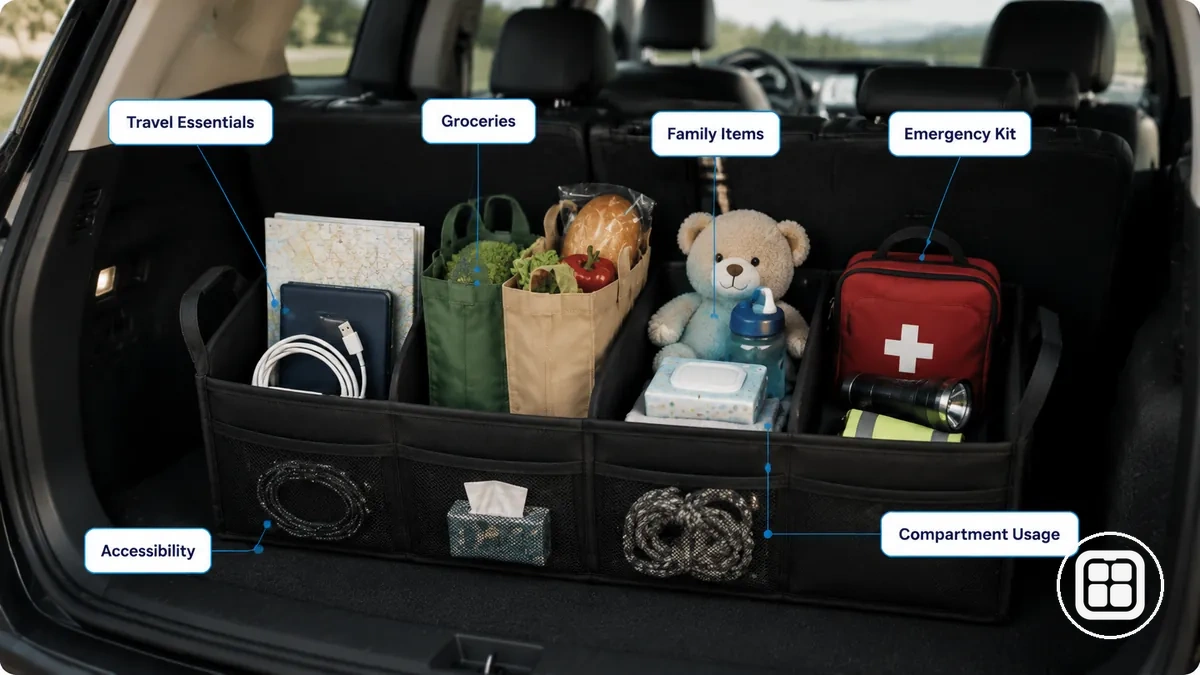
Category organization helps match storage items to appropriate compartments without creating overlap between uses. Travel essentials may include items regularly needed during trips, while groceries are often better grouped separately to simplify retrieval and reduce mixing with personal belongings. Family items can remain together in dedicated compartments when passengers frequently require them during travel. An emergency kit is usually most useful when stored in an accessible but less frequently accessed area, keeping emergency supplies separate from everyday items. This approach supports compartment usage based on item priority, accessibility needs, and intended purpose.
- Travel Essentials: Frequently accessed personal items that may be needed during routine driving or longer journeys.
- Groceries: Short-term storage items that benefit from grouped placement and easier unloading.
- Family Items: Passenger-related belongings that may require quick access during travel.
- Emergency Kit: Emergency supplies stored separately from daily-use items for clearer organization.
Storage priorities can change depending on whether the vehicle is used for commuting, errands, family transport, or longer travel. Items accessibility usage requirements may increase when certain belongings are needed repeatedly during a trip, while other items can remain in less prominent compartments. Category organization grouping helps maintain clarity by assigning a clear purpose to each storage area. Rather than creating an exhaustive checklist, the goal is to select storage items that match actual usage patterns and support a more organized driving environment. This categorization logic creates a foundation for examining storage decisions across different driving scenarios.
Travel and Commuting Essentials
Commuting essentials should prioritize quick access and minimal distraction so frequently used commuting items remain within a convenient accessibility zone while supporting driver focus during routine travel. The relevance of specific essentials may vary by commuting pattern, but items with higher access frequency are usually easier to manage when placed in compartments that reduce unnecessary reach or searching. Documents, chargers, bottles, and small accessories are often suitable commuting items because they may be needed during regular trips without requiring extensive storage space. Organizing these items according to access frequency, placement zone, and potential driving safety impact can support smoother access speed and more efficient compartment usage. Keeping only relevant essentials within immediate reach may help reduce distraction from loose objects during driving. Maintaining a clear accessibility zone also supports driver focus and safer in-motion item access.
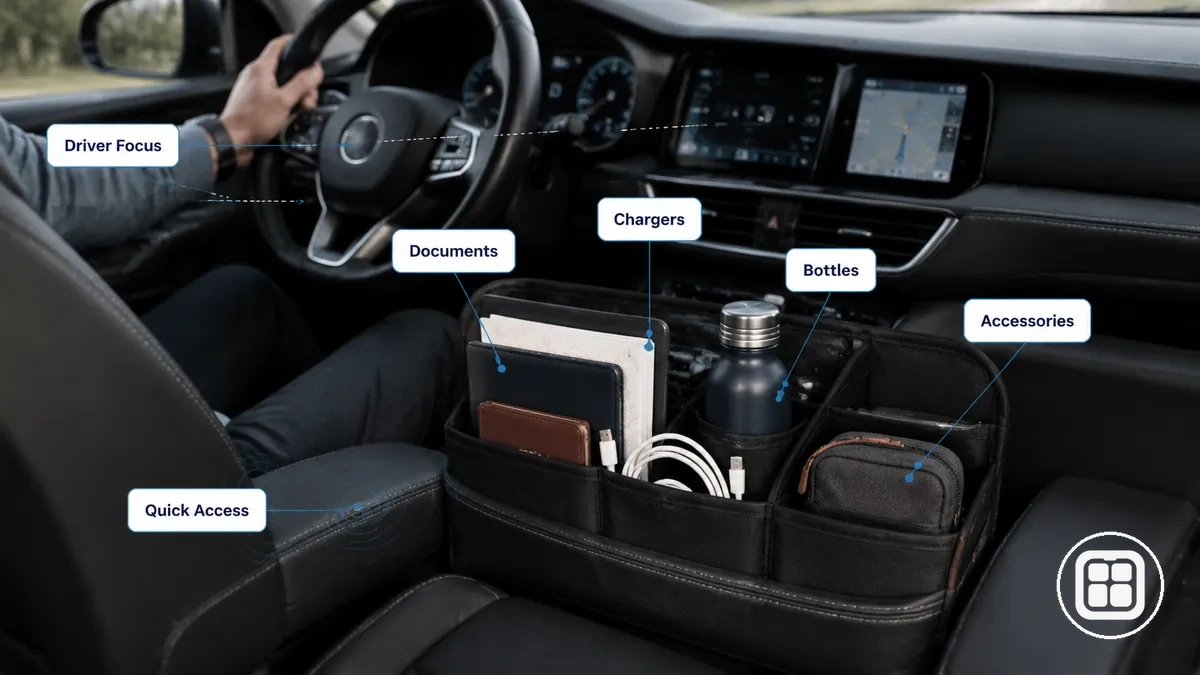
- Documents: Higher access frequency items that are often easier to manage in a reachable compartment.
- Chargers: Frequently used accessories that may benefit from placement near an accessibility zone.
- Bottles: Common commuting items that are usually easier to access when stored in a designated holder or compartment.
- Small Accessories: Lightweight essentials that can remain organized when grouped in a dedicated storage area.
Groceries and Shopping Load Management
Groceries require stable placement to help prevent movement during driving and maintain better load balance inside the vehicle. Grocery storage in car organizers is usually more effective when items are grouped according to weight, fragility, and movement risk rather than placed loosely in trunk storage. Heavier items may benefit from deeper compartments that can help reduce shifting, while fragile items often benefit from separation from harder or heavier goods. Stability and spill prevention typically depend on how well groceries are supported and organized within available storage space. Grouping groceries by item characteristics can also make retrieval and unloading easier after shopping. This approach focuses on load control and organization without relying on rigid packing rules.
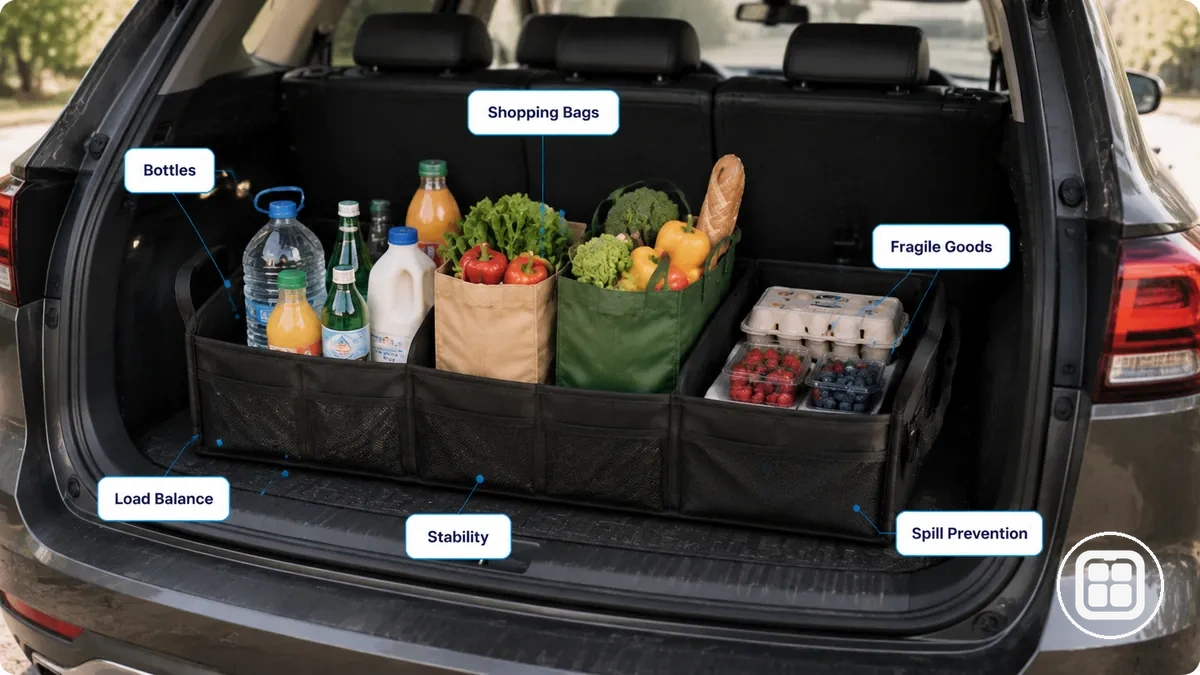
- Bottles: Heavier liquid containers that may benefit from deeper compartments to support stability.
- Shopping Bags: Grouped grocery loads that can be separated to help maintain load balance during transport.
- Fragile Goods: Delicate items that are often easier to manage when isolated from heavier groceries.
- Mixed Loads: Combined grocery items that may require separation based on weight and movement risk.
After shopping, trunk storage can be organized by placing heavier grocery bags in more stable areas while keeping fragile goods separated from items that may shift during travel. Bottles and other liquid containers may be positioned in compartments that help reduce rolling or tipping when the vehicle changes direction. Spill prevention often depends on container condition, storage orientation, and compartment support rather than the organizer alone. A balanced grocery layout can help limit unnecessary movement and support clearer separation between item groups. This practical arrangement supports stability throughout the drive while keeping groceries easier to manage during unloading.
Kids Items and Family Travel Storage
Family travel storage prioritizes safety, accessibility, and quick retrieval so frequently used kids items remain easy to reach while supporting distraction reduction during travel. Family travel storage in car organizers is usually more effective when storage zones are assigned according to item urgency and expected use during the journey. Items that may be needed more often can be placed in accessible compartments, while less urgent belongings can remain in secondary storage zones. Separating messy and clean items may help maintain better organization and reduce unnecessary searching. Accessibility and item grouping often depend on vehicle layout, passenger needs, and trip duration. This organization strategy focuses on driving focus and practical retrieval rather than carrying every possible item.
- Toys: Frequently requested kids items that may benefit from placement in an accessible storage zone.
- Snacks: Travel items that are often easier to manage when separated from clean belongings.
- Bottles: Common family travel items that may be stored in dedicated compartments for easier access.
- Entertainment Accessories: Items that can remain organized when grouped within a designated storage area.
During a longer family travel journey, organizers can be arranged so toys and snacks remain within convenient accessibility zones while less frequently used items stay in secondary compartments. Clean belongings may be stored separately from items that are more likely to create crumbs, spills, or clutter during use. This separation can help simplify retrieval without mixing different item types together. When storage zones are assigned according to urgency, commonly used items may be located more efficiently. A structured family travel layout can support distraction reduction by limiting unnecessary searching during the trip. The effectiveness of the arrangement usually depends on the types of kids items carried and how frequently they are needed.
Tools and Emergency Equipment Organization
Emergency tools should be stored in secure, low movement compartments so critical items remain accessible when needed while supporting organized trunk storage. Emergency tools in car organizers are usually easier to manage when storage locations reflect item criticality, accessibility needs, and security requirements. Items with higher emergency urgency may benefit from placement in compartments that allow quicker access, while less frequently used equipment can remain in more isolated areas. This organization method supports readiness without requiring constant visibility of every item. Accessibility often depends on how clearly emergency equipment is separated from routine belongings. A structured layout helps maintain preparedness while keeping trunk storage organized for everyday use.
- Jumper Cables: High-priority tools that may benefit from secure storage with relatively easy accessibility.
- First Aid Kit: An emergency kit component that is often easier to locate when isolated from general cargo.
- Flashlights: Readiness items that may be stored in a dedicated compartment to simplify access.
- Tools: Maintenance and support equipment that can remain organized when grouped in a secure storage zone.
If a vehicle breakdown or unexpected issue occurs during a trip, organized trunk storage can make emergency equipment easier to locate without searching through unrelated items. A first aid kit, flashlight, or jumper cables may be accessed more efficiently when each item has a designated storage location. Separating emergency equipment from everyday cargo can help reduce confusion during situations where access becomes more urgent. Security and accessibility often depend on how consistently the storage arrangement is maintained. This readiness-focused approach supports practical organization without overemphasizing rare events. The effectiveness of the setup usually depends on the equipment carried and its assigned storage zone.
Proper Placement of Car Organizers for Stability and Easy Access
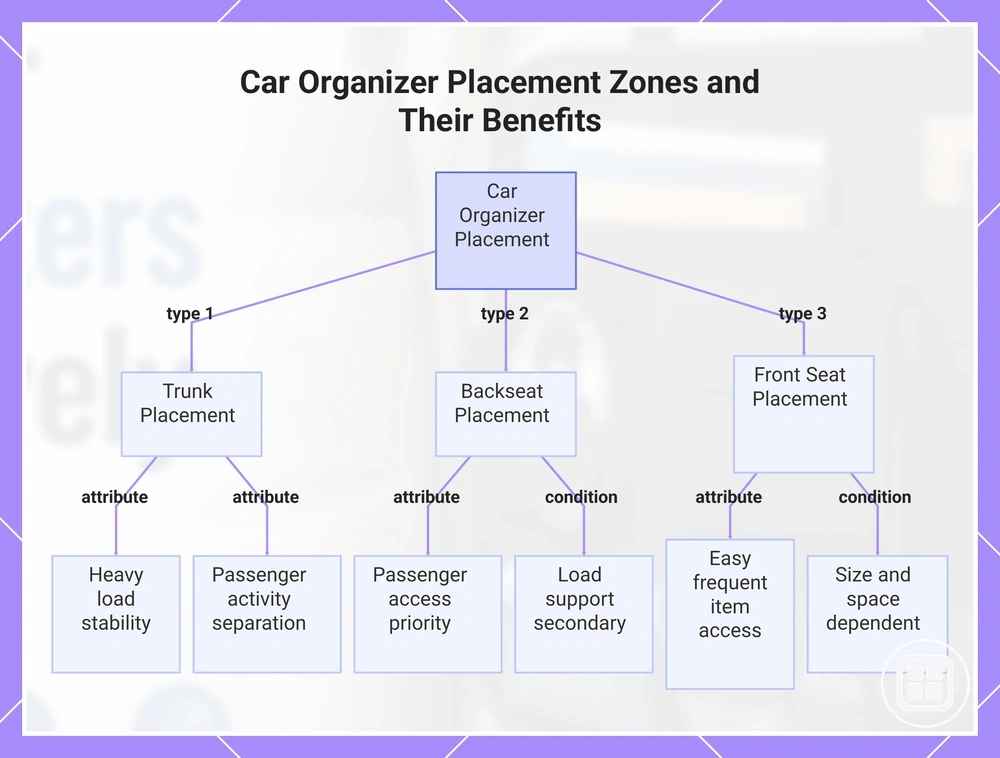
Placement determines both the stability and usability of car organizers because each placement zone interacts differently with vehicle layout, load weight, and accessibility needs. Organizer placement in vehicles is most effective when the selected location matches the organizer type and the nature of the stored items. A suitable placement zone can help support stability while maintaining practical access reach during driving. The relationship between storage location and organizer performance often varies by vehicle layout, available space, and load distribution. Trunk, backseat, and front seat areas each provide different advantages depending on storage purpose and item weight. Proper placement therefore focuses on balancing stability, accessibility, and placement balance safety rather than treating every vehicle zone as equally suitable.
The trunk is often more suitable for larger organizers or heavier loads because this vehicle zone may provide greater stability and separation from passenger activity. Backseat placement is commonly associated with organizers intended for passenger access, where accessibility may be more important than maximum load support. Front seat placement can support easier access reach for frequently used items, although suitability often depends on organizer size and available space around the driving area. The connection between vehicle zone, organizer type, load weight, and stability outcome differs across vehicle layouts and storage priorities. A trunk organizer may emphasize load stability, a backseat organizer may prioritize accessibility, and a front seat organizer may support convenient item retrieval. Comparing placement zones through these attributes helps explain why organizer suitability depends on matching storage requirements to the most appropriate location within the vehicle.
This chart shows how trunk, backseat, and front seat placement affect stability, accessibility, and suitability for different storage needs.
Optimizing Accessibility and Usage Flow During Driving
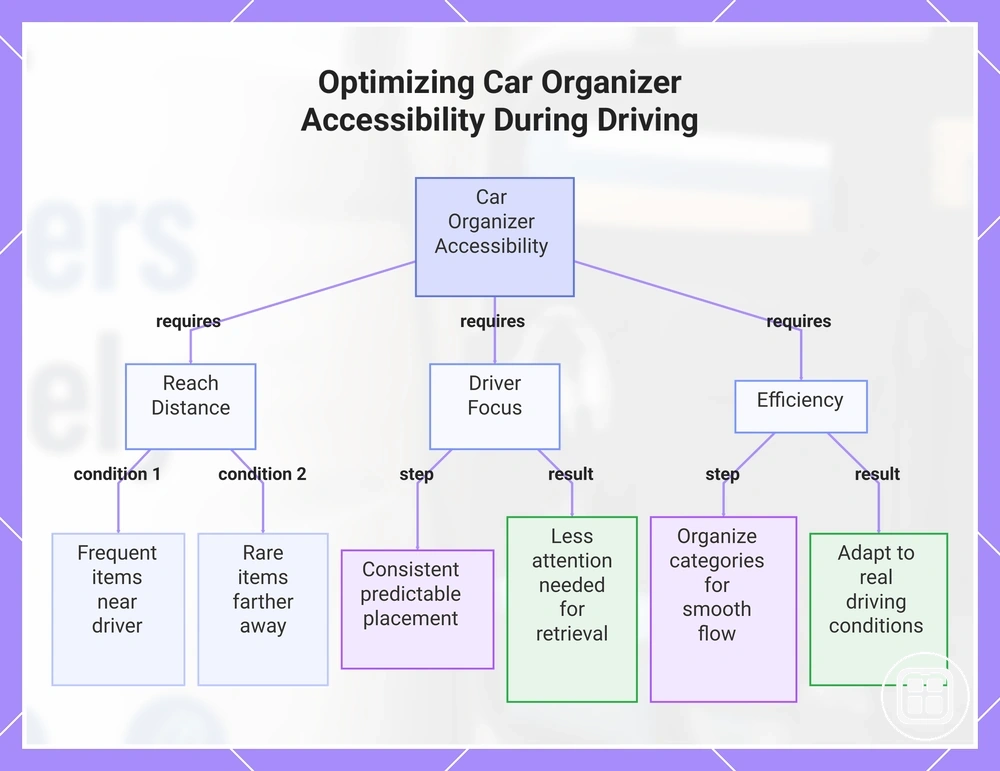
Accessibility depends on minimizing distraction and maximizing reach efficiency so frequently used items can be accessed with less attention demand during driving. Accessibility in car organizer usage is influenced by how item categories relate to reach distance, driver focus, and the surrounding vehicle layout. Items that are needed more often may benefit from placement within a practical reach zone, while less frequently used belongings can remain farther away without reducing everyday usability. The relationship between reach and attention load often changes based on driving conditions, seating position, and storage habits. Safety and efficiency are usually supported when the organizer layout reduces unnecessary searching and helps maintain predictable item locations. Rather than relying on rigid rules, accessibility depends on how well the storage arrangement matches actual usage patterns.
- Accessibility: Keep frequently used items in locations that support efficient reach.
- Reach: Match item distance to how often the item is needed.
- Driver Focus: Reduce unnecessary searching by maintaining consistent item placement.
- Efficiency: Organize item categories in a way that supports smoother usage flow.
During a brief stop at a traffic signal or parking area, a driver may need access to a commonly used item such as a charging cable, document holder, or personal accessory. When item categories are organized according to reach requirements, retrieval can often occur with less attention directed toward storage areas. A layout that supports accessibility may help maintain driver focus because item locations remain predictable. The effect of any arrangement depends on user behavior, organizer design, and the surrounding vehicle layout. Accessibility and efficiency therefore relate more to usability flow under real driving conditions than to static placement decisions alone. This approach emphasizes practical reach management without assuming that a single arrangement suits every vehicle or driver.
This chart shows three key principles for organizing car items to improve accessibility, reduce distraction, and support efficient retrieval while driving.
Common Mistakes That Reduce Car Organizer Efficiency During Use
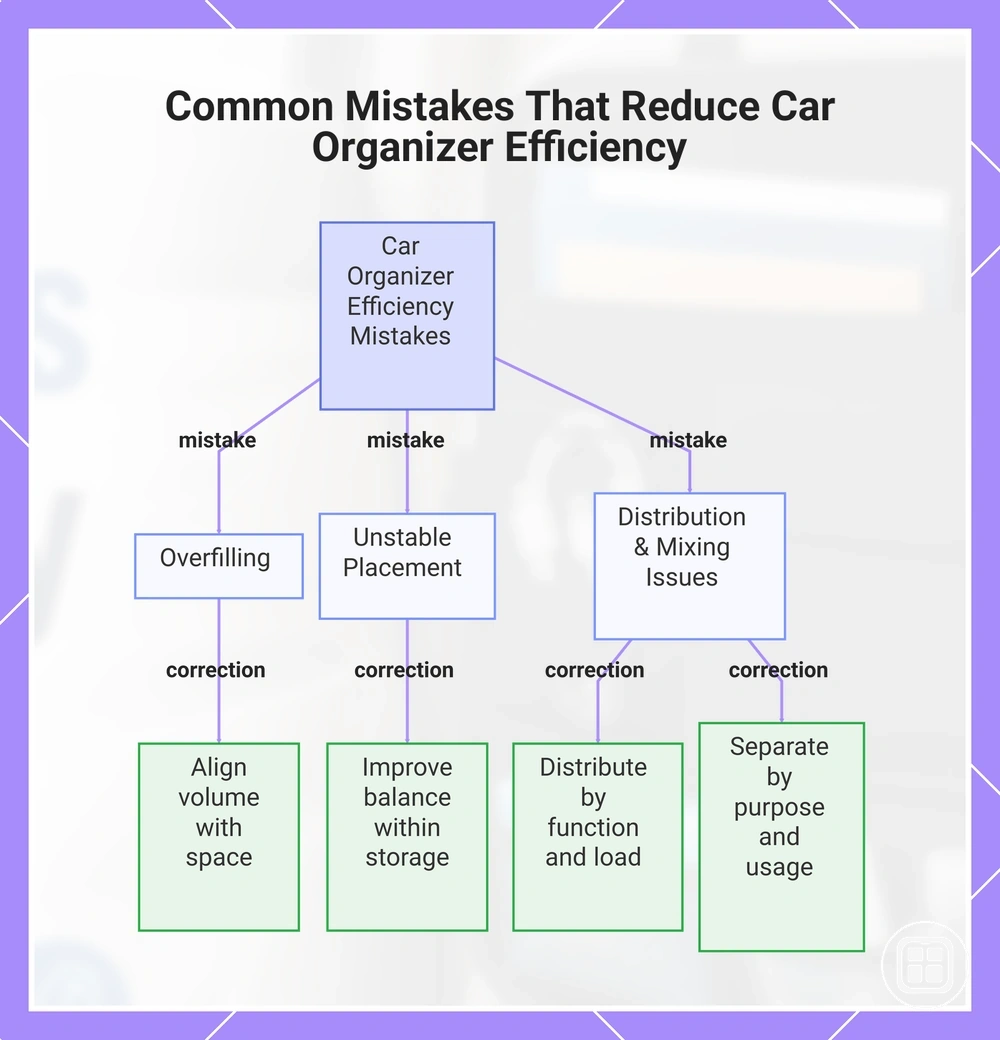
Inefficiency in car organizer use usually comes from overload and poor item distribution that reduce stability and make stored items harder to manage. Common mistakes in car organizers can affect accessibility, organization quality, and overall efficiency when compartments are used without considering item characteristics. Overload may limit available space and make retrieval less predictable, while uneven distribution can contribute to instability during normal vehicle movement. Mixing incompatible items may also reduce organization clarity because different item categories compete for the same storage area. These failure patterns often develop gradually rather than from a single decision. Understanding the relationship between mistakes, distribution, and efficiency helps identify why an organizer may become less effective over time.
- Overfilling: Excess items can create overload, reduce accessibility, and limit organization efficiency. A correction principle is to align storage volume with available compartment space.
- Unstable Placement: Poorly supported items may shift more frequently, reducing stability and storage consistency. A correction principle is to improve balance within the storage area.
- Poor Distribution: Concentrating items in one section can reduce efficiency and contribute to uneven organization. A correction principle is to distribute items according to storage function and load characteristics.
- Mixing Incompatible Items: Combining unrelated item categories may increase retrieval difficulty and reduce organizational clarity. A correction principle is to separate items by purpose and usage pattern.
- Incorrect vs Correct Behavior: Storing heavy, fragile, and frequently used items together may reduce efficiency, while organizing items according to category, handling needs, and accessibility requirements can support a clearer storage structure.
This chart shows the main mistakes that reduce car organizer efficiency and their corresponding correction principles.
Best Practices and Usage Tips for Long-Term Organization Efficiency
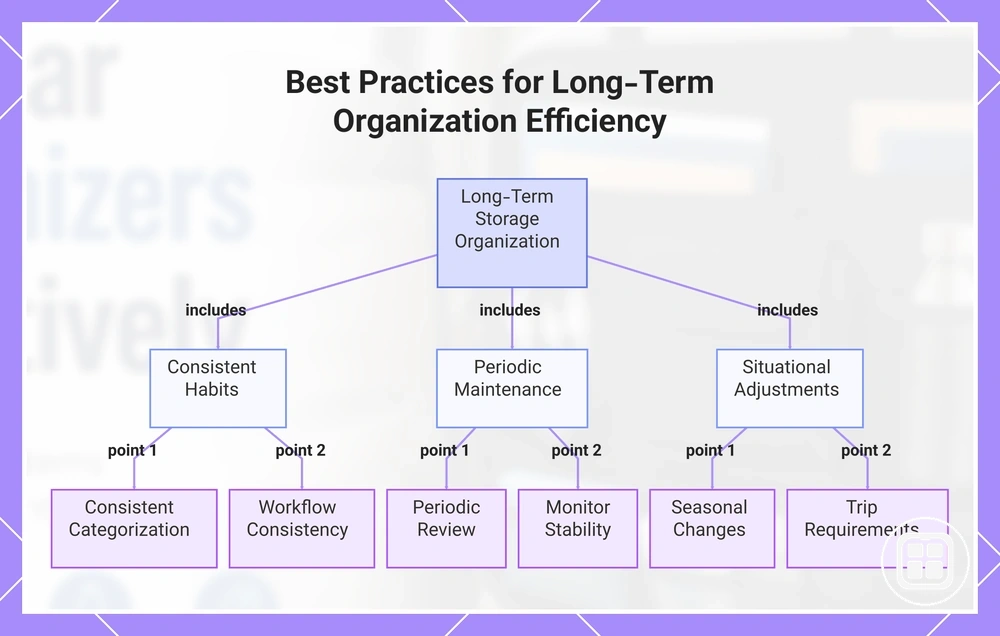
Long-term efficiency depends on consistent categorization and periodic reorganization that keep storage habits aligned with actual vehicle use. Organization habits often influence usability more than short-term adjustments because efficiency can gradually decline when item categories become mixed or outdated. Consistency in categorization helps maintain a predictable workflow and can make item retrieval easier over time. Periodic maintenance may help restore organization stability by identifying items that are no longer relevant to current usage patterns. The relationship between maintenance frequency and usability outcome often depends on how frequently storage needs change. Seasonal driving conditions, travel schedules, family activities, or trip-specific requirements can create practical reasons to review and reorganize stored items.
- Maintain Consistent Categorization: Keep similar items grouped together to support organization habits and predictable retrieval.
- Review Storage Periodically: Regular maintenance may help remove unnecessary items and preserve organization stability.
- Adapt to Seasonal Changes: Reorganize storage categories when vehicle usage patterns change throughout the year.
- Adjust for Trip Requirements: Temporary reorganization can help align storage space with the needs of a specific journey.
- Preserve Workflow Consistency: Returning items to designated categories may support long-term efficiency and reduce storage confusion.
- Monitor Organization Stability: Small adjustments over time can help maintain usability without requiring a complete reorganization.
This chart shows the key best practices for maintaining long-term organization efficiency, grouped into consistent habits, periodic maintenance, and situational adjustments.
Adapting Car Organizer Usage for Different Trips, Loads, and Driving Conditions
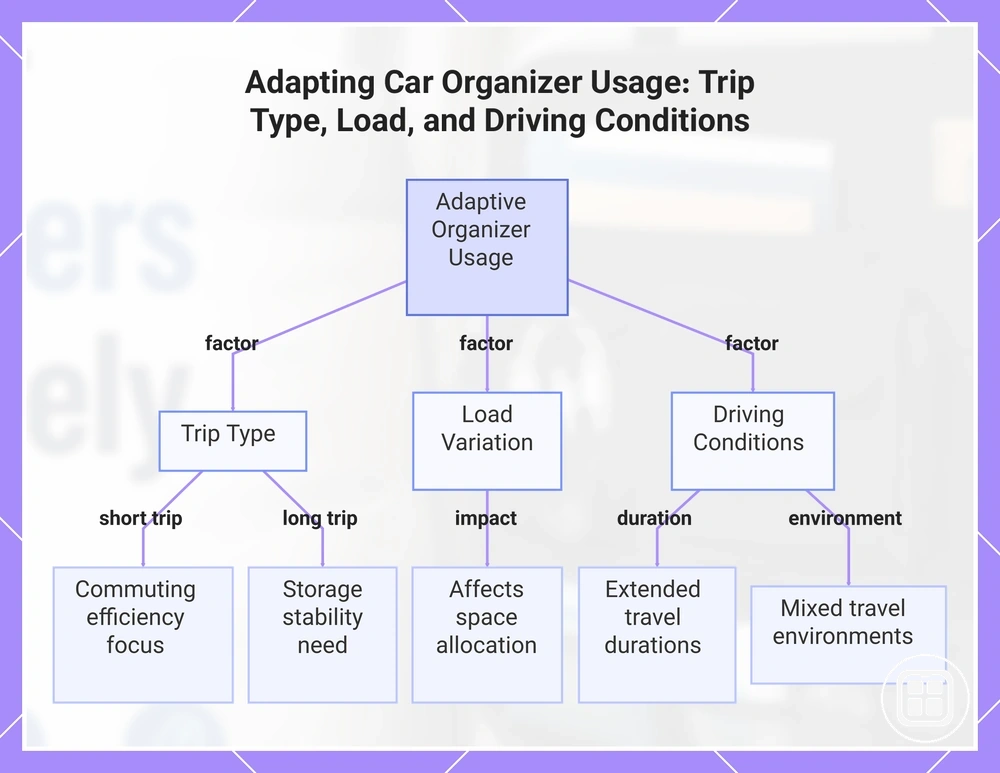
Car organizer usage changes based on trip length, load variation, and driving conditions because different situations create different storage and accessibility requirements. Adaptive usage involves adjusting the organizer configuration to match a specific trip type rather than maintaining a fixed arrangement for every journey. The relationship between trip type and usability often depends on the items being carried, how frequently they are needed, and the expected driving environment. Load variation can influence how storage space is allocated, while changing driving conditions may affect how practical a particular configuration feels during use. A configuration that supports one travel scenario may require adjustment when trip priorities change. As a result, usability often depends on how closely the organizer setup reflects current travel needs.
For a short trip, a simplified configuration may support commuting efficiency by prioritizing everyday essentials and reducing unnecessary storage complexity. During urban commuting, usability may improve when frequently used items remain aligned with routine travel needs and changing stop patterns. A long distance journey often introduces greater load variation because more belongings may remain stored for extended periods, making storage stability a more relevant consideration. Different driving conditions, including extended travel durations or mixed travel environments, can also influence how storage categories are organized. Small configuration changes may help accommodate changing trip requirements without requiring a complete reorganization. This adaptive approach focuses on conditional adjustment rather than universal rules, allowing car organizer usage to remain practical across different travel scenarios.
This chart shows the three main factors that influence adaptive car organizer usage and how each factor affects configuration decisions.